The Firsts – Luke

Luke 1:1 Many have undertaken to draw up an account of the things that have been fulfilled among us, 2 just as they were handed down to us by those who from the first were eyewitnesses and servants of the word. 3 With this in mind, since I myself have carefully investigated everything from the beginning, I too decided to write an orderly account for you, most excellent Theophilus, 4 so that you may know the certainty of the things you have been taught

This chapter’s recent history as part of the Christmas celebration gave me pause as I began.  The familiarity of these beautiful Christmas passages can make it easy to overlook other details.  I read the chapter several times before something caught my eye.  The angel brings up the Holy Spirit when he introduces Mary to what God has in mind for her but the Holy Spirit “filling” John, Elizabeth and Zechariah is a big truth that got lost for me in the familiar.

*15… he [John the Baptist] will be filled with the Holy Spirit even before he is born. 16 He will bring back many of the people of Israel to the Lord their God.
*41 When Elizabeth heard Mary’s greeting, the baby leaped in her womb, and Elizabeth was filled with the Holy Spirit.
*67 His [John’s] father Zechariah was filled with the Holy Spirit and prophesied

It makes so much sense now that I’ve noticed that truth.  The main characters of this unlikely mystery were given the verification of one Spirit to another.   The Holy Spirit was a work of God in the flesh for them that knit them together in unique kind of baptism of spiritual recognition. 

This is truth for us today too.  Living a life of faith is still a mystery of God that only becomes recognizable to the eye or mind when the Holy Spirit verifies itself in the flesh, one to another. 

The Firsts – Mark

You might wonder why a chapter about baptism and the confession of sin for repentance would possibly include “Jesus the Messiah,” the perfect, sinless Son of God.  I wondered too, so I read this chapter and made my notes with that in mind.  I think God purposely included the baptism of his perfect, sinless Son in his plan of confession so we might better understand what the Baptist meant when he said “I baptize you with water, but he will baptize you with the Holy Spirit.”  Our confession is more than a one-time event.

That makes Jesus’s confessions that day important to think about because he was perfect.  These are only my imagined confessions Jesus might have made based on Marks words but maybe they’re still examples to follow that can make our confession an ongoing connection to that perfect Spirit.

• The Confession of Baptism
9 At that time Jesus came from Nazareth in Galilee and was baptized by John in the Jordan.

• The Confession of Spirit
10 Just as Jesus was coming up out of the water, he saw heaven being torn open and the Spirit descending on him like a dove. 11 And a voice came from heaven: “You are my Son, whom I love; with you I am well pleased.” 

• The Confession of Belief
14 After John was put in prison, Jesus went into Galilee, proclaiming the good news of God. 15 “The time has come,” he said. “The kingdom of God has come near. Repent and believe the good news!”

• The Confession of Followers
17 “Come, follow me,” Jesus said, “and I will send you out to fish for people.

• The Confession of Authority
27 The people were all so amazed that they asked each other, “What is this? A new teaching—and with authority! He even gives orders to impure spirits and they obey him.”

• The Confession of Sacrifice
44 “See that you don’t tell this to anyone. But go, show yourself to the priest and offer the sacrifices that Moses commanded for your cleansing, as a testimony to them.

The Firsts – Matthew

This is the genealogy of Jesus the Messiah…Thus there were fourteen generations in all from Abraham to David, fourteen from David to the exile to Babylon, and fourteen from the exile to the Messiah.

Most of us just skim-read Matthew’s  genealogy list.  Abraham’s there √ and Jesus who is called the Messiah is there √.  There are other recognizable names in between but  I was surprised to discover why that genealogy is important.  Maybe you will be too.  We live in an age when we can know about anything and everything, even ancestry through Google and DNA results that connect us with the past and long-lost family connections.

Matthew’s genealogy list was the early cliff notes version of that.   Those lives and names validated their pedigree and became a memory device to help them remember the details of their history. They  were time-stamped code words for them.  God had chosen those ancestors to be part of the creation of a new nation,  Somehow their descendants preserved the nation  through disaster and they’d endured the shame of their exile into slavery.   Finally that remnant of people saw the restoration of their freedom through the birth of Messiah  and that would turn tragedy into triumph.  

It’s mind boggling to imagine the volumes of information represented by the simple connecting thread of those names.   I wonder if the purpose of that geneology is to remind us of a timeless truth: the sovereign God works His Story THROUGH people…not because of them.

That truth of God is still part of our DNA.  Maybe that helps explain the current explosion of curiosity about ancestry and finding the surprises it may hold.  I know that’s happened to me and my list of “begats” has grown in ways I never expected.  My pedigree is not a list of purity of line but proof that by God’s design the barrier between saint and sinner is down.  My list of ancestors persevered in their lives and became my opportunity to recognize Jesus Christ as the Son of God who could turn an ordinary life of daily events, good and bad, into triumph.  

That’s the pedigree I want to be part of the ancestry of my own descendants.

Hello 2019!

“For everything that was written in the past was written to teach us, so that through the endurance taught in the Scriptures and the encouragement they provide we might have hope.” Romans 15:4 NIV

I read the Scripture from Romans early Sunday morning before church. It caught my eye because my last post had been about letting our history become His Story in the New Year.  I thought of history as being wiped away to clear the slate for a new year.  Then I went to church and heard “The promise of salvation doesn’t always look like what we expect or want.”  It wasn’t a sermon about wiping away the unexpected and unwanted interruptions that happen in every life.  It was a message of recognizing the promised presence of Jesus with you in the midst of the worst news or circumstances.

Later that day I read this from Henri Nouwen’s Creative Ministry: “We are…invited to look at our history as the sequence of events that brought us to where we are now and that help us to understand what it means to be here at this moment in this world.” 

History has impact on our present, our future and our imperfection.  The ultimate unwanted and unexpected interruption of the perfection God created happened way back in Genesis 3.  Even in the consequences that followed  that sin I see God’s hope for history in His unexpected provision for those first two people.  “The Lord God made garments of skin for Adam and his wife and clothed them.”  There are many other examples of people in the Bible who endured the consequences of their own imperfection but found strength to hope in God’s Word.

We’ve just completed the celebration of God’s ultimate solution for our imperfection, the birth of Jesus Christ.  He’s our evidence of “everything that was written in the past.”  The details of the promise of our salvation won’t always work out as we expect or want. We’re still dealing with the consequences of imperfection but we can trust and depend on God’s perfect solution “so that through the endurance taught in the Scriptures and the encouragement they provide we might have hope.”  Faith in Jesus is evidence of God’s hope for our life and that makes it a part of His Story.

Let History become His Story in 2019

               A New Year is one of those times when I just need God to tell me:
“So here’s what I want you to do, God helping you: Take your everyday, ordinary life—your sleeping, eating, going-to-work, and walking-around life—and place it before God as an offering. Embracing what God does for you is the best thing you can do for him. Don’t become so well-adjusted to your culture that you fit into it without even thinking. Instead, fix you attention on God. You’ll be changed from the inside out. Readily recognize what he wants from you, and quickly respond to it. Unlike the culture around you, always dragging you down to its level of immaturity, God brings the best out of you, develops well-formed maturity in you.” [Romans 12:1-2 MSG]

That’s the Happy in this New Year I pray for you

Because of the Baby!

II Corinthians 13:11 Finally, brothers and sisters, rejoice! Strive for full restoration, encourage one another, be of one mind, live in peace. And the God of love and peace will be with you.  12 Greet one another with a holy kiss. 13 All God’s people here send their greetings.  14 May the grace of the Lord Jesus Christ, and the love of God, and the fellowship of the Holy Spirit be with you all.Today in the town of David a Savior has been born to you; he is the Messiah, the Lord. Luke 2:11


See, Hear, Know and Remember

II Corinthians 11:21-23 Since you admire the egomaniacs of the pulpit so much (remember, this is your old friend, the fool, talking), let me try my hand at it. Do they brag of being Hebrews, Israelites, the pure race of Abraham? I’m their match. Are they servants of Christ? I can go them one better. (I can’t believe I’m saying these things. It’s crazy to talk this way! But I started, and I’m going to finish.)  [MSG]

The familiar Christmas song Do You Hear What I Hear came to mind when I read Paul’s challenge to the Corinthians.  He felt foolish having to justify his credibility to them after his perseverance in teaching them the truth of the Gospel.  He felt frustration over their attraction to what they saw and heard from those “egomaniacs in the pulpit.”  Paul’s own plea to the Corinthians could have been these very words…
Do you see what I see?
Do you hear what I hear?
Do you know what I know?

God has used the Apostle’s frustration and the lyrics of this contemporary [1962] Christmas song as a reminder of the servants who’ve been part of God’s preparation for me.  They persevered week after week in their own preparation to teach me the reality of living a life of faith only to discover how easily I could be distracted from what they were trying to help me see, hear, know and remember.  I know they’ve all walked the same path as that Apostle, faithful and sometimes frustrated.  

My Christmas gift to those servants this year is that they be remembered.  Only a couple will receive a note in the mail but there are others who’s names I’ve long forgotten and lost touch with.  Their gift will be given with the unique delivery system only God can provide.  I promise you I will remember to thank them all for being an “old friend” foolish enough to believe this gift would ever come:
I see what you see –
I hear what you hear –
I know what you know –
Listen to what I say!

The Advent has come!
“The Child, the Child sleeping in the night
He will bring us goodness and light.”

Today Scripture is the Final Word

“I believe with perfect faith in the coming of the mashiach [Messiah], and though he may tarry, still I await him every day.”   [Click here to read Rambam’s 13 Principles of Jewish Faith then click the word(show) to view.]

We know the desire of Israel’s heart was that Messiah would come as a powerful and conquering King.  Remember that?  They were tired of war but who would choose a helpless baby to win a battle?  Answer: God himself.   I hope you’ll click on the link above and read all 13 Principles.  They are powerful and beautiful.  I think they will surprise you as they did me.  Moses’ and the prophets are still our truth.  The big change for us is the tense in that twelfth principle has changed for us from “will” to “has.”  That one “small” variation is what we’re celebrating in this season of preparation. 

Now we are in the “New” Testament and Paul tells us we are still at war.  We fight a war against strongholds, arguments and pretensions that keep people separate from the knowledge of God.  We fight hoping to capture their minds and hearts forever.   This is the reason we remember and celebrate this season: God’s own gift “has” come with the power to assure our confidence in Him and ensure the certainty of His promise to us that insures our success.  Today Scripture is the final word for us.

“II Corinthians 10:3 For though we live in the world, we do not wage war as the world does. 4 The weapons we fight with are not the weapons of the world. On the contrary, they have divine power to demolish strongholds. 5 We demolish arguments and every pretension that sets itself up against the knowledge of God, and we take captive every thought to make it obedient to Christ.”

Special Gift of Access

I’m diverting from II Corinthians because at the moment you’re reading this I’m on the high seas for a 3-day cruise but thanks to WordPress I can schedule this story and at the appointed time [I hope] it will be told.

Thank you Lord  for the image of “your” new life, your Son, lying in a Cradle of circumstances.  This time of preparation shows us how important this annual pilgrimage is to our celebration of that birth and that Cradle.  It was your own preparation for us that made Advent a celebration at all and Jesus your special gift of access for us.

We all enter the Kingdom of God through that same Cradle: another “new” life born in the midst of a broken world.  The Cradle still contains the memory of God’s preparation.  It still holds the promise of what new life can become through the stories of wise men, shepherds and angels, even in a still-broken world.  That Cradle is the shelter of God’s provision for us when there doesn’t seem to be room for us anywhere else.  This annual journey shows us one more time where we’ve come from,  where we’re going and how we’re going to get there.  There will be emotional and physical joy and hardship involved in that journey but…

• We have wise men today that have found their special path to that Cradle to offer their treasure and then share their story with us so we can follow and find our way too.

• We have shepherds today who despite their own fears rise and boldly share your Story.

• We have angels in our lives who sing your praises and share your promises of renewal, restoration and grace that prepare us to recognize and receive your gift of forever…again this year.

It’s glorious to remember isn’t it?

Gifting

II Corinthians 8:1 And now, brothers and sisters, we want you to know about the grace that God has given the Macedonian churches. 2 In the midst of a very severe trial, their overflowing joy and their extreme poverty welled up in rich generosity. 3 For I testify that they gave as much as they were able, and even beyond their ability. Entirely on their own, 4 they urgently pleaded with us for the privilege of sharing in this service to the Lord’s people. 5 And they exceeded our expectations: They gave themselves first of all to the Lord, and then by the will of God also to us.

Paul’s words about gifts brought this “gifting” process to mind: * Choosing, * Presenting, * Receiving.  

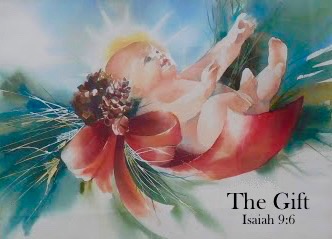
* Choosing: God chose a part of himself, Jesus Christ, to be his gift to us and for our celebration.  

* Presenting: God chose to present himself to us in a surprise package for an unusual reason.   A baby is a far more intimate gift than the might be expected from the supreme ruler of the universe.  God chose intimacy not intimidation and possibilities not preconceived ideas as his preparation for us to receive.  

* Receiving: God chose and presented his gift. Now all that’s left is opening that surprise package filled with growth, change, nurture, grace and His own will for us to give ourselves back to him. The gift has been successfully delivered.  Open it and follow the example of the church at Macedonia to keep the gift going. “They gave themselves first of all to the Lord, and then by the will of God also to us.”