Happy [Almost] 2024

We record life based on years, but what makes a year New?  Really each additional year ties together the as-yet unknown of the future year with the leftover realities of the previous year.  So describing it as “New” isn’t quite accurate.  It’s those leftover realities that often prompt us to make a “new year’s” resolution. That also is an inaccurate way to describe our hopeful yearning between the transition of one year ending and another beginning.  We need a vision!  Those who’ve pledged their heart to following the Creator’s Vision of the New Beginning whose birth we’ve just celebrated know it’s that Vision of life, not a new year or a new resolution that ties together the realities of the past with the unknown future to allow 2024 to become the reality of hope for a truly

Be Thou My Vision
Be Thou my vision, O Lord of my heart
Naught be all else to me, save that Thou art
Thou my best thought, by day or by night
Waking or sleeping, Thy presence my light

Be Thou my wisdom, and Thou my true word
I ever with Thee and Thou with me, Lord
Thou my great Father, and I Thy true son
Thou in me dwelling and I with Thee one

Riches I heed not, nor vain, empty praise
Thou mine inheritance, now and always
Thou and Thou only first in my heart
High King of heaven, my treasure Thou art

High King of heaven, my victory won
May I reach heaven’s joys, O bright heaven’s sun
Heart of my own heart, whatever befall
Still be my vision, O ruler of all 

Image

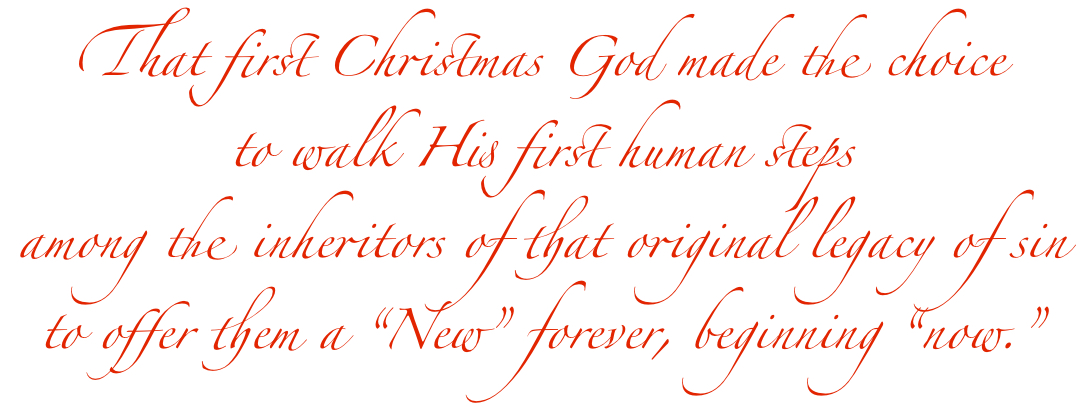
The Christmas Purpose of Daily

New Forever

Romans 8:3 For what the Law could not do, weak as it was through the flesh, God did: sending His own Son in the likeness of sinful flesh and as an offering for sin, He condemned sin in the flesh, 4 so that the requirement of the Law might be fulfilled in us who do not walk according to the flesh but according to the Spirit. 5 For those who are in accord with the flesh set their minds on the things of the flesh, but those who are in accord with the Spirit, the things of the Spirit. NASB

Looking for an Advent connection to this passage seems odd for several reasons. It doesn’t use the word baby, it doesn’t mention birth and why would God choose to intervene on behalf of the people He described as making His Law “weak as it was through the flesh?”  But thankfully “God did.”

God filled that Advent cradle with a perfect impression of Himself, free of mankind’s original legacy; “the likeness of sinful flesh.”   God chose to step out of His timeline of eternity and insert Himself into the human timeline of years “according to the flesh…as the one recognizably human proof of a new beginning…a Baby…“so that the requirement of the Law might be fulfilled in us who do not walk according to the flesh but according to the Spirit.”  It took a beat for my heart to recognize the purpose of God “sending His own Son in the likeness of sinful flesh“ was to eliminate the forever part of that legacy of sinful flesh from His timeline of eternity, for many.

 Jesus’s life would change the forever part of the human timeline of years for many in another way.  This “Baby” step for mankind would give “those who are in accord with the Spirit, the things of the Spirit” and teach them to begin living forever with God, now.  There’s an old legend of a European ruler who would sneak away and walk among his people incognito.  It drove his security people nuts but his response was “I cannot rule my people unless I know how they live.”

Third Sunday of Advent

1 Corinthians 15:44b…If there is a natural body, there is also a spiritual body. 45 So it is written: “The first man Adam became a living being;” the last Adam, a life-giving spirit. 46 The spiritual did not come first,  but the natural,
and after that the spiritual.

Remember this saying — You never get a second chance to make a first impression? That’s not true if your identity has been changed by the Creator of Life.  God’s first impression of life was a grand miracle that revealed life itself.  He picked up a handful of dust and “the first man Adam became a natural living being.”  “God saw everything that he had made, and behold, it was very  good.” That first man’s natural identity was a perfect relationship with God, meant to last forever, in a perfect place.  But sin changed that identity.  Fast forward to a much later time in a world where all that’s left of that first natural identity is the impression of separation and loss.  

Now reread those verses above.  They’re the hope of Advent…God’s choice was a second grand miracle of life, “the spiritual,” and it came to pass in those days!  We celebrate Advent because “after that” natural time God chose to reveal His Own Identity to mankind in the most easily recognizable human form of a new beginning — a baby.

Life must always begin with a natural birth but that Baby was God revealing a second impression of life that could never be separated from Him or lost. “The last Adam, a life-giving spirit,” would replicate God’s own pattern of life.  “New” life for many, and a new identity that would exist forever in perfect relationship with God, not because it happened in a perfect place but because His Perfect Life would be in them.  “The Son of God became a man to enable men to become sons of God.a 

a CS Lewis, Mere Christianity


The First Church

While they were there, the time came for the baby to be born, and she gave birth to her firstborn, a son. She wrapped him in cloths and placed him in a manger, because there was no guest room available for them. Luke 2:6-7

Churches today are definitely different than that stable, but in this season there are similarities that caused me to ask this question: was that feeding trough the first “church?”  That manger was not an accident that happened because of an overcrowded village at a busy time…God provided it!   Don’t be fooled into believing any details of the birth of Jesus were God’s last-ditch effort to provide a place for Jesus because there was “no room in the inn.” God picked that time and place and designated it a sacred space because Jesus the Christ was there. 

A stable isn’t the perfect structure I would have hoped to find a new beginning, but like every other “church,” availability matters.  That first church wasn’t meant to be a place for privileged and perfect people, but for people who just needed a “place.”  A place where the curious could come and look to see whether what they’d heard was real. The things that made that “first” church perfect, still matter.  The angel’s praise-filled words still remind our hearts of their timeless proclamation; “Glory to God in the highest heaven.”  We still have shepherds who boldly tell the story of what they’ve seen and heard.  There are still wise men and women that follow a Holy path to a “modern stable” to offer the gifts they bring to Him.  Today’s modern stable still holds the eternal promise of that first church: God has chosen His church today as a sacred space where the needs of the people and His holiness finally have the opportunity to come together…because Jesus the Christ is there.

Discovering Sacred Space


Acts 7
:7 ‘But I will judge the nation that they serve,’ said God, ‘and after that they shall come out and worship me in this place.  8 And he gave him the covenant of circumcision. And so Abraham became the father of Isaac, and circumcised him on the eighth day, and Isaac became the father of Jacob, and Jacob of the twelve patriarchs.  9 “And the patriarchs, jealous of Joseph, sold him into Egypt; but God was with him 10 and rescued him out of all his afflictions and gave him favor and wisdom before Pharaoh, king of Egypt, who made him ruler over Egypt and over all his household. 11 Now there came a famine throughout all Egypt and Canaan, and great affliction, and our fathers could find no food. 12 But when Jacob heard that there was grain in Egypt, he sent out our fathers on their first visit. 13 And on the second visit Joseph made himself known to his brothers, and Joseph’s family became known to Pharaoh

LEARNING FROM OTHERS: Brian Borgman

Cliff Notes: Stephen uses the history of God’s interaction with Abraham and Joseph — before the law, before Moses and before the Temple — to point out to the Jewish leaders they have forgotten the real identity and location of Sacred space.

LEARNING ABOUT SACRED SPACE FROM JESUS — ESV Verses from John with only Chapter citations.
8 Truly, truly, I say to you, before Abraham was, I am. 6 Truly, truly, I say to you, whoever believes has eternal life. I am the bread of life. 6  I am the living bread that came down from heaven. If anyone eats of this bread, he will live forever. And the bread that I will give for the life of the world is my flesh. 8 I am the light of the world. Whoever follows me will not walk in darkness, but will have the light of life. 10 Truly, truly, I say to you, I am the door of the sheep.  10 I am the door. If anyone enters by me, he will be saved and will go in and out and find pasture. 10 I am the good shepherd. The good shepherd lays down his life for the sheep. 11 I am the resurrection and the life. Whoever believes in me, though he die, yet shall he live, and everyone who lives and believes in me shall never die. 14 I am the way, and the truth, and the life. No one comes to the Father except through me. 15 I am the true vine, and my Father is the vinedresser. 15  I am the vine; you are the branches. Whoever abides in me and I in him, he it is that bears much fruit, for apart from me you can do nothing.

Learning Acts 7:2-7

Acts 7:2 And Stephen said: “Brothers and fathers, hear me. The God of glory appeared to our father Abraham when he was in Mesopotamia, before he lived in Haran, 3 and said to him, ‘Go out from your land and from your kindred and go into the land that I will show you.’ 4 Then he went out from the land of the Chaldeans and lived in Haran. And after his father died, God removed him from there into this land in which you are now living. 5 Yet he gave him no inheritance in it, not even a foot’s length, but promised to give it to him as a possession and to his offspring after him, though he had no child. 6 And God spoke to this effect—that his offspring would be sojourners in a land belonging to others, who would enslave them and afflict them four hundred years. 7 ‘But I will judge the nation that they serve,’ said God, ‘and after that they shall come out and worship me in this place.’ 


LEARNING FROM JESUS — MATTHEW 5:2-10
2 And he opened his mouth and taught them, saying:
3 “Blessed are the poor in spirit, for theirs is the kingdom of heaven.
4 “Blessed are those who mourn, for they shall be comforted.
5 “Blessed are the meek, for they shall inherit the earth.
6 “Blessed are those who hunger and thirst for righteousness, for they shall be satisfied.
7 “Blessed are the merciful, for they shall receive mercy.
8 “Blessed are the pure in heart, for they shall see God.
9 “Blessed are the peacemakers, for they shall be called sons of God.
10 “Blessed are those who are persecuted for righteousness’ sake, for theirs is the kingdom of heaven.

Learning Acts 6:11-15

Acts 6:11 Then they secretly instigated men who said, “We have heard him speak blasphemous words against Moses and God.” 12 And they stirred up the people and the elders and the scribes, and they came upon him and seized him and brought him before the council, 13 and they set up false witnesses who said, “This man never ceases to speak words against this holy place and the law, 14 for we have heard him say that this Jesus of Nazareth will destroy this place and will change the customs that Moses delivered to us.” 15 And gazing at him, all who sat in the council saw that his face was like the face of an angel.

LEARNING FROM OTHERSBen Witherington
— Luke is patterning the death of Stephen after the trial and execution of Jesus…[it] only appear[s] in Luke/Acts] This is an important observation since in the Gospels the Jewish people reject Jesus as the Messiah, in Acts they are rejecting the promised Holy Spirit, the foundation for the Messianic Kingdom.  Both rejections are punctuated by an execution of an innocent man…A Jew saying the High Priest and Temple was corrupt was not particularly revolutionary–but to say the work of your teacher replaced the work of the Temple would have been radical.
— Angels in the Bible were more likely to send their witnesses to their knees in terror—virtually every person in Scripture who sees an angel immediately has to be told not to be afraid…Despite Stephen’s good reputation, wisdom, and submission to God, he will be killed: the first Christian martyr.a
— When Luke depicted Stephen as having the face of an angel, he was setting the stage for Stephen’s martyrdom.b

LEARNING FROM JESUS —Matthew 5:17-20
“Do not think that I have come to abolish the Law or the Prophets; I have not come to abolish them but to fulfill them.  For truly, I say to you, until heaven and earth pass away, not an iota, not a dot, will pass from the Law until all is accomplished. Therefore whoever relaxes one of the least of these commandments and teaches others to do the same will be called least in the kingdom of heaven, but whoever does them and teaches them will be called great in the kingdom of heaven. For I tell you, unless your righteousness exceeds that of the scribes and Pharisees, you will never enter the kingdom of heaven.

Learning from Scripture

Acts 6:7 And the word of God continued to increase, and the number of the disciples multiplied greatly in Jerusalem, and a great many of the priests became obedient to the faith. 8 And Stephen, full of grace and power, was doing great wonders and signs among the people. 9 Then some of those who belonged to the synagogue of the Freedmen (as it was called), and of the Cyrenians, and of the Alexandrians, and of those from Cilicia and Asia, rose up and disputed with Stephen. 10 But they could not withstand the wisdom and the Spirit with which he was speaking. 

LEARNING FROM OTHERS
“The first disciples in the gospels actually devoted themselves to the way of life taught by John the Baptist. The gospel of John depicts this time of discipleship as rather short- lived since John the Baptist understood his own work as in part a preparation for the coming of Jesus…In the book of Acts, the resurrection of Jesus adds a new dimension to discipleship. In a sense, the disciples also devoted themselves to a particular teaching about Jesus, that God raised Jesus from the dead, which in turn further substantiated devotion to Jesus’ teaching after his crucifixion. [Robert L. Foster] 

The question arises: why is the word ‘disciple’ only found in the Gospels and in the Book of Acts? According to Alison Morgan: “The difference is that the emphasis is now not on the individual, responding to the call of Jesus, but on the group, learning to reshape their lives in the light of that call”. She concludes: “The plural of disciple is church.  [Paul Beasley Murray]  

“New Testament scholar Darrell Bock says: “At salvation, a believer becomes a disciple.” He goes on to say that “discipleship is a walk that lasts the rest of one’s life.” Bock lists some of the key aspects of this lifelong discipleship that are emphasized in Luke and Acts: total commitment; love for God and neighbor; prayer; perseverance in suffering; watchfulness, patience and boldness; faith and dependence; joy and praise; testimony and witness; stewardship of wealth and possessions; commitment to the lost.17 Embracing and maturing in each of these areas takes time and is challenging, but those who receive the grace of God and enter His kingdom are enabled to do so through the empowering presence of the indwelling Holy Spirit…With total commitment to orient us, the Word of God to instruct us, the Spirit of God to empower us, the people of God to support us and a gracious Lord to pardon us, we are able to live out faithful and fruitful discipleship leading to increasing Christlikeness. [CS Lewis Institute]

LEARNING FROM JESUS
“If ye abide in My word, then are ye truly My disciples ; and ye shall know the truth, and the truth shall make you free ” [Jesus]

The Court of History

Acts 5:34 But a Pharisee in the council named Gamaliel, a teacher of the law held in honor by all the people, stood up and gave orders to put the men outside for a little while. 35 And he said to them, “Men of Israel, take care what you are about to do with these men. 36 For before these days Theudas rose up, claiming to be somebody, and a number of men, about four hundred, joined him. He was killed, and all who followed him were dispersed and came to nothing. 37 After him Judas the Galilean rose up in the days of the census and drew away some of the people after him. He too perished, and all who followed him were scattered. 38 So in the present case I tell you, keep away from these men and let them alone, for if this plan or this undertaking is of man, it will fail; 39 but if it is of God, you will not be able to overthrow them. You might even be found opposing God!” So they took his advice, 40 and when they had called in the apostles, they beat them and charged them not to speak in the name of Jesus, and let them go. 41 Then they left the presence of the council, rejoicing that they were counted worthy to suffer dishonor for the name. 42 And every day, in the temple and from house to house, they did not cease teaching and preaching that the Christ is Jesus.

RESEARCH:a
These chosen men went to distant lands to call many to repentance and faith in the risen Christ. The court of history has recorded this evidence:
Peter and Paul “were martyred in Rome about 66 AD.”
Andrew “went to the land of the man-eaters in what is now the Soviet Union…He also preached in Asia Minor, modern-day Turkey, and Greece.”
Thomas “was probably most active in the area east of Syria. Tradition has him preaching as far east as India, where the ancient Marthoma Christians revere him as their founder.”
Philip “possibly had a powerful ministry in Carthage in North Africa and Asia Minor.”Matthew “the tax collector, and writer of a Gospel ministered in Persia and Ethiopia.”
Bartholomew “had widespread missionary travels attributed to him by tradition: to India with Thomas and back to Armenia, Ethiopia, and Southern Arabia.”
James “the son of Alpheus…is said to have ministered in Syria.”
John “the church leader in the Ephesus area…exiled to the island of Patmos…credited with writing the last book of the New Testament—the Revelation.”
YOU are the evidence the world sees today of how extraordinarily successful these men’s efforts were in proving Gamaliel’s prophetic truth “for if this plan or this undertaking is of man, it will fail; but if it is of God, you will not be able to overthrow them. You might even be found opposing God!” 

a christianity.com