Tag Archives: Obligation

Week 1: Choice

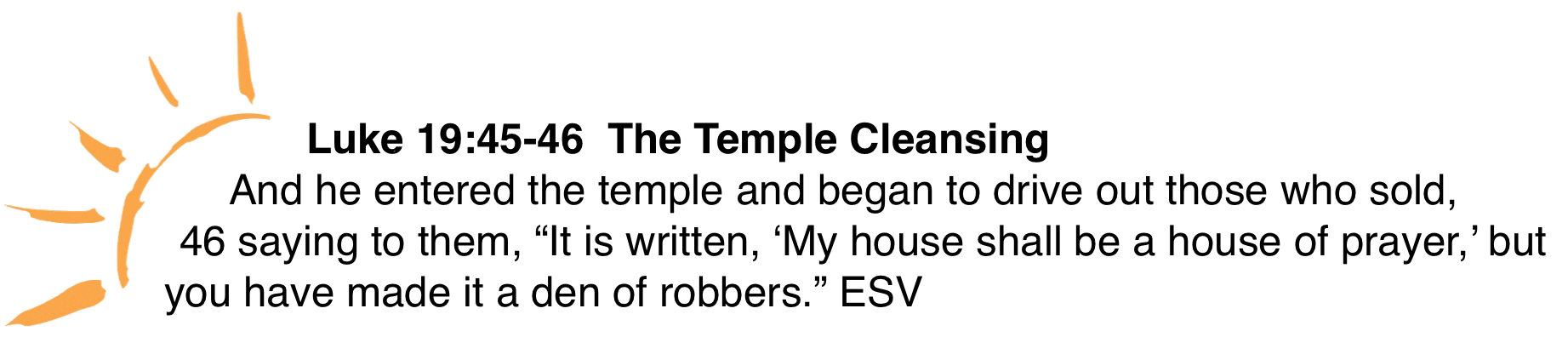
citing Isaiah 56:7
…these I will bring to my holy mountain, and make them joyful in my house of prayer; their burnt offerings and their sacrifices will be accepted on my altar; for my house shall be called a house of prayer for all peoples.”
and Jeremiah 7:11
Has this house, which is called by my name, become a den of robbers in your eyes? Behold, I myself have seen it, declares the Lord.

This is my first attempt at using a new study idea based on a book — Old Made New[a].  It’s a how-to book with a different premise;  to let the New Testament read the Old Testament to me thru its citations.  I’m going to use the Scripture references in the book for my post each Wednesday and pay attention to those citations.  What is it about them that mattered to Jesus and may change my mind about what I read?  Here we go…Week 1.

The Book of Jeremiah was written between 630 and 580 B.C. and Isaiah was written sometime during the ministry of Isaiah (approximately 740–701 B.C.).  I can’t be the only one who’s forgotten the antiquity timeline is a countdown.  So…Isaiah wrote first, then Jeremiah.  Their  words show the progression of their choice to neglect those old words.  Luke is reminding his readers that Jesus saw their choice and grieved over the loss of God’s purpose for the purity of His house of prayer.

Jesus had paused to look over the city as he neared Jerusalem and was moved to tears over the “things that make for peace” that are no longer visible there.  They no longer had any claim to innocence.  The passage of time showed the result of neglect to those old Words. Jeremiah had to pass along God’s harsh observation about His house looking like a den of robbers. I  don’t know how to explain why Jesus chose such uncharacteristic behavior in the Temple.  Maybe it was anger, frustration, judgment and grief all combined at their willing acceptance of what had been lost.  Did they even notice the decline?

I’ve noticed something because of following those citations in this passage.  My emphasis changed as I read from wondering about Jesus’s unexplainable behavior to thinking about mine.  It’s a choice to pay attention to old Words like Isaiah’s promise of acceptance and Jeremiah’s warning about neglect.  It’s become a reality check about not neglecting old Words.  Romans 8:12 says we do have an “obligation.” Our obligation to the “house that is called by [God’s] name is not our innocence, Adam took care of that.  It’s our choice!  Jesus is calling us to choose purity and He’s given us a completely different how-to Book filled with everything that can make that a reality in our life.

[a] Old Made New

 

Obligation

Romans 8:10 If Christ is in you, though the body is dead because of sin, yet the spirit is alive because of righteousness. 11 But if the Spirit of Him who raised Jesus from the dead dwells in you, He who raised Christ Jesus from the dead will also give life to your mortal bodies through His Spirit who dwells in you.  12 So then, brethren, we are under obligation, not to the flesh, to live according to the flesh— 13 for if you are living according to the flesh, you must die; but if by the Spirit you are putting to death the deeds of the body, you will live. 14 For all who are being led by the Spirit of God, these are sons of God.

Jesus’s Part:
…to give life to your mortal bodies” that overcomes sin because “the spirit [of Christ in you] is alive because of [His] righteousness.”

Our Part:
…“We are under obligation” to live being “led by the Spirit of God,”

What does that look like to you?  I’ll bet you dollars to donuts you’ve fallen into the same trap I have – it looks like doing the right thing at the right time in the right place. That’s certainly a good look but it’s the least valuable part in God’s eyes.  Remember all the venerated people from the Old Testament who did the wrong thing at the right time and in the right place?  God led them and saved them despite the evidence they were often careless, broken and flawed people.  They have their place in the Bible because of one simple thing; they were willing to be reminded by God of their need to pursue their relationship with Him despite having only the slightest inkling of what He really desired from them.

For most of us that’s still the reality of what we have to offer God today.  It’s true we have much more knowledge, we have the Bible and we often have true shepherds who lead us.  Sadly, we have have turned those things into our “obligation” instead of recognizing our magnificent and determined Creator has given us those things as His graces.  Our obligation is still the same simple one from long ago; that we be willing to pursue our relationship with “the Spirit of Him who raised Jesus from the dead” and He will lead us and save us despite the repeated evidence we too are often careless, broken and flawed people.  

This Then…Forgive Us

4. Matthew 6:9 “This, then, is how you should pray:…12 And forgive us our debts, as we also have forgiven our debtors.

• debt: something that is owed or due, a feeling of gratitude for a service or favor, obligation
• obligation: an act or course of action to which a person is morally or legally bound;

A dictionary definition can bring up a less commonly used word like “obligation” as part of “debt.”  It’s a tool that helps me think about what I’m reading in a broader way.  That one word “obligation” reminded me of Romans 8:12: “Therefore, brothers and sisters, we have an obligation—but it is not to the flesh, to live according to it.” That’s truth, right?

The terms of a debt are usually not ours to set but once agreed upon they are a contract.  We owe…we pay…”we have an obligation.”  What I’m pondering is why that truth is obviously grace when we pray Jesus’s words “forgive US our debts” but becomes an obligation to repay it when we add “as we also have forgiven our debtors.”  

We recognize our indebtedness. We want his forgiveness.  Our debt is too big to pay without it, but it’s easy to forget we’ve agreed to all the clauses of that contact.  That obligation is where Jesus’s prayer model meshes together with Romans to become the confession he meant it to be for us.  Lord help us to recognize your forgiveness of our debt has such an important relationship to our struggle to recognize our obligation to forgive.

This Then…123 Thy Kingdom Come

2. Matthew 6:9 “This, then, is how you should pray:…
10 your kingdom come, your will be done, on earth as it is in heaven.

1. Kingdom: the spiritual reign or authority of God
2. Will: expressing God’s desire, consent, or willingnes
3. Heaven and Earth: used to indicate the whole universe. Genesis 1:1

It’s tempting to ask “what went wrong” instead of praying “thy kingdom come.”  It’s easy to forget two kingdoms were created by your will Father, heaven AND earth.  Earth is not an act of creation that went awry.  The reality is you are still in charge!  We are your act of creation that went awry. That’s an uncomfortable reality.

We pray your words not because we’re perfect but because as imperfect as we are, we’re expressions of your will right here on earth.  Romans 8:12 reminds us we have an obligation to be evidence of your desire to reunite those two kingdoms.  Many of us now find ourselves with one foot in your heavenly kingdom and the other planted firmly here on earth. Who else would know what it means to live with the separation of those kingdoms?  We persist.  We pray for your reality…“thy kingdom come, thy will be done on earth as it is in heaven.”