Tag Archives: Righteousness

What Do You Think?

Matthew 21:28 “What do you think? A man had two sons. And he went to the first and said, ‘Son, go and work in the vineyard today.’ 29 And he answered, ‘I will not,’ but afterward he changed his mind and went. 30 And he went to the other son and said the same. And he answered, ‘I go, sir,’ but did not go. 31 Which of the two did the will of his father?” They said, “The first.” Jesus said to them, “Truly, I say to you, the tax collectors and the prostitutes go into the kingdom of God before you. 32 For John came to you in the way of righteousness, and you did not believe him, but the tax collectors and the prostitutes believed him. And even when you saw it, you did not afterward change your minds and believe him.”

What do you think?  That’s what Jesus’s wants to know.  I think there are two unmentioned words missing here; obedience and submission.  Those two missing words have become the unusual twist I needed to ponder more about this parable.  At first glance neither son’s response to the father would be called obedient or submissive.  The first son’s response to what his father asks is “I will not.” He did not want to be obedient!  The father seems to have accepted the son’s “I will not” and moves on to the second son.  The second son’s response is to please the father, “I go sir!”  They both end up changing their minds and flip-flopping to do exactly the opposite of what they said. That is the point in my pondering where Jesus interrupted my neat little devotion about this parable with an interesting observation: this parable is about that flip-flopping not which son was more obedient and submissive.  

Our human process of life is exactly like those two sons.  It’s built of uneven flip-flopping between our words and our behavior.  God has designed a life of faith through belief in Jesus that will change our minds and offer us a dependable “way of righteousness” that can make us reliable in our obedience and trustworthy in our submission…at first glance.

Compete Glory

Around the Truth of God spoken in the Old Testament
— Exodus 32:9 
And the Lord said to Moses, “I have seen this people, and behold, it is a stiff-necked people. 10 Now therefore let me alone, that my wrath may burn hot against them and I may consume them, in order that I may make a great nation of you.” 11 But Moses implored the Lord his God 

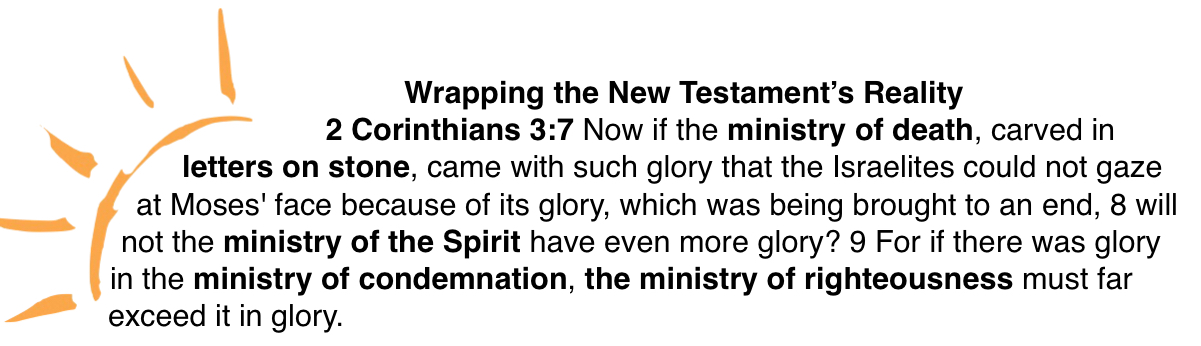
Premise: The weight and heaviness of God’s Sovereignty and Glory were captured within the Words he wrote on those stone tablets of His testimony so they would last.  How would you describe Glory?  I’d go for words like majestic and powerful.  Paul has given us a vivid word picture of God’s complete glory that includes four unusual aspects to think about.  These  10 Words were God’s own Testimony of the purpose of His Glory — to reveal what He required for the people to live in relation to Him and to make sin so obvious, the reality of it could not be denied. That Testimony was to be administered not just through the power of the Words themselves but because they were infused with evidence that the completeness of  God’s Glory was designed to overcome the corruption of sin, death and condemnation with the ministry of the Spirit and righteousness for His people.

You Can Do It

And Old Testament Verses
Leviticus 18:5 You shall therefore keep my statutes and my rules; if a person does them, he shall live by them: I am the Lord.
Deuteronomy 30:12 It is not in heaven, that you should say, ‘Who will ascend to heaven for us and bring it to us, that we may hear it and do it?’ 13 Neither is it beyond the sea, that you should say, ‘Who will go over the sea for us and bring it to us, that we may hear it and do it?’ 14 But the word is very near you. It is in your mouth and in your heart, so that you can do it.

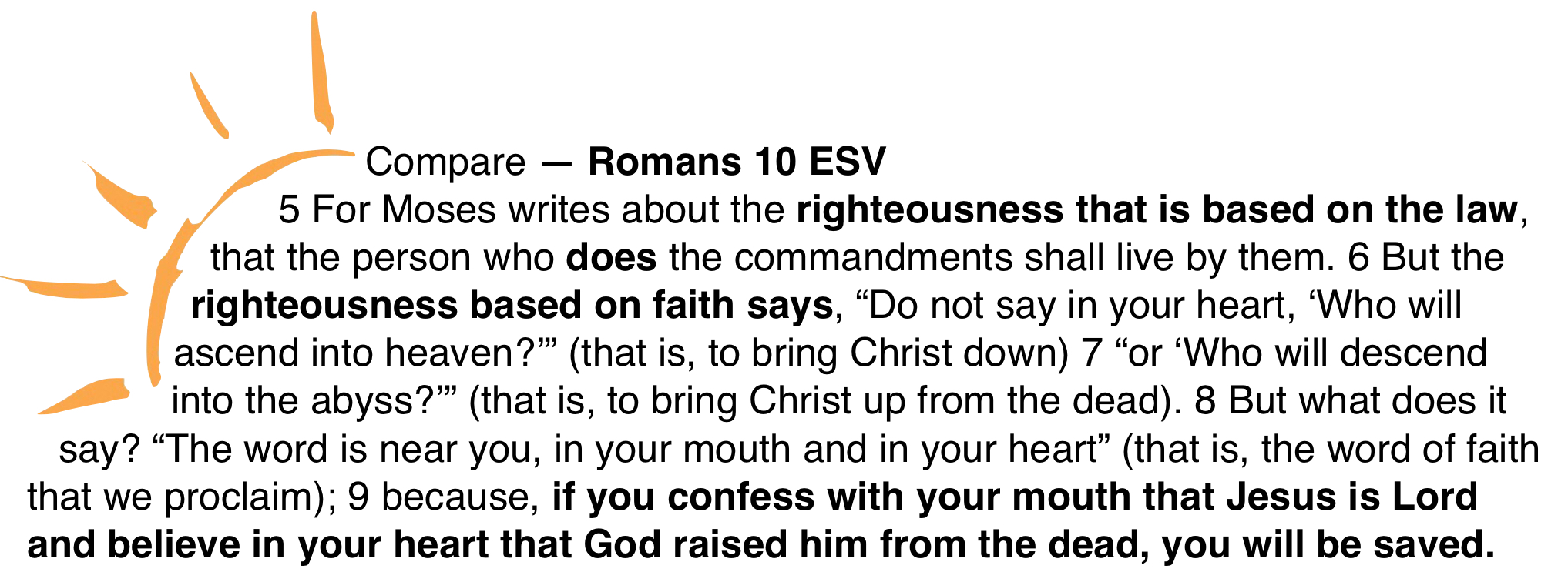
I think I learned a simple base-line truth about righteousness when I was highlighting the Romans verses.  Righteousness that is based on the law…does AND righteousness based on faith saysFor with the heart one believes and is justified, and with the mouth one confesses and is saved.

In between those …’s is the mysterious truth about righteousness.  There are rules and how you keep them impacts everything about your life.  The Lord says so!  “The design of the law was to lead people to Christ. The moral law was but for the searching of the wound, the ceremonial law for the shadowing forth of the remedy; but Christ is the end of both.”[a]

— My heart heart knows when my mind choses to obey God’s statutes as if they’re a bandaid that can cover the accusation that it’s my behavior that will strengthen my heavenly image here on earth instead of Christ.
— My heart knows when my mind relies on the phony satisfaction of good intentions and moral righteousness as if they’re a good excuse for not opening my mouth to say they were the result of Christ resurrecting my life so I actually had something to rely on.

The simple base-line truth about righteousness
for my life and yours is:

If you confess with your mouth that Jesus is Lord and believe in your heart that God raised him from the dead, you will be saved…
The word is near you in your mouth and in your heart, so that
YOU CAN DO IT!

[a] Matthew Henry

Sunday with John – Purity

John 7:53 – 8:1-11
7:53 [[They went each to his own house,
1 but Jesus went to the Mount of Olives. 2 Early in the morning he came again to the temple. All the people came to him, and he sat down and taught them. 3 The scribes and the Pharisees brought a woman who had been caught in adultery, and placing her in the midst 4 they said to him, “Teacher, this woman has been caught in the act of adultery. 5  Now in the Law, Moses commanded us to stone such women. So what do you say?” 6 This they said to test him, that they might have some charge to bring against him. Jesus bent down and wrote with his finger on the ground. 7 And as they continued to ask him, he stood up and said to them, “Let him who is without sin among you be the first to throw a stone at her.” 8 And once more he bent down and wrote on the ground. 9 But when they heard it, they went away one by one, beginning with the older ones, and Jesus was left alone with the woman standing before him. 10 Jesus stood up and said to her, “Woman, where are they? Has no one condemned you?” 11 She said, “No one, Lord.” And Jesus said, “Neither do I condemn you; go, and from now on sin no more.”]]
[[The earliest manuscripts do not include 7:53–8:11.]

What is the general theme of the passage?
One guilty woman, a crowd of male accusers and Jesus — all facing the reality and consequence of sin!  Jesus must distill the broad brush of the situation into something personal for both the guilty woman and her accusers.  The woman caught in the act of adultery must see that disgrace and guilt are not what Jesus has in mind for her even though she is far from innocent.  Jesus with so few words and such an underwhelming physical display of His presence has reminded the accusers they are not innocent either.  Both the guilty woman and the guilty accusers must recognize the consequence of sin is lost innocence and once lost, innocence can never be recovered.  Whatever Jesus wrote on the ground, twice, has convinced the accusers of that. They go away with only their guilty memories never acknowledging what Jesus wants them to see. While the law cannot restore their innocence, the experience of the law through His grace offers something more lasting for those accused by their own sin…a pathway to purity, “go, and from now on sin no more.”

What does it say about God (or Jesus or the Holy Spirit?)
Jesus bent down and wrote with his finger on the ground… once more he bent down and wrote… Jesus was left alone with the woman standing before Him.  

What does it say about people?
Here are a couple ideas to consider about what Jesus might have written before those men.  Maybe Jesus wrote the scripturesa that spoke about adultery and guilt. “If a man is found lying with the wife of another man, both of them shall die, the man who lay with the woman, and the woman. So you shall purge the evil from Israel” and “If a man commits adultery with the wife of his neighbor, both the adulterer and the adulteress shall surely be put to death.” Were there guilty men there? Or maybe it was the names of the two required eyewitnesses needed to bring this charge.  The standard for bringing such a rare charge was extremely detailed; the witnesses must see the actual sexual act with their own eyes.  Were those men there? Jesus clearly identified “something” the accusers recognized with their own eyes in those words or marks He made on the ground …and “they went away one by one.”
a Deuteronomy 22:22 and Leviticus 20:10 ESV
Is there truth here for me?
Jesus was left alone with the woman, not to reveal her obvious guilt, but to offer her His guiltless righteousness to replace the condemnation of her lost innocence.  “Therefore there is now no condemnation at all for those who are in Christ Jesus. For the law of the Spirit of life in Christ Jesus has set you free from the law of sin and of death. For what the Law could not do, weak as it was through the flesh, God did: sending His own Son in the likeness of sinful flesh and as an offering for sin, He condemned sin in the flesh…” Ro 8:1-3 NASB


Advocate

John 16:7 But very truly I tell you, it is for your good that I am going away. Unless I go away, the Advocate will not come to you; but if I go, I will send him to you. 8 When he comes, he will prove the world to be in the wrong about sin and righteousness and judgment: 9 about sin, because people do not believe in me; 10 about righteousness, because I am going to the Father, where you can see me no longer; 11 and about judgment, because the prince of this world now stands condemned. NIV

“…the one who is in you is greater than the one who is in the world.” 1 John 4:4 NIV

Psalm 119:33-40 ה He – Window

Reading these verses forwards, and then backwards and pondering their meaning continues.  It seems like all of Psalm 119 has been about the building of the temple within the people of God; you and I.  Today seems a perfect time for to punch a hole in the walls that we depend on for protection to let in a little more light using the Hebrew “ה He.”  I haven’t missed the “coincidence” that God has used winter darkness, a raging pandemic and the period of Advent to do just that.

ה He – Window, Lattice
Psalm 119: 33-40 ESV
33 Teach me, O Lord, the way of your statutes; and I will keep it to the end.
34 Give me understanding, that I may keep your law and observe it with my whole heart.
35 Lead me in the path of your commandment for I delight in it.
36 Incline my heart to your testimonies, and not to selfish gain!
37 Turn my eyes from looking at worthless things; and give me life in your ways.
38 Confirm to your servant your promise, that you may be feared.
39 Turn away the reproach that I dread, for your rules are good.
40 Behold, I long for your precepts; in your righteousness give me life!

>§§§>

33 I will keep the way of your statures to the end, O Lord; teach me
34 I keep your law and observe it with my whole heart because you give me understanding
35 I delight in the path of your commandment, lead me to it
36 Your testimonies, not Selfish gain, inclines my heart
37 Give me life in your ways and turn my eyes from looking at worthless things
38 Your promise confirms that you may be feared to your servant
39 Your rules are good for they turn away the reproach that I dread
40 Your righteousness gives me life! Behold I long for your precepts

Click here to read a previous post about the meaning of ה He – Window

The Third Chapter – Romans

Romans 3:21 But now the righteousness of God has been manifested apart from the law, although the Law and the Prophets bear witness to it— 22 the righteousness of God through faith in Jesus Christ for all who believe. For there is no distinction: 23 for all have sinned and fall short of the glory of God, 24 and are justified by his grace as a gift, through the redemption that is in Christ Jesus, 25 whom God put forward as a propitiation by his blood, to be received by faith. This was to show God’s righteousness, because in his divine forbearance he had passed over former sins. 26 It was to show his righteousness at the present time, so that he might be just and the justifier of the one who has faith in Jesus.

>§§§>

Paul is purposefully using a type of word play in much of this chapter that I didn’t include above.  His words are meant to shift the focus of familiar concepts and challenge thought processes about how we interact with God.  There were two things I read in preparing for this post that were helpful to me.  One was a line from The Message version of Romans 3; “Our involvement with God’s revelation doesn’t put us right with God. What it does is force us to face our complicity in everyone else’s sin.”  The second was from one of John Piper’s writings about this chapter where he referred to the Law as a track, not a ladder.  

Ladder-thinking regarding God, sin, obedience to the Law, faith and justification seems to be part of human nature.  I know my own tendency is to want a list to check items off so I can move on to the next rung.  Instead God has provided reality.  Life is filled with either/or’s, if/then’s and hide & seek’s. It’s like a track where the same laps must be repeated over and over in order to achieve the desired goal.  That is exactly why Paul’s challenge from Romans is so important today.   

• Sin hides us from God.
• The Law of self-preservation hides us from grace.
• Self-preservation hides us from obedience of the heart.
• Christ reveals the truth of the Law and obedience of the heart
• Obedience of the heart reveals faith
• Faith reveals grace
* Grace reveals justification
• Justification reveals God’s righteousness.

These realities are  a vital part of our relationship with the Sovereign God of the universe through Jesus Christ.  There is not a ladder, only a track.  Repeat laps as needed. 

Optional Ending

I Peter 2:24 He himself bore our sins in his body on the tree, that we might die to sin and live to righteousness. By his wounds you have been healed. 25 For you were straying like sheep, but have now returned to the Shepherd and Overseer of your souls. [ESV]

>§§§>

I’ve Been Healed – by Shirle Bedient circa late 1980s
It’s lonely Lord, with people all around when no one knows what’s really deep inside.  Give me the courage not to hide my hollow life from you for by your wounds my lonely heart is healed.
I’ve been healed, I’ve been healed, praise the Lord
for by His wounds I have been healed.
The guilt I bear is heavy on my heart.  I want to hide my sin and shame from you.  Lord, I’m not worthy but forgive me, show me once again that by your wounds my sins have all been healed.
I’ve been healed, I’ve been healed, praise the Lord
for by His wounds I have been healed.
My spirit Lord is sometimes very low, for I forget just where my strength comes from.  Remind my heart to sing your praises all of my days, for by your wounds my spirit has been healed.
I’ve been healed, I’ve been healed, praise the Lord
for by His wounds I have been healed.

Earlier this Spring a little-known Gospel trio, The Followers, had their 40-ish reminiscence reunion and we recorded this song, from the “old” days.  I hope you ‘ll listen to the audio file all the way to the end because it’s the very end that inspired the object lesson of this post.  Many years have passed since I wrote this song but the lyrics still reflect truth; hiding, guilt and anxiety are realities of everyday life but “praise the Lord, for by His wounds” we can be healed.  Jesus has given us access to an optional ending.  “He himself bore our sins in his body on the tree” [and this is key] to guarantee every day our life could be “returned to the Shepherd and Overseer of your soul…that we might die to sin…”  That is the daily process the Lord has provided to teach us how to”live to righteousness.”  That’s the reality that makes healing and laughter the “optional” ending to a life of hiding, guilt and anxiety.

The Gospel Balance

Continue reading

Second Chance: Romans 2

√ Re·new·al: the replacing or repair of something that is worn out, run-down, or broken

Romans 2 [NIV]
13 For it is not those who hear the law who are righteous in God’s sight, but it is those who obey the law who will be declared righteous…15 They show that the requirements of the law are written on their hearts, their consciences also bearing witness, and their thoughts sometimes accusing them and at other times even defending them.
18 if you know his will and approve of what is superior because you are instructed by the law; 19 if you are convinced that you are a guide for the blind, a light for those who are in the dark, 20 an instructor of the foolish, a teacher of little children, because you have in the law the embodiment of knowledge and truth— 21 you, then, who teach others, do you not teach yourself? 

• What “if you know his will and approve of what is superior BECAUSE you are instructed by the law” written on your heart, not a list of do’s and don’ts.
• What if the “requirements of the law” include internal instruction about judgment and renewal for those who are “righteous in God’s sight?”

• Then the accusation of judgment becomes the instruction of the law within us that bears witness to our conscience and the needs of our heart.
• Then our renewal becomes the evidence within us of God’s own defense of our heart as He directs our thoughts toward His righteousness.

“If you are convinced that you are a guide for the blind, a light for those who are in the dark, an instructor of the foolish, a teacher of little children, because you have in the law the embodiment of knowledge and truth.“  God is “bearing witness’ to your thoughts through those requirements of judgement and renewal.  What is written on your heart is His best option for the renewal of your mind and His best defense of your righteousness.  “You, then, who teach others, do you not teach yourself?