Category Archives: Old Testament

The “More”

24 “Everyone then who hears these words of mine and does them will be like a wise man who built his house on the rock. 25 And the rain fell, and the floods came, and the winds blew and beat on that house, but it did not fall, because it had been founded on the rock. 26 And everyone who hears these words of mine and does not do them will be like a foolish man who built his house on the sand. 27 And the rain fell, and the floods came, and the winds blew and beat against that house, and it fell, and great was the fall of it.” ESV

Jesus is telling this story about people.  In this case it’s pretty obvious the good choice would be building on the rock but it’s “more” than a story about good/bad options.  It’s a story for everyone whether they’re wise or foolish.  Each hears these words…each built his house and on each the rain fell, and the floods came, and the winds blew and beat on that house.   There’s “more” to consider here if the two builder’s circumstances were not what made the difference in their outcome.

This parable is not a story about the danger of circumstances. The danger Jesus is warning about is our destiny if we trust more in our belief rather than the truth of His Words.  Recently I’ve discovered something new about how the Bible can tell me “more.”  It was a surprise to me to discover if I’d been doing a word or topical search and copying the verses I found I could then read those verses as a story of their own without the references and Voila! I found “more” from His Word.  So here’s “more” for today.

“The Rock, his work is perfect, for all his ways are justice.  A God of faithfulness and without iniquity, just and upright is he.a  So the honor is for you who believe, but for those who do not believe, ‘the stone that the builders rejected has become the cornerstone,’ and ‘a stone of stumbling, and a rock of offense.’  They stumble because they disobey the word, as they were destined to do.”b

a Deut 32:4
b 1 Peter 2:7

The Mystery In-Between

1 What then shall we say was gained by Abraham, our forefather according to the flesh? 2 For if Abraham was justified by works, he has something to boast about, but not before God. 3 For what does the Scripture say? “Abraham believed God, and it was counted to him as righteousness.” 

Romans 4 contains a timeless truth about righteousness.  I’ve removed Romans 4-12 from this post on purpose to stir up your interest in the mysterious truth that lies in-between those first three verses and verse 24.  I want you to read and ponder those verses for yourself because they are thought-provoking reminders of the visceral [felt in or as if in the internal organs of the body] reality of God’s intent to interact physically with His people not just instruct them.

Romans 4:4-12 is the reality of a physical interaction between God and Abraham that’s now uniquely part of our heritage as his descendants.  True to His word God has given all Abraham’s descendants a new seal  to verify what He has already done; the precise surgical procedurea  that purposely removed the barrier left in-between the heart and the righteousness He counts as His own.

Romans 4:24…It [Righteousness] will be counted to us who believe in him who raised from the dead Jesus our Lord, 25 who was delivered up for our trespasses and raised for our justification.

a Deuteronomy 30:6

Compete Glory

Around the Truth of God spoken in the Old Testament
— Exodus 32:9 
And the Lord said to Moses, “I have seen this people, and behold, it is a stiff-necked people. 10 Now therefore let me alone, that my wrath may burn hot against them and I may consume them, in order that I may make a great nation of you.” 11 But Moses implored the Lord his God 

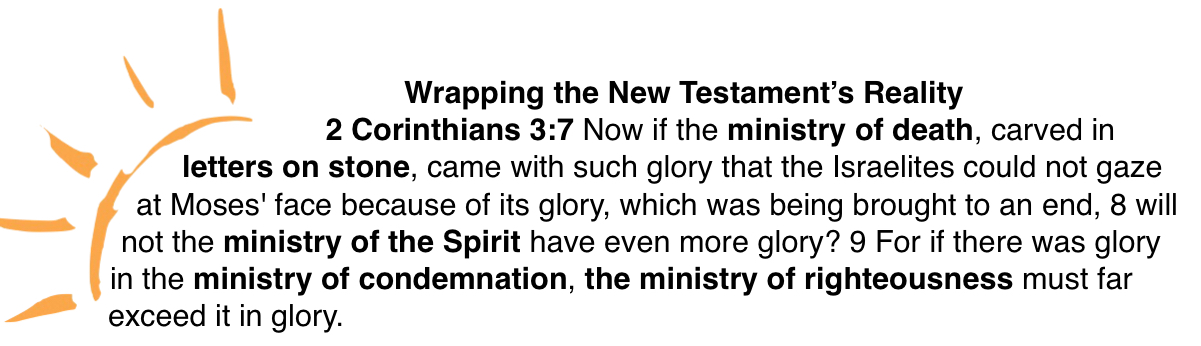
Premise: The weight and heaviness of God’s Sovereignty and Glory were captured within the Words he wrote on those stone tablets of His testimony so they would last.  How would you describe Glory?  I’d go for words like majestic and powerful.  Paul has given us a vivid word picture of God’s complete glory that includes four unusual aspects to think about.  These  10 Words were God’s own Testimony of the purpose of His Glory — to reveal what He required for the people to live in relation to Him and to make sin so obvious, the reality of it could not be denied. That Testimony was to be administered not just through the power of the Words themselves but because they were infused with evidence that the completeness of  God’s Glory was designed to overcome the corruption of sin, death and condemnation with the ministry of the Spirit and righteousness for His people.

Shiloh

To the Truth of God fulfilled in the Old Testament
Genesis 17:6 I will make you exceedingly fruitful, and I will make you into nations, and kings shall come from you.
Genesis 49:10 [KJV] “The sceptre shall not depart from Judah, nor a lawgiver from between his feet, until Shiloh come; and unto him shall the gathering of the people be.”
Judges 1:1 “Who shall go up first for us against the Canaanites, to fight against them?” 2 The Lord said, “Judah shall go up; behold, I have given the land into his hand.”

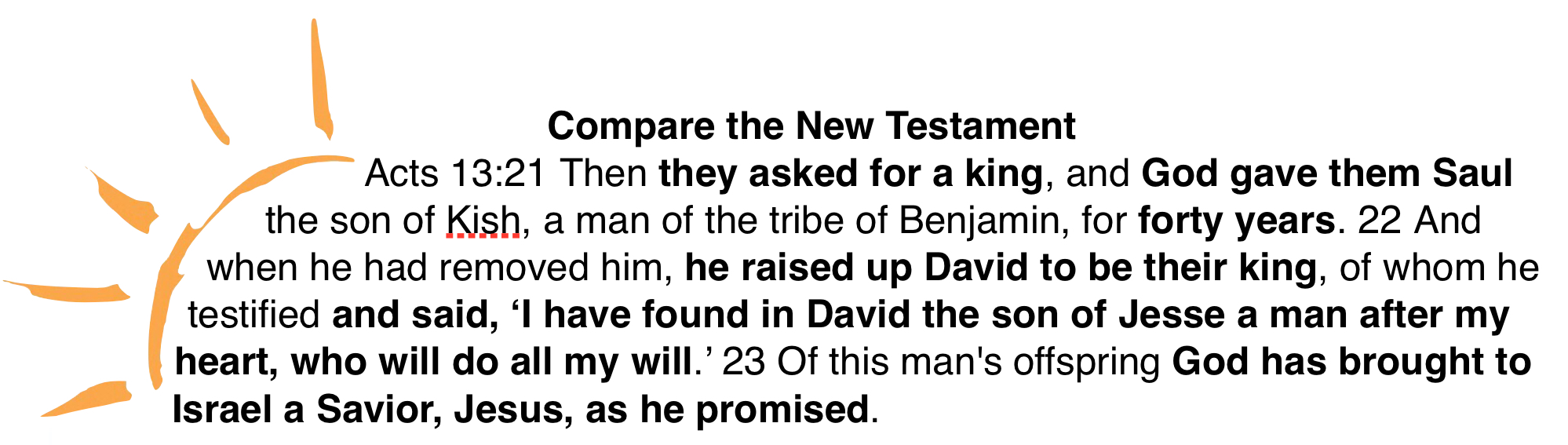
God is establishing His family tree based on the new Blood Covenant given to Abraham in Genesis 17 not on the law of blood lines and first-borns. God chooses Isaac over Ishmael, his first son. Then history repeats itself and from Isaac’s sons God chooses Jacob,  his second born twin.  The line is shifted even further when Jacob gives his fourth son a prophetic blessing of authority in Genesis 49. FYI: Shiloh is a name of Hebrew origin, meaning “tranquil,” “abundance,” and “His gift — and it’s “unto him shall the gathering of the people be.”

Luke 1:33
When the angel Gabriel appeared to Mary to announce she had been chosen by God to give birth to the Messiah, these were the words used to describe what he (the Gift) would accomplish:
“And he will reign over the house of Jacob forever”


Don’t Miss the Details

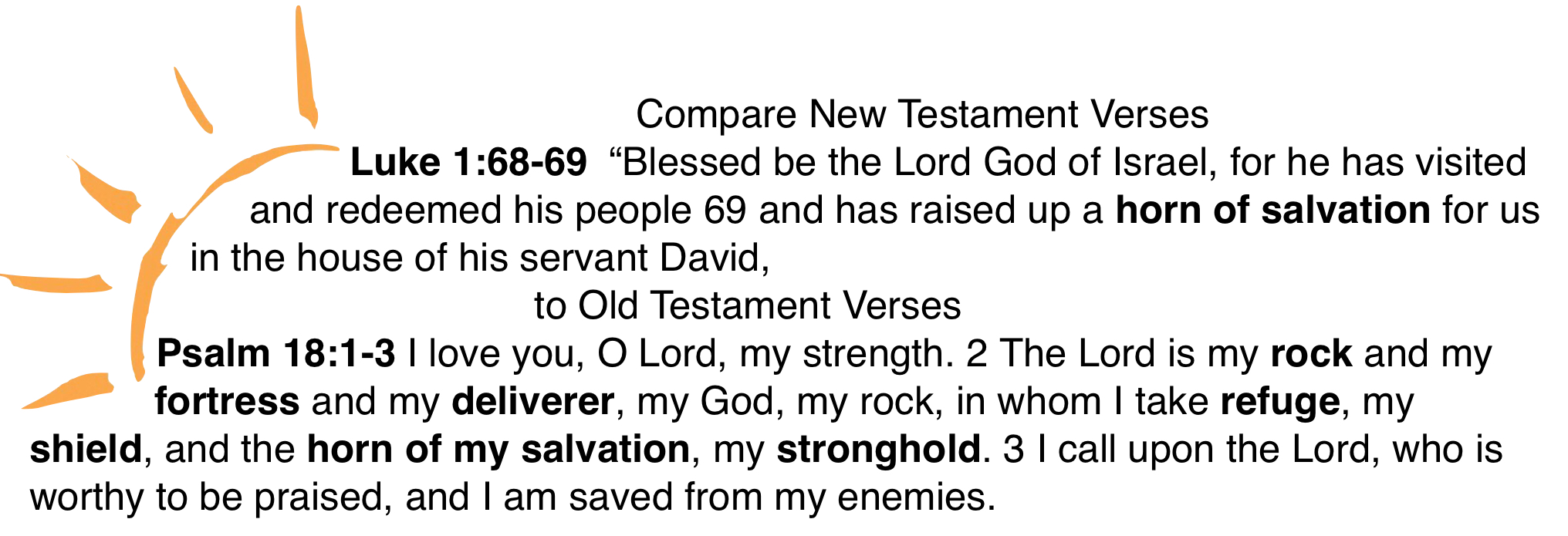
This is a perfect example of the premise of letting one Testament read you the other.  Jesus talks in John 16:25 about using “figures of speech.”  The “horn of salvation” is like that.  I have read it, I know it’s Jesus, I have no reason to disagree. It’s a “figure of speech” I can easily skip over except this exercise has caused me to see a tiny little letter that directs my attention to Psalm 18 and I find details of worship for that moment I would have otherwise missed.

I love you, Jesus, my strength. You are my rock and my fortress and my deliverer the rock, in whom I take refuge, my shield AND “the reality of my salvation,” my stronghold.  Amen.

The Integrity of Grace

And Old Testament Verses 
— Isaiah 6:9 And he said, “Go, and say to this people:  “‘Keep on hearing, but do not understand; keep on seeing, but do not perceive.’ 10 Make the heart of this people dull, and their ears heavy, and blind their eyes; lest they see with their eyes, and hear with their ears, and understand with their hearts, and turn and be healed.”
— Isaiah 53:1 Who has believed what he has heard from us? And to whom has the arm of the Lord been revealed?

John repeats some of the most troublesome Words in the Bible.  They are God’s judgement given to Isaiah to let unbelievers know He will use their unbelief for His purpose.  Not all judgment of God is punishment, but it is always reality.  God sets the rules.  He has judged this group of unbelievers will be made deaf, blind and dull of heart.  I see that, but I wish it weren’t so.  

What possible purpose could the Sovereign Lord have in making such a judgment?  Why has He identified these unbelievers in this way?  He’s obviously not punishing them for what He’s done.  I have an idea that this judgment has to do with the reality of grace and glory.

I wonder if what He has seen in this group of people is the nature of man’s heart to listen but not heed His truth and see that truth as a useful tool to manipulate life but not believe it’s His power.  The nature of God’s Sovereignty is driven by grace that must respond to belief.  Could it be that God has judged these unbelievers in order to protect the integrity of His grace for those who DO see with their eyes, and hear with their ears,and understand their transformed heart is for the sake of God’s glory and for His purpose.

“God is sovereign over all belief and unbelief.
He knows exactly how to plan both of them in ways
that exalt his sovereignty and preserve man’s accountability.”
[John Piper]

In “This” Day

Citing:
— Amos 9:11-12 “In that day I will raise up the booth of David that is fallen and repair its breaches, and raise up its ruins and rebuild it as in the days of old, that they may possess the remnant of Edom (Mount Esau) and all the nations who are called by my name,” declares the Lord who does this.
— Jeremiah 12:15 And after I have plucked them up, I will again have compassion on them, and I will bring them again each to his heritage and each to his land.
— Isaiah 43:7…everyone who is called by my name, whom I created for my glory, whom I formed and made.
— Jeremiah 14:9 Why should you be like a man confused, like a mighty warrior who cannot save? Yet you, O Lord, are in the midst of us, and we are called by your name; do not leave us.”
— Daniel 9:19 O Lord, hear; O Lord, forgive. O Lord, pay attention and act. Delay not, for your own sake, O my God, because your city and your people are called by your name..

Rebuild and restore are common themes in the New Testament.  Throughout the Bible that is a common theme.  For a couple of days this week I’m at the ocean with my daughter and son-in-law and as God so often does He’s made a connection I can see with my own eyes to these passages.  Two hurricanes battered this area last fall and as a result of that, the work of rebuilding and restoring what was lost is obvious.  The rebuilding is the cosmetic fix but the restoration of what was lost is the ultimate goal.  

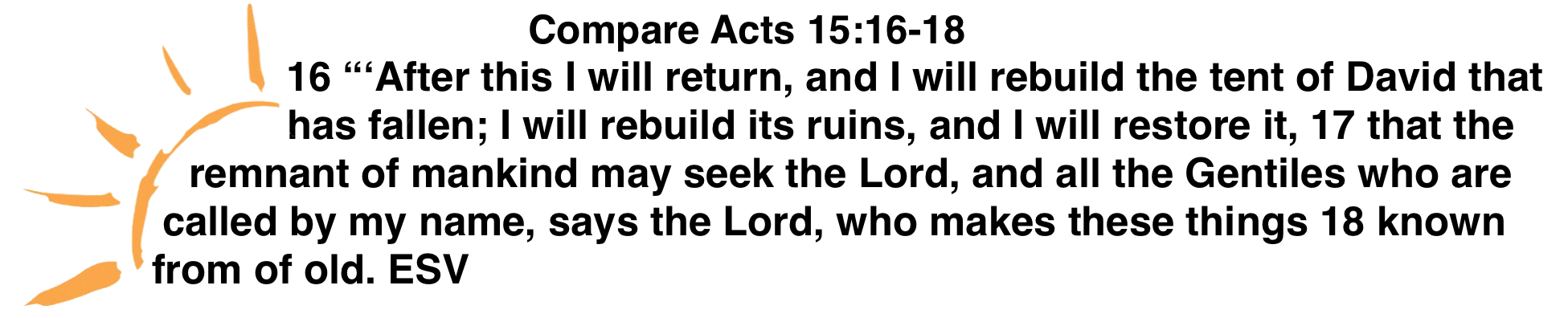
Acts quotes Amos saying the Lord has said the “remnant of mankind” will include Gentiles He’s called by His name.  What is “after this”?  Why does Amos refer to “a remnant of Edom?  Why do they want that remnant back?   What does that word “back” really mean? Why is Acts referencing Amos to explain Gentiles who are called by the Lord’s name?  Now Lord read me your truth from the Old Testament written to confirm it’s connection to the New Testament.  

I learned two “new” ancient Greek words studying for today. “Ethne” was a name used to refer to Gentiles or nations and “Laos” referred to the “people of God” the name the Jews called themselves.  Amos has chosen to use Laos to refer to Gentiles including them as “people of God.”  Gentiles who hadn’t become Jews but had remained Gentiles and been called by God’s name way back then in the Old Testament.√  After this?  After the “remnant of mankind,” Jews and Gentiles alike have been shaken and sifted to removed their sin, then “I will rebuild its ruins, and I will restore it.  Then they will seek the Lord.√   Edom [Mount Esau]  a kingdom thought to be founded by the angry, wronged brother of Jacob.  Esau will be restored to complete the restoration of the Kingdon of God.√   And now we come to that word “back.”  The word that says it all. God had never had any other plan but for His Kingdom to a) be rebuilt and b) be restored to the perfection He’d created in those first days of Genesis.   And finally we have our name the Lord Himself has given us, Christians, followers of Jesus Christ and Daniels plea to make our own — “O Lord, hear; O Lord, forgive. O Lord, pay attention and act. Delay not, for your own sake, O my God, because your city and your people are called by your name” — who makes these things known from of old” in “this” day.

Week 1: Choice

citing Isaiah 56:7
…these I will bring to my holy mountain, and make them joyful in my house of prayer; their burnt offerings and their sacrifices will be accepted on my altar; for my house shall be called a house of prayer for all peoples.”
and Jeremiah 7:11
Has this house, which is called by my name, become a den of robbers in your eyes? Behold, I myself have seen it, declares the Lord.

This is my first attempt at using a new study idea based on a book — Old Made New[a].  It’s a how-to book with a different premise;  to let the New Testament read the Old Testament to me thru its citations.  I’m going to use the Scripture references in the book for my post each Wednesday and pay attention to those citations.  What is it about them that mattered to Jesus and may change my mind about what I read?  Here we go…Week 1.

The Book of Jeremiah was written between 630 and 580 B.C. and Isaiah was written sometime during the ministry of Isaiah (approximately 740–701 B.C.).  I can’t be the only one who’s forgotten the antiquity timeline is a countdown.  So…Isaiah wrote first, then Jeremiah.  Their  words show the progression of their choice to neglect those old words.  Luke is reminding his readers that Jesus saw their choice and grieved over the loss of God’s purpose for the purity of His house of prayer.

Jesus had paused to look over the city as he neared Jerusalem and was moved to tears over the “things that make for peace” that are no longer visible there.  They no longer had any claim to innocence.  The passage of time showed the result of neglect to those old Words. Jeremiah had to pass along God’s harsh observation about His house looking like a den of robbers. I  don’t know how to explain why Jesus chose such uncharacteristic behavior in the Temple.  Maybe it was anger, frustration, judgment and grief all combined at their willing acceptance of what had been lost.  Did they even notice the decline?

I’ve noticed something because of following those citations in this passage.  My emphasis changed as I read from wondering about Jesus’s unexplainable behavior to thinking about mine.  It’s a choice to pay attention to old Words like Isaiah’s promise of acceptance and Jeremiah’s warning about neglect.  It’s become a reality check about not neglecting old Words.  Romans 8:12 says we do have an “obligation.” Our obligation to the “house that is called by [God’s] name is not our innocence, Adam took care of that.  It’s our choice!  Jesus is calling us to choose purity and He’s given us a completely different how-to Book filled with everything that can make that a reality in our life.

[a] Old Made New


Think About These Things


What If…
— Before I formed you in the womb I knew you, before you were born I set you apart…” Jeremiah 1:5

— You formed my inward parts; you knitted me together in my mother’s womb. Psalm 139:13

— We are his workmanship, created in Christ Jesus for good works, which God prepared beforehand, that we should walk in them. Ephesians 2:10

— God’s workmanship in me began long before a specific egg and sperm met one another

— God began to justify His choice in my mother’s womb before my first breath

— That first breath began my sanctification even before my first cognitive thought

— God has created me in the likeness of His perfection to insure I could be of value and succeed at what He’s prepared beforehand

— My whole imperfect and incomplete way of life is the inspired field of operation He’s chosen to accomplish His good works

— In him we live and move and have our being…for we are indeed his offspring  Acts 17:28

Whatever is true, whatever is honorable, whatever is just,
whatever is pure, whatever is lovely, whatever is commendable,
if there is any excellence, if there is anything worthy of praise,
think about these things.  Philippians 4:8

The Bread of Life

But you, O Bethlehem Ephrathah, are only a small village among all the people of Judah.  Yet a ruler of Israel will come from you, one whose origins are from the distant past. Micah 5:2   

ethlehem means the “House of Bread” in both Hebrew and Aramaic and thanks be to God, because Mary and Joseph’s hearts were obedient in the less-desirable details of life, Jesus began His earthly life born in the House of Bread just as Micah had forecast in “the distant past.”  I hadn’t purposely planned to be baking bread today because of this post but as it turns out I’m sitting here at the table waiting for my batch of dough to rise.  I’m watching it climb up the side of the clear dough-mixing bucket and enjoying the yeast’s aroma as I write.  It’s satisfying, but it’s the bread I’m really waiting for.  This simple choice to make bread today seems too relevant to this Advent post to be anything other than a homemade picture of God’s recipe. His recipe had the right ingredients, the right place, the right timing and the right baby to reveal His own identity as the Bread of Life the world was really waiting for.  God’s own recipe would satisfy the “aroma” of the prophet’s word and Jesus, the Bread of Life, would rise up and save many souls.  ‘Taste and see that the LORD is good. Oh, the joys of those who take refuge in him!”  Psalm 34:8 NLT  PS: Today’s bread turned out good too.