Category Archives: Psalms

This Jesus God Raised Up

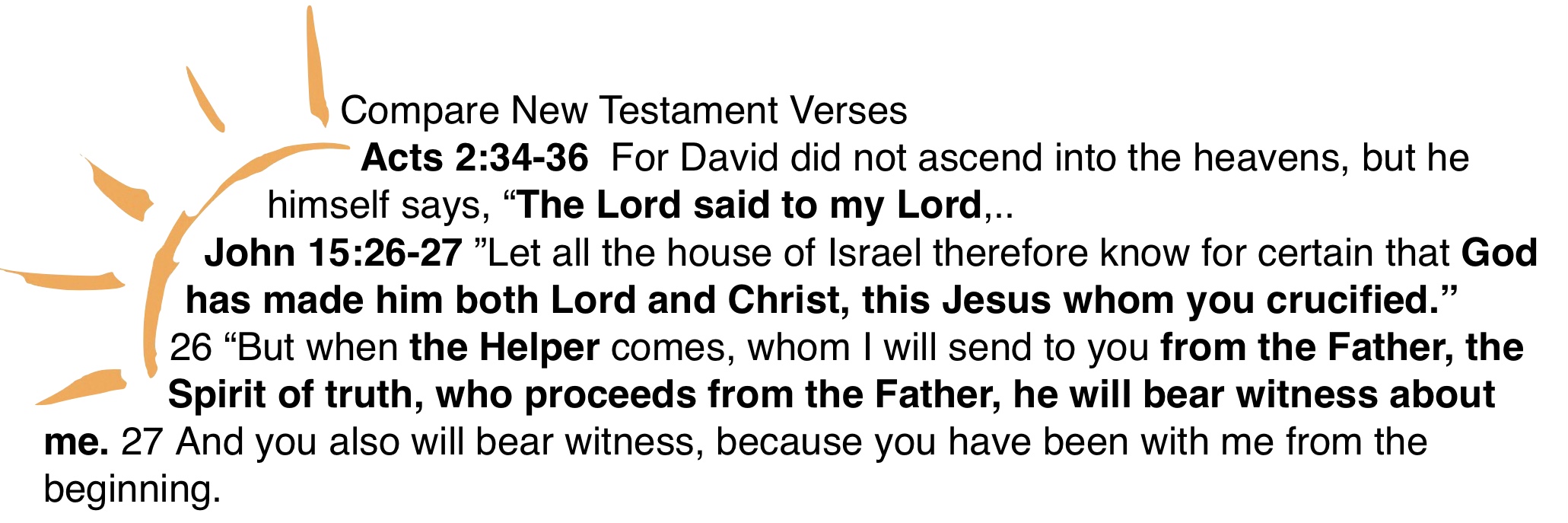
Acts 2:29 “Brothers, I may say to you with confidence about the patriarch David that he both died and was buried, and his tomb is with us to this day. 30 Being therefore a prophet, and knowing that God had sworn with an oath[a] to him that he would set one of his descendants on his throne, 31 he foresaw and spoke about the resurrection of the Christ, that he was not abandoned to Hades, nor did his flesh see corruption. 32 This Jesus God raised up, and of that we all are witnesses. 33 Being therefore exalted at the right hand of God, and having received from the Father the promise of the Holy Spirit, he has poured out this that you yourselves are seeing and hearing. 34 For David did not ascend into the heavens, but he himself says, “‘The Lord said to my Lord, “Sit at my right hand, 35 until I make your enemies your footstool.”’ 36 Let all the house of Israel therefore know for certain that God has made him both Lord and Christ, this Jesus whom you crucified.” [b]

“This Jesus God raised up” is the whole point of Peter’s speech.  Some of the “brothers” needed to be convinced. Some of them had heard of, or seen the supernatural signs Jesus had done but they questioned if those were of God.  Some of them may actually have been in the crowd that had chanted “crucify him” and maybe were also part of the ghastly parade that followed Jesus to the cross.  Some of them having witnessed the spectacle of Jesus’s death by crucifixion would certainly eliminate any possibility of life for Him.   Some of them accepted Peter’s confident statement that what they had witnessed was the exaltation of Jesus “at the right hand of God.”  Some had recognized what they’d seen and heard was a new Spirit “from the Father.”  Very few of them would have expected to hear Peter’s words that accused them of crucifying Jesus.  Would you?

Some of the “brothers” response might have been to discredit Peter’s words because of that accusation.  But all of them needed to be reminded they had seen what “God had sworn with an oath” to their revered patriarch, come to pass. God’s choice was no longer a historical record, He had made this death personal…and Peter meant them to feel the sting of those words “whom you crucified.”  God had chosen “the one who would build a house for my Name” from David’s descendants to “establish the throne of His kingdom forever.” “This Jesus whom you crucified,” was made “both Lord and Christ” so you could be certain “this that you yourselves are seeing and hearing” is His Son’s Spirit, received from the Father and forever poured out as a witness to you.“And of that we all are witnesses.”

[a] 2 Samuel 7:12 When your days are fulfilled and you lie down with your fathers, I will raise up your offspring after you, who shall come from your body, and I will establish his kingdom. 13 He shall build a house for my name, and I will establish the throne of his kingdom forever. 14 I will be to him a father, and he shall be to me a son.
[b] Psalm 110:1

The Unworthy Servant

Luke 17:7 “Will any one of you who has a servant(a) plowing or keeping sheep say to him when he has come in from the field, ‘Come at once and recline at table’? 8 Will he not rather say to him, ‘Prepare supper for me, and  dress properly, and serve me while I eat and drink, and afterward you will eat and drink’? 9 Does he thank the servant because he did what was commanded? 10 So you also, when you have done all that you were commanded, say, ‘We are unworthy(b) servants; we have only done what was our duty.’”

One of the most important things I’ve learned in the last year was to pay attention to those “little” letters as I study, particularly when they’re red and relate to the resource Jesus relied on.  For instance because of that one little (a) this parable would begin: “Will any of you who has a bondservant bound to their service without wages, plowing or keeping sheep say to him when he has come in from the field, ‘Come at once and recline at table?”  There’s tension in this parable and it’s about expectations. It’s Interesting to note it isn’t God who uses the word “unworthy” — lacking merit or value, — in verse 10.  It’s the servants who identify themselves that way.  I wonder about that. 

That little letter (b) cross referenced several places in the Old Testament.  That’s where I discovered Jesus probably began there too.  “-Can a man be profitable to God?  Surely he who is wise is profitable to himself. Is it any pleasure to the Almighty if you are in the right, or is it gain to him if you make your ways blameless? -The God who equipped me with strength [has] made my way blameless. -If you are righteous, what do you give to him? Or what does he receive from your hand?”(b)   

We have a lot of Biblical evidence of our worth to God(c) so there is definitely something more to ponder in this parable. The man “who has a slave” rightfully expects a dutiful response from the servant but his reputation will not be changed whether the servant acts in a profitable way toward him or not. The servant is made blameless not by his service but because the owner has taken responsibility for the command’s he’s given the servant to obey by simply doing his duty.  The servant must come to the awareness his only expectation of worth is completing his duty to the master. “We are always debtors to grace before we have done anything and after we have done our duty.”(d)

(a) Bondservant: a person bound to service without wages
(b) Job 22:2-3, Psalm 18:32 & Job 35:7 copied in this sequence
(c) Our Worth to God
(d) John Piper

They Should’a Known

Acts 2:22 Men of Israel, hear these words: Jesus of Nazareth, a man attested to you by God with mighty works and wonders and signs that God did through him in your midst, as you yourselves know— 23 this Jesus, delivered up according to the definite plan and foreknowledge of God, you crucified and killed by the hands of lawless men. 24 God raised him up, loosing the pangs of death, because it was not possible for him to be held by it. 

Hear these words! Words to those law-less men to whom God provided clear evidence of who Jesus was.  According to God’s definite plan and foreknowledge… those men crucified and killed Jesus!  The crucifixion wasn’t what made them lawless, that was a grisly but legal process.  Their law-lessness was rejecting the signs of God in their midst they should’a recognized. They rejected those signs because their God inhabited the place of their choosing, acted in response to their record of His laws and then waited until they were ready to approach Him with a legal sacrifice.  Their law-lessness was blind unbelief in what God had already made known to them about His presence in their long and revered history.  

25 For David says concerning him, “‘I saw the Lord always before me, for he is at my right hand that I may not be shaken; 26 therefore my heart was glad, my tongue rejoiced; my flesh also will dwell in hope. 27 For you will not abandon my soul to Hades, or let your Holy One see corruption. 28 You have made known to me the paths of life; you will make me full of gladness with your presence.’

Long before Jesus, David knew[a] that God was always present with him and accessible.  He knew even when his sin was revealed God would not abandon him to destruction.  He knew death could not destroy the Holy One.  He knew the Lord had made known the paths of life.  He knew God’s presence filled him with unshakable hope that made his heart glad.  He knew because God had made it known to him.  Even the history of God’s presence that lived in David’s words from the past was not enough for the lawless men to believe God would be present with them, now!   Their law-lessness was that God had come into their midst and made Himself known to them and they rejected Him.  They should’a known!

[a] quoting Psalm 16:8-11

Rich is “More” than money

16 And he told them a parable, saying, (AF)“The land of a rich man produced plentifully, 17 and he thought to himself, (AG)‘What shall I do, for I have nowhere to store my crops?’ 18 And he said, ‘I will do this: I will tear down my (AH)barns and build larger ones, and there I will store all my grain and my goods. 19 And I will say to my soul, “Soul, you have ample goods laid up (AI)for many years; relax, (AJ)eat, drink, be merry.”’ 20 But God said to him, (AK)‘Fool! (AL)This night (AM)your soul is required of you, and the things you have prepared, (AN)whose will they be?’  21 So is the one (AO)who lays up treasure for himself and is not rich toward God.

If there’s an opposite to ‘cliff notes’ this post is certainly it!
This parable had so many Old Testament (cross reference) letters I couldn’t ignore them.  They were an insistent interruption to an easy read.  The Old Words are compiled together in order of appearance below. Read in that way they verify there’s continuity of truth in the Bible that matters.
Jesus spoke the truth He knew about what turns a “rich man” into a rich “Fool.”
All the references are footnoted at the bottom.

THE OLD WORDS
1  Be not afraid when a man becomes rich, when the glory of his house increases.  For when he dies he will carry nothing away; his glory will not go down after him.  For though, while he lives, he counts himself blessed—and though you get praise when you do well for yourself—his soul will go to the generation of his fathers, who will never again see light.  Man in his pomp yet without understanding is like the beasts that perish. 2  He who loves money will not be satisfied with money, nor he who loves wealth with his income; this also is vanity. 3  Do not boast about tomorrow, for you do not know what a day may bring. 4  There is nothing better for a person than that he should eat and drink and find enjoyment in his toil. This also, I saw, is from the hand of God,
5  Rejoice, O young man, in your youth, and let your heart cheer you in the days of your youth. Walk in the ways of your heart and the sight of your eyes. But know that for all these things God will bring you into judgment. 6  Like the partridge that gathers a brood that she did not hatch, so is he who gets riches but not by justice; in the midst of his days they will leave him, and at his end he will be a fool. 7  Do not boast about tomorrow, for you do not know what a day may bring. 8  For what is the hope of the godless when God cuts him off, when God takes away his life? 9 Surely a man goes about as a shadow!  Surely for nothing they are in turmoil; man heaps up wealth and does not know who will gather!
10  He may pile it up, but the righteous will wear it, and the innocent will divide the silver. He builds his house like a moth’s, like a booth that a watchman makes. He goes to bed rich, but will do so no more; he opens his eyes, and his wealth is gone. Terrors overtake him like a flood; in the night a whirlwind carries him off. The east wind lifts him up and he is gone; it sweeps him out of his place. It hurls at him without pity; he flees from its power in headlong flight.

1 Psalm 49:16-20, 2 Ecclesiastes 5:10, 3 Proverbs 27:1, 4 Ecclesiastes 2:24,
5 Ecclesiastes 11:9, 6 Jeremiah 17:11,  7  Proverbs 27:1, 8 Job 27:8,”
9 Psalm 39:6, 10 Job 27:17-22

Treasure Hunt

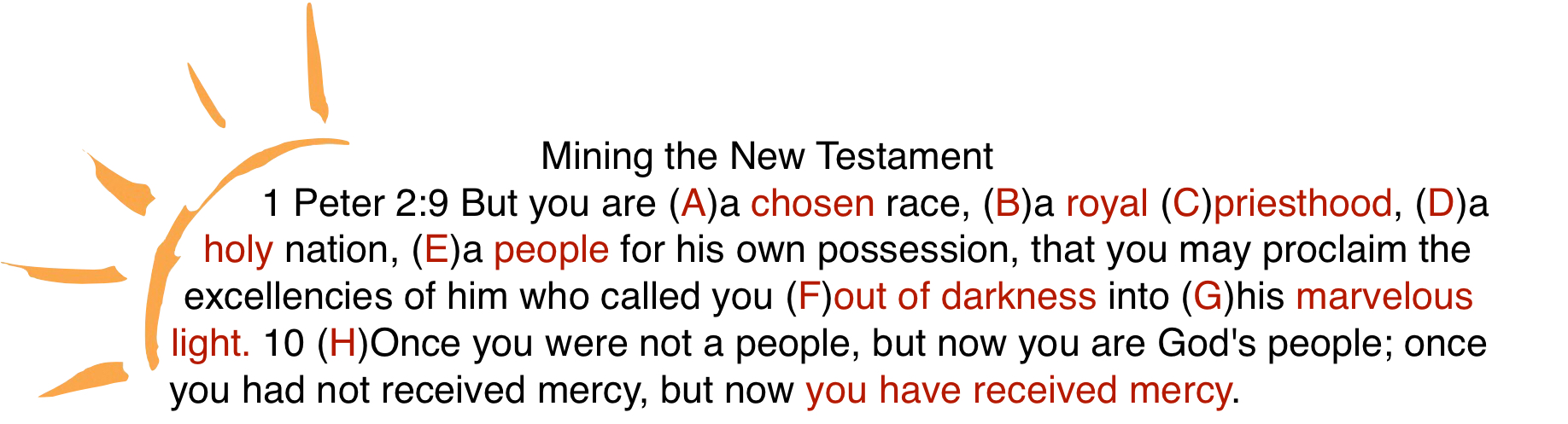
Two little verses in 1 Peter have become the treasure map
to a gold mine. I feel like a prospector from bygone days having
to dig and sift to find treasure. And now I’m asking you to do the same. Here are my special tips for finding gold for yourself today. First read
1 Peter noting the [lettered] WORDS that are about to become your map.  Now comes the mining part: Follow the map, reading just the Scriptures associated with those RED WORDS — in sequence. I promise you there is no “fools” gold here but nuggets you might have missed without following the MAP OF WORDS from the New Testament that turns them into the guide that walks you through the gold mine of the Old Testament.  It will take some time
but they promise to become the gold of your personal treasure.

Discovering Treasure in the Old Testament
CHOSEN [A] Yet the Lord set his heart in love on your fathers and chose their offspring after them, you above all peoples, as you are this day. Deuteronomy 10:15
ROYAL [B]…and you shall be to me a kingdom of priests and a holy nation. These are the words that you shall speak…Exodus 19:6
PRIESTHOOD [C]…you shall be called the priests of the Lord; they shall speak of you as the ministers of our God; Isaiah 61:6
HOLY [D] For you are a people holy to the Lord your God. The Lord your God has chosen you to be a people for his treasured possession, out of all the peoples who are on the face of the earth. Deuteronomy 7:6
PEOPLE [E] Now therefore, if you will indeed obey my voice and keep my covenant, you shall be my treasured possession among all peoples, for all the earth is mine; Exodus 19:5
OUT OF DARKNESS [F] And I will lead the blind in a way that they do not know, in paths that they have not known I will guide them.  I will turn the darkness before them into light, the rough places into level ground. These are the things I do, and I do not forsake them. Isaiah 42:16
INTO MARVELOUS LIGHT [G] For with you is the fountain of life; in your light do we see light. Psalm 36:9
HAVE RECEIVED MERCY [H]…the number of the children of Israel shall be like the sand of the sea, which cannot be measured or numbered. And in the place where it was said to them, “You are not my people,” it shall be said to them, “Children of the living God.” Hosea 1:10

Don’t Miss the Details

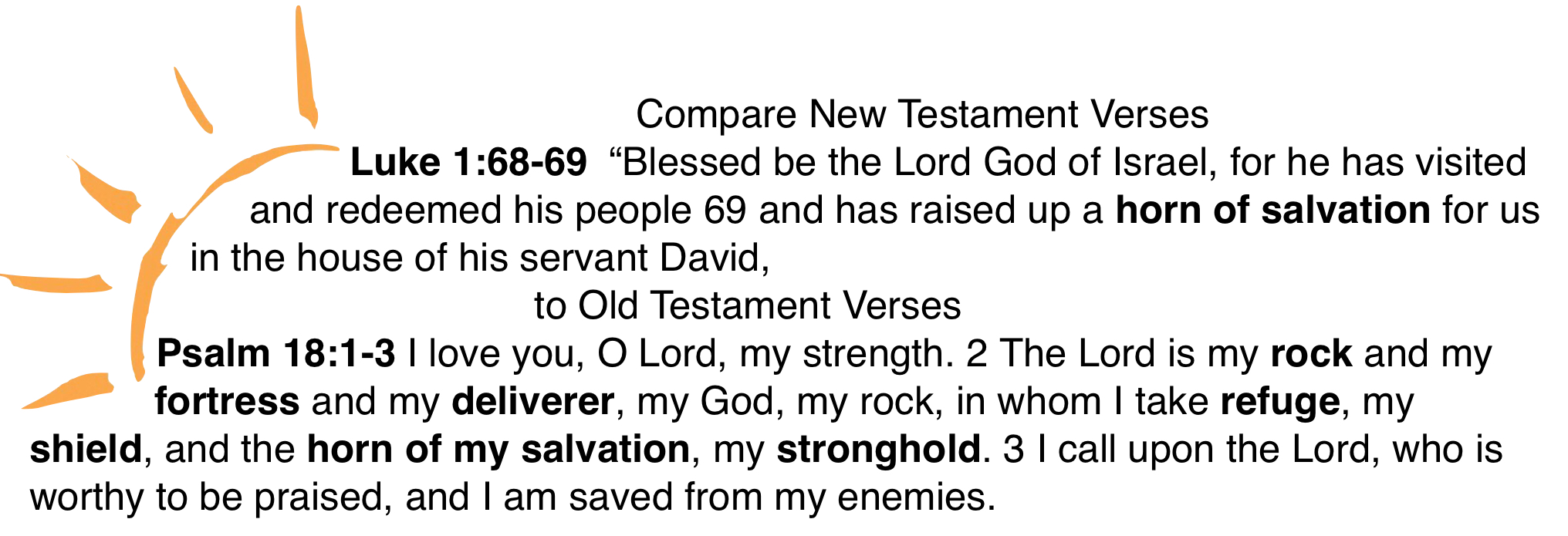
This is a perfect example of the premise of letting one Testament read you the other.  Jesus talks in John 16:25 about using “figures of speech.”  The “horn of salvation” is like that.  I have read it, I know it’s Jesus, I have no reason to disagree. It’s a “figure of speech” I can easily skip over except this exercise has caused me to see a tiny little letter that directs my attention to Psalm 18 and I find details of worship for that moment I would have otherwise missed.

I love you, Jesus, my strength. You are my rock and my fortress and my deliverer the rock, in whom I take refuge, my shield AND “the reality of my salvation,” my stronghold.  Amen.

Three in One

to Old Testament Verses
Genesis 1:26-28 Then God said, “Let us make man in our image, after our likeness. And let them have dominion over the fish of the sea and over the birds of the heavens and over the livestock and over all the earth and over every creeping thing that creeps on the earth.”  So God created man in his own image, in the image of God he created him; male and female he created them.  And God blessed them. And God said to them,“Be fruitful and multiply and fill the earth and subdue it, and have dominion over the fish of the sea and over the birds of the heavens and over every living thing that moves on the earth
Psalm 110:1 The Lord says to my Lord:..

I love that God has a history of talking to Himself!  And I love that these Old Testament verses use plural pronouns to confirm the reality that God exists in the mysterious wonder of three identities for the purpose of identifying Himself to the them that includes me.  As believers in Christ we know those three identities are a)the creator God, b)the Son Jesus and c) the Holy Spirit, the witness — but why Three?   I wonder if there’s more to that conversation God was having with Himself?  I wonder if knowing about His self-talk and that we’re created in His image means I need to pay more attention to my self-talk as a follower of Jesus because self-talk may be God’s way of speaking to me.  It does say “God said to them.”

Self-talk is an inner voice that combines our thoughts, beliefs and feelings to influence our response to life.  Sometimes it’s way below the radar of consciousness but that’s why that mysterious three are so important. The one who at creation knew He would speak life into you just as He did for Adam, at just the right time. The one who walked on earth to be the guide for your steps through the twists and turns of daily life, and the one who came after, to be the internal helper that could keep track of those steps long before anyone else even thought of step tracking.  They are the same Three in One having an important conversation with each other about your life and their intended purpose for it that spans creation to eternity.  Listen carefully, and practice their Words as part of your own self-talk.

Remember Now!


Cited from the ESV
— Isaiah 49:8 Thus says the Lord: “In a time of favor I have answered you; in a day of salvation I have helped you; I will keep you and give you as a covenant to the people, to establish the land, to apportion the desolate heritages
— Isaiah 55:6 “Seek the Lord while he may be found; call upon him while he is near;
— Psalm 32:6 Therefore let everyone who is godly offer prayer to you at a time when you may be found; surely in the rush of great waters, they shall not reach him.
— Psalm 69:13 But as for me, my prayer is to you, O Lord.  At an acceptable time, O God, in the abundance of your steadfast love answer me in your saving faithfulness.

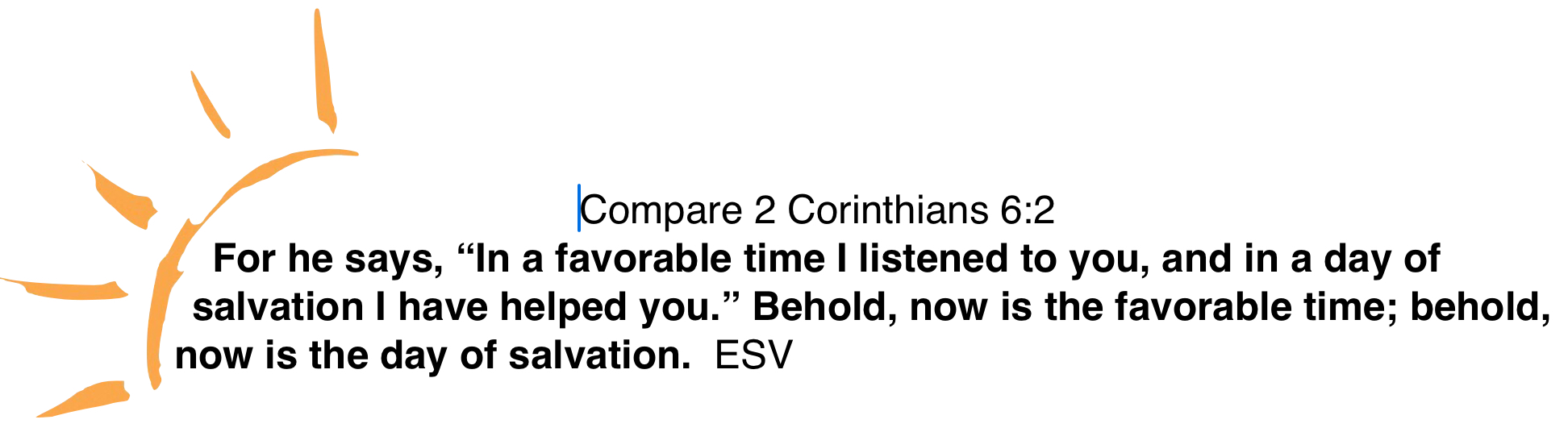
Look at 2 Corinthians 6:2 and ask these valid questions. When is the “favorable time?”  Is it when God listens…or when you speak to Him?  Are you aware that God is saving you right now?  Can we expand the comfortable little box for that word “salvation” from one and done for eternity to a continuous stream of activity for life?  When we became a follower of Jesus Christ there was a spiritual sigh of relief because God saved us to Himself for all eternity. God has affirmed Himself in these scriptures with words like “I have” and “I will.” They have secured the past and the future but that “a” has become the big idea that God is continuously saving in the “present”  There was “a day of salvation” but that was then.  This is now.

Isn’t the reality of “seek the Lord while he may be found” necessary now?  “Now” is the day we need to be saved from drowning in the unexpected flood of circumstances of daily life.  The Lord reminds us of His past faithfulness in our past encounters with Him. I have listened to your prayers, I have answered, I have helped and saved you — remember how you found me then?  It was a favorable and acceptable time between us.  Don’t miss the reality that those memories of “found” time with me are the time you knew I was near.  Those times are past, the present is now.   Now I will keep you just as I did before — I remember, do you?  Now is the time I set for “everyone who is godly [to] offer prayer. “O God, in the abundance of your steadfast love answer me in your saving faithfulness…Behold, now is the favorable time — behold now is the day of salvation.”

The Bread of Life

But you, O Bethlehem Ephrathah, are only a small village among all the people of Judah.  Yet a ruler of Israel will come from you, one whose origins are from the distant past. Micah 5:2   

ethlehem means the “House of Bread” in both Hebrew and Aramaic and thanks be to God, because Mary and Joseph’s hearts were obedient in the less-desirable details of life, Jesus began His earthly life born in the House of Bread just as Micah had forecast in “the distant past.”  I hadn’t purposely planned to be baking bread today because of this post but as it turns out I’m sitting here at the table waiting for my batch of dough to rise.  I’m watching it climb up the side of the clear dough-mixing bucket and enjoying the yeast’s aroma as I write.  It’s satisfying, but it’s the bread I’m really waiting for.  This simple choice to make bread today seems too relevant to this Advent post to be anything other than a homemade picture of God’s recipe. His recipe had the right ingredients, the right place, the right timing and the right baby to reveal His own identity as the Bread of Life the world was really waiting for.  God’s own recipe would satisfy the “aroma” of the prophet’s word and Jesus, the Bread of Life, would rise up and save many souls.  ‘Taste and see that the LORD is good. Oh, the joys of those who take refuge in him!”  Psalm 34:8 NLT  PS: Today’s bread turned out good too.

Sunday with John + Escape

John 10:31 The Jews picked up stones again to stone him. 32 Jesus answered them, “I have shown you many good works from the Father; for which of them are you going to stone me?” 33 The Jews answered him, “It is not for a good work that we are going to stone you but for blasphemy, because you, being a man, make ourself God.” 34 Jesus answered them, “Is it not written in your Law, ‘I said, you are gods’? [Psalm 82:6] 35 If he called them gods to whom the word of God came—and Scripture cannot be broken— 36 do you say of him whom the Father consecrated and sent into the world, ‘You are blaspheming,’ because I said, ‘I am the Son of God’? 37 If I am not doing the works of my Father, then do not believe me; 38 but if I do them, even though you do not believe me, believe the works, that you may know and understand that the Father is in me and I am in the Father.” 39 Again they sought to arrest him, but he escaped from their hands. 40 He went away again across the Jordan to the place where John had been baptizing at first, and there he remained. 41 And many came to him. And they said, “John did no sign, but everything that John said about this man was true.” 42 And many believed in him there. ESV

What is the general theme of the passage?
Jesus is threatened but once again he’s “escaped” the sure death they wish for Him.  “How did that happen?” was the first question I had. The second question was “is Psalms part of the “law?”  This passage seems like a perfect example of God making His point about about the power of Scripture.  Inspired old Words have the same power today, as they did then, to demand thoughtful pauses.  Jesus “escaped” by using His knowledge of the old Words of Psalm 82:6 to effectively push pause in the minds of those Pharisees long enough to get away from them.  He gives them their own law to point out they are accusing Him of the very thing God has declared about them [I said, “You are gods, sons of the Most High, all of you].  Then…“He escaped…He went away again across the Jordan…there He remained…many came to Him…and many believed in Him…”

What does it say about God (or Jesus or the Holy Spirit?)
“I have shown you many good works from the Father…” Jesus is confident the basis of His works and His words are from His Father. 

What does it say about people?
From Spurgeon’s Treasury of David: When the dispensers of law have dispensed with justice, settlements are unsettled, society is unhinged, the whole fabric of the nation is shaken.

Is there truth here for me?
Sometimes I find my judgements fall so short of justice that I am unsettled by my own harshness. I realize how easy it is for me to use the Word of God to confirm my judgement instead of pausing to let the God of Mercy confirm His truth that has allowed me to escape sure death.