Category Archives: Sunday

Psalm 119:145-152 ק Qoph Axe, Back of Head

Psalm 119 – Qoph Axe, Back of Head,
145 I call with all my heart; answer me, Lord, and I will obey your decrees.
146 I call out to you; save me and I will keep your statutes.
147 I rise before dawn and cry for help; I have put my hope in your word.
148 My eyes stay open through the watches of the night, that I may meditate on your promises.
149 Hear my voice in accordance with your love; preserve my life, Lord, according to your laws.
150 Those who devise wicked schemes are near, but they are far from your law.
151 Yet you are near, Lord, and all your commands are true.
152 Long ago I learned from your statutes that you established them to last forever.

Right >§§§> Left

Lord, I will obey your decrees; answer me; I call with all my heart.  I will keep your statutes, I call out to you, save me.  I have put my hope in your word; I rise before dawn and cry for help.  Through the watches of the night my eyes stay open that I may meditate on your promises.  Preserve my life, Lord, according to your laws; hear my voice in accordance with your love.  Your law is far from those who devise wicked schemes near me.  All your commands are yet true, Lord, you are near.  You established your statutes to last forever, long ago I learned from them.

–––∞∞∞–––

I write what I “think I know,” because I want God to “know I think.” More importantly I believe God knows what I need to know, and He wants me to know it too.  I wonder if that’s the process of discernment?

I’m guessing seeing beyond what he thinks he knows is why the Psalmist writes too. Maybe that’s the secret of his obscure title Ooph – axe, back of head. The “back of the head” according to a Google search about anatomy is the “occipital lobe that controls sight.  What the Psalmist “sees” are his life experiences but he knows there is a greater truth that can cut away the debris of life and reveal a much greater reality.  The decrees, statutes and promises are the “axe” that can open his mind beyond what he thinks he knows, so he can see their truth; God wants him to know that His love preserves life.  “All your commands are yet true, Lord, you are near.”a

a  Rewrite of September, 2016
Psalm 119:121-128 ע Ayin – Eye

Psalm 119
121 I have done what is righteous and just; do not leave me to my oppressors.
122 Ensure your servant’s well-being; do not let the arrogant oppress me.
123 My eyes fail, looking for your salvation, looking for your righteous promise.
124 Deal with your servant according to your love and teach me your decrees.
125 I am your servant; give me discernment that I may understand your statutes.
126 It is time for you to act, Lord; your law is being broken.
127 Because I love your commands more than gold, more than pure gold,
128 and because I consider all your precepts right, I hate every wrong path.

Right >§§§> Left

Do not leave me to my oppressors; I have done what is righteous and just. Do not let the arrogant oppress me; ensure your servant’s well-being.  Looking for your righteous promise my eyes fail, looking for your salvation. According to your love, teach me your decrees, deal with your servant.  Give me discernment that I may understand your statutes; I am your servant.  Your law is being broken; it is time for you to act, Lord. More than gold, more than pure gold, I love your commands and I hate every wrong path because I consider all your precepts right.

–––∞∞∞–––

Praying is hard.  Emotions are involved and sometimes they actually become a barrier to praying at all.  Who wants to admit they think the key to God’s behavior might be getting the wording just right to assure Him of your trust at the same time you’re trying to keep any negative thoughts from Him?  That’s the opposite of what the Psalmist’s prayers and this section of Psalm 119 show us.  His no-holds-barred method of praying is right there for us to see.   He’s learned something about true humility; God does not see the Psalmist’s words or emotions as good or bad.  His prayers are his true heart given to God whether they’re words of harsh desperation or high praise.  God has given the Psalmist the courage to reveal everything in his heart to the God whose “eye” is always on him anyway.  ע Ayin is right there for us to “see” too.

At first glance the word “humble” wouldn’t be how I’d describe the prayers of this Psalmist king.  He’s as straightforward with his bold demands of God as he is with his praise.  He adds no timid phrases like “thy will be done” to soften what he asks.  His prayers combine his own desperate physical and emotional needs along with his fervent praise of the God who continues to be his teacher.  God has given the Psalmist the assurance of true humility that recognizes nothing he says can remove God from his heart OR remove his heart from God’s own.

That is the kind of prayer I want to learn.  

Psalm 119:105-112 נ Nun – Fish, Longevity

Psalm 119 Nun – Fish, Longevity
105 Your word is a lamp for my feet, a light on my path.
106 I have taken an oath and confirmed it, that I will follow your righteous laws.
107 I have suffered much; preserve my life, Lord, according to your word.
108 Accept, Lord, the willing praise of my mouth, and teach me your laws.
109 Though I constantly take my life in my hands, I will not forget your law.
110 The wicked have set a snare for me, but I have not strayed from your precepts.
111 Your statutes are my heritage forever; they are the joy of my heart.
112 My heart is set on keeping your decrees to the very end.

 Right >§§§> Left

The light on my path for my feet is the lamp of your word.  I will follow your righteous laws. I have taken an oath and confirmed that.  Preserve my life, Lord, is according to your word.  I have suffered much.  Teach me your laws and accept the willing praise of my mouth.  I will not forget your law though I constantly take my life in my hands.  I have not strayed from your precepts but the wicked have set a snare for me.  The joy of my heart and my heritage forever are your statutes.  My heart is set on keeping your decrees to the very end.

—∞∞∞—

For some time now I’ve been separating the Scripture from my own writing using a typographical sign of the fish [ >§§§> ] so  the meaning of “Nun” didn’t seem unusual.  It’s a familiar image many Christians use to associate themselves with Jesus.  The surprise was to find it hidden here in Psalm 119. 

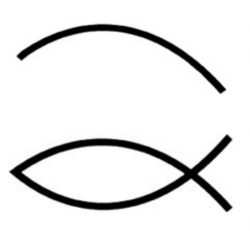
 The fish symbol was a common pagan symbol long before it was chosen as an identifying mark for Christians. Early believers in Jesus Christ chose the
“fish” because it was a sign that would attract less attention than, say the sign of the cross might, because people were familiar with seeing it.  It became a way to safely identify themselves to one another.  The story is told that when strangers met, the Christian could draw a simple arc in the sand with his toe and wait for the other to respond.  If the other was a Christian, he would respond by drawing the lower arc to form the outline of a fish.  

The “fish” is the surprise set-up for these devotional thoughts.  Did God reveal
נ Nun to the Psalmist king as a mark of a greater KING, yet to come, or was it just a poetic accident?  Was that secret little Hebrew heading written as a familiar signal for generations in the future to respond to, and reveal their own identity? 

This Psalmist king knew the law of God.  He knew it made the path he wanted to follow visible to him.  He knew seeing that path was one thing, but deciding to walk it demanded a way to identify truth and people he could trust.  He knew the writings of the prophets.  He knew life was his training ground with a divine purpose; intimacy with God.  I think he knew the significance of נ Nun – Fish was longevity, that his identity with God would last into our future too.

The Psalmist king has become known throughout history as a “man after God’s own heart.”  He knew his own identity was as sketchy and unreliable as any other human being except for his awareness that God’s truth [aka, the law] had saved and changed him.  The Psalmist knew he could trust God to be just and fair even when his own behavior and words were not.   Long before Jesus fulfilled the law, the Psalmist identified himself completely with the fullness of God revealed in His law, it’s precepts and statutes.  The value that has been ascribed to his heart was that he gave the fullness of it to God without reservation; the very best parts as well as well as the very worst parts.   That was the identification mark the Psalmist king made face to face with God trusting it would be recognized and God’s response would be to complete His identity with him.  >§§§>

Psalm 119:89-96 ל Lamedh – to learn, to teach

Psalm 119
89 Your word, Lord, is eternal; it stands firm in the heavens.
90 Your faithfulness continues through all generations; you established the earth, and it endures.
91 Your laws endure to this day, for all things serve you.
92 If your law had not been my delight, I would have perished in my affliction.
93 I will never forget your precepts, for by them you have preserved my life.
94 Save me, for I am yours; I have sought out your precepts.
95 The wicked are waiting to destroy me, but I will ponder your statutes.
96 To all perfection I see a limit, but your commands are boundless.  [NIV]

>§§§>

Learning how to be taught today from left to right:
“In the heavens Lord, your word stands firm and is eternal.  You established the earth and it endures.  Your faithfulness continues through all generations.  All things serve you for your laws endure to this day.  I would have perished in my affliction if your law had not been my delight.  You have preserved my life by them and I will never forget your precepts.  I have sought out you precepts; save me for I am yours.  I will ponder your statutes but the wicked are waiting to destroy me. Your commands are boundless but to all perfection I see a limit.”

∞∞∞

My challenge is trying to read and write about this section of Psalm 119 with fresh thinking.  The Psalmist has focused his belief on the faithfulness of God enduring despite the risk of his own circumstances.  Several things were clear to him.  Endurance came packaged with correction and learning.  His own endurance was dependent on God’s boundless laws, precepts and statutes even when faced with dramatic events that called into question his own security.  The final clarity of truth the Psalmist’s grappled with, were his words that the Lord’s “commands are boundless, but to all perfection I see a limit.”

The circumstances we have seen with our own eyes this last week in the Capital of the United States have shown us how much we need to read and ponder these words of the Psalmist in a contemporary way.  His clarity must become ours.  As limited as perfection may be it never looks like an angry mob causing chaos, destruction and death.  Lamedh is the powerful reminder the Psalmist has given us this week; every person of faith must deliberately make the choice every day to let God’s boundless laws, precepts and statutes teach them to be willing to learn.

Psalm 119:73-80 י Yodh – Hand [Bent]

Psalm 119 [NIV]
73 Give me understanding to learn your commands and how your hands made me and formed me
74 I have put my hope in your word so those who fear you can rejoice when they see me
75 You have afflicted me in faithfulness I know Lord and your laws are righteous
76 According to your promise to your servant, may your unfailing love be my comfort.

77 Your law is my delight that I may live and your compassion come to me
78 I will meditate on your precepts, may the arrogant be put to shame for wronging me without cause
79 May those who fear you turn to me, those who understand your statutes.
80 May I wholeheartedly follow your decrees, that I may not be put to shame.   

>§§§>

The mention of hands  in v73 was distracting in terms of that small Hebrew subtitle, “Bent.”  Reading each individual section of Psalm 119 backwards and rewriting them without changing their intent [I hope] has made them seem more like a personal prayer to me.  The last two verses today couldn’t possibly have been any more personal so I haven’t changed them.  I hope they’ll be your personal prayer too.

My first thoughts about “bent” evoked the imagery of the gently bent hand of God reaching toward us.   I don’t think that’s what the Psalmist had in mind, as true and welcoming as that is.  “Bent” is something more than a description of the physical hand of God.  Instead I believe the Psalmist has discovered “Bent” is God’s purpose for His laws, precepts, statutes, decrees and commands.   God’s promise was to change His servant’s natural “bent,”* so his inclination would be the determination to do or have all that God was offering him: hope, faithfulness, unfailing love, comfort and compassion.

*Bent: determined to do or have or a natural talent or inclination

Psalm 119: 57-64 Heth – Hedge, Fence, Surround

Psalm 119: 57-64 ח Heth – Hedge, Fence, Surround
57 You are my portion, Lord; I have promised to obey your words.
58 I have sought your face with all my heart; be gracious to me according to your promise.
59 I have considered my ways and have turned my steps to your statutes.
60 I will hasten and not delay to obey your commands.
61 Though the wicked bind me with ropes, I will not forget your law.
62 At midnight I rise to give you thanks for your righteous laws.
63 I am a friend to all who fear you, to all who follow your precepts.
64 The earth is filled with your love, Lord; teach me your decrees. NIV

>§§§>

The “I” statements are so striking in these verses they have preempted my forwards/backwards plan as the last days of 2020 unroll.  Heth is part of the wisdom revealed to us again in Christmas, 2020.  Jesus was God Himself, offered to the world to be the true Hedge, Fence, Surround between the vulnerabilities of life and our confidence in the unknown days of 2021 yet to come.

“We have a shelter, we have our defense and now we have a hedge, fence or a surround. Heth is a boundary; “a point or limit that indicates where two things become different. ” Look at the Psalmist, the hero of the song. His theme [in all his Psalms] regularly shifts from complete confidence in his knowledge of God to the awareness, and sometimes even fear, of how vulnerable he is.

God has set himself as the boundary line between those shifts of confidence and vulnerability. It’s that point of Heth from which the Psalmist speaks; “I have promised…I have sought…I have considered…I will hasten,,,I will not forget…I rise to give you thanks…The earth is filled with your love, Lord; teach me your decrees.”a

a 8/16/2016

A Wake Up Call to Wonder – Luke 2:8-12

Luke 2:8 And there were in the same country shepherds abiding in the field, keeping watch over their flock by night.  9 And, lo, the angel of the Lord came upon them, and the glory of the Lord shone round about them: and they were sore afraid.  10 And the angel said unto them, Fear not: for, behold, I bring you good tidings of great joy, which shall be to all people.  11 For unto you is born this day in the city of David a Savior, which is Christ the Lord.  12 And this shall be a sign unto you; Ye shall find the babe wrapped in swaddling clothes, lying in a manger.

🎄>§§§>🎄

As I read this passage from Luke I couldn’t help but compare that first Christmas to today.  “Normal” Christmas is filled with a lot of beautiful imagery that fills my head.  Today as I reread the actual circumstances of that night, I’ve been reminded this is not a “normal” year and Advent this year is not just a preparation, it’s a wake-up call to “Wonder.”  Centuries of hindsight have eclipsed the realities of that night in the middle of nowhere when the Glory of the Lord lit up the sky for a very frightened group of shepherds.  Their story has become a window for us to see that while God chose to send them His promise  in a frightening blaze of holiness, they responded to the wonder of God in an ordinary way despite their fear and the harsh realities of their circumstances.  That is what has given them their special place in our history.  

The story of the birth of “a Savior, which is Christ the Lord” triggers beautiful romantic images for me of a newborn baby with a halo of light about His head.   I hear the romance of my own history in the angel’s words “Fear not: for, behold, I bring you good tidings of great joy, which shall be to all people.”  The circumstances of Advent in the Year of our Lord, 2020 have reminded me God chose to fulfill the dramatic promise from the angel in what appeared to be a far more ordinary way.   “And this shall be a sign unto you; Ye shall find the babe wrapped in swaddling clothes, lying in a manger.”  That still matters.

There’s an old story of a European ruler who would sneak away and walk among his people incognito.  It drove his security people nuts but his response was “I cannot rule my people unless I know how they live.”   The reality of the ordinary birth of Jesus Christ is that God found a way to walk among His people “incognito.”  Christmas began with what appeared to be an ordinary baby…wrapped in ordinary swaddling clothes…from ordinary parents…in an ordinary stable…for ordinary people.

God has triumphed through the ordinary record of Luke’s story to remind me He will redeem Christmas again this year.  During these last few days of Advent, despite the harsh realities of darkness, pain and loss, the Wonder of God can still appear in the reality of the ordinary and encourage us to respond.  “And this shall be a sign unto you…”

• Ordinary Christmas lights twinkling everywhere as a visible reminder “the glory of the Lord shone round about them.”
• The ordinary music of Christmas audibly breaking through the noise of life with different angelic words that remind us to respond “For unto you is born this day in the city of David a Savior, which is Christ the Lord.”
• The ordinary seasonal 
“Merry Christmas” greeting taking on new meaning this year as a way for us to remind each other to “Fear not,” God is with us.
• Ah, and those bell-ringers with red kettles are surely angels of God that remind us that He will turn what appears to be an ordinary gift into into “good tidings of great joy, which shall be to all people.”

Likeness

Romans 8:3 For what the Law could not do, weak as it was through the flesh, God did: sending His own Son in the likeness of sinful flesh and as an offering for sin, He condemned sin in the flesh, 4 so that the requirement of the Law might be fulfilled in us, who do not walk according to the flesh but according to the Spirit. 5 For those who are according to the flesh set their minds on the things of the flesh, but those who are according to the Spirit, the things of the Spirit. NASB

>§§§>

This week an interesting discussion about the word “likeness” became the catalyst for fresh look at Romans 8 and part of a previous Advent post from 2015.  We all know what the “Law could not do.”  It couldn’t change us and even those first two people couldn’t manage to obey it.

“What a surprise to find myself in my favorite chapter from the whole Bible for my Advent reading today.  If you remove the “religiousity” factor of laws you have to admit we can’t live without them.  We need laws to create order and some level of security in our society.  I’ll bet I’m not the only one that’s broken some of them: ever rolled through a stop sign?  That’s an easier-to-swallow version of “weak as it was through the flesh” to own up to.  Now that our minds are in the right place maybe we can face the issue of “sinful flesh”…and “in us.”a   

Eden was where “weak as it was through the flesh” became a reality.  There was only one law but the bad choice to violate it was where the separation between man and God began.  [BTW that’s not unlike that stop sign.]  The amazing truth of Advent is God chose new birth to fulfill something that one “first” law was unable to accomplish.  

Advent is pretty dramatic evidence of the second time God created perfection for all mankind to experience.  The birth of Jesus revealed God’s determination to redeem and replace what had been lost in Eden.  This time perfection was a person, not a place.  That first Advent God chose a baby, His Son…God with us…Jesus, to restore His own “Image” within “the likeness of sinful flesh and as an offering for sin.”  Advent is our annual reminder that Jesus is the reality of God’s promise to unite the likeness of our sinful flesh with His own Image “in us.”

a Click here to read that original post

God Was THERE!

Ephesians 5:8 For you were once darkness, but now you are light in the Lord. Live as children of light 9 (for the fruit of the light consists in all goodness, righteousness and truth) 10 and find out what pleases the Lord. [NIV]

>§§§>

I’ve mentioned before that words spark thought for me.  Today was an interesting variation on that.  I read verse eight several times before I realized I’d been subconsciously adding the word [IN] before the word “darkness.” Dropping the [IN] and reading “you were once darkness” changed my whole perspective on what I’d read.  It has reminded me this Word is not only timeless but it’s still alive and well. Darkness is not a place I was “IN”  but the far more ugly reality of “what I was.”  It says it right there but I missed it.

I re-read those verses thankful for the specific words of hope I found there, words like “now you are light in the Lord” and “the fruit of the light.”  The emphasis on “WHAT I was” [darkness] has now been dramatically changed because of God’s intervention through Jesus in my life to “what I WAS [past tense].  “Once darkness” was changed to “the fruit of the light” and that is the joyful connection to Advent I share with you in December, 2020.

That first “Advent” in Bethlehem was God’s intervention in the world He’d created.  His choice was to make Himself visible once more to redeem His people and free them from their dependence on their own best efforts to dispel the darkness that plagued their lives.  Jesus was born to reveal God’s promise to ordinary people who were “once darkness.”  The “Advent of Light” could forever change their emphasis from knowing “there was GOD” [hope] into the new reality that “God was THERE!”

O Come, O Come, Emmanuel

Birth of Faith

Isaiah 7:14 Therefore the Lord himself will give you a sign: The virgin will conceive and give birth to a son, and will call him Immanuel.


Every year during December we see the signs of Christmas around us, wreathes, trees, lights and baubles. Advent encourages us to watch for another kind of sign.  A sign from the Lord himself that leads us to the cradle again this year to give our own witness to the birth of Christ.  Information is one gift the Bible has given us.  It paints a vivid picture of the perfect and glorious outcome of that journey of the pregnant virgin and that carpenter to that first cradle and the finally the Birth of Faith, Jesus. That’s what I give thanks for but I believe I may have overlooked another reality to be thankful for.  It’s the reality of their tough circumstances and simple obedience that ultimately led to another kind of birth, the birth of my faith.  This year I want to imagine and give thanks for their long, hard days on dusty roads and the fatigue, discomfort and inconvenience of travel.  I want to appreciate the reality of the relief and gratitude they felt sinking into a pile of smelly straw in a barn at the end of their journey.  It was not a perfect situation but they would become part of a perfect plan.  I want to be grateful for that too.  That pregnant virgin and that carpenter have walked through the words of the prophets, through history, into Bethlehem and now into my life this year to become the Lord’s sign for me of the reality that the Birth of Faith can happen in the most unusual places and circumstances.

Originally posted November 30, 2015