Category Archives: Wednesday

Comforter, Counselor, Rescuer

John 20
19 On the evening of that first day of the week, when the disciples were together, with the doors locked for fear of the Jewish leaders, Jesus came and stood among them and said, “Peace be with you!”
20 After he said this, he showed them his hands and side. The disciples were overjoyed when they saw the Lord.
21 Again Jesus said, “Peace be with you! As the Father has sent me, I am sending you.”
22 And with that he breathed on them and said, “Receive the Holy Spirit 

Who came to mind when you read these three
words chosen for this post?

I’m willing to bet your answer was the same as mine.  It’s Jesus…and that’s absolutely right!  I pondered these verses and those three words and realized Comforter, Counselor and Rescuer are nouns that we all identify as interchangeable with Jesus Himself.  What caught my attention was those same three words can also be used as verbs that describe an action if you just change the ending to “ing.”

I am confident every one of those frightened men would have answered my first question in the same way we did, it’s Jesus!  They certainly recognized Jesus as Comforter, Counselor and Rescuer.  What may seem like subtle shades of difference between a noun and a verb has helped me recognize knowing the identity of Jesus is vital but it’s incomplete without the personal experience of His purpose for our life.

  • Jesus’s identity is Comforter, but His purpose is comforting so we may be comforted
  • Jesus’s identity is Counselor, but His purpose is counseling so we may be taught
  • Jesus’s identity is Rescuer, but His purpose is rescuing so we may be saved

The hope for those men as they hid behind “doors locked for fear of the Jewish leaders” was summed up in one simple phrase; “Jesus came and stood among them…”   Jesus came to verify his identity as Comforter, Counselor and Rescuer AND put His purpose for their lives into action by comforting frightened people with His presence, counseling them with His peace and rescuing them with His Spirit. Thanks be to God, Jesus has become our hope for completeness too.

Cornerstone, Life, Breath

John 20:1 Early on the first day of the week, while it was still dark, Mary Magdalene went to the tomb and saw that the stone had been removed from the entrance.  2 So she came running to Simon, and said, “They have taken the Lord out of the tomb, and we don’t know where they have put him!”


We know Lent is leading us, first to the Tomb, then to the Cross and finally to examine our heart.  It seems like the empty tomb has come too soon in my readings.  I’m still in preparation mode. “The stone” is the thing that has repeatedly caught my attention. In all four Gospel versions the story is about the empty and open tomb with specific mention of the stone and how it was moved.

My Cliff Notes:
– God chose “stone” to write His most important Words on
– Living stones
– Stone: a hard substance that comes from the ground, used for building of carving, used for a particular purpose.

It’s not too big a stretch of faith to associate these two verses and the mystery of that heavy “stone” having been moved.  God’s first choice of material to write the 10 most important things He wanted His people to know was stone.  Jesus is described as the Cornerstone,a and you are described as living stones.  That’s in the Bible too. The wonder of the stone being moved is that once again God used a “Stone” to reveal exactly what He wanted His people to know.  We know, thanks be to God, that it was His Breath of Life that moved Jesus from the tomb to His place in us.  “As you come to him, the living Stone—rejected by humans but chosen by God and precious to him— you also, like living stones, are being built into a spiritual house to be a holy priesthood, offering spiritual sacrifices acceptable to God through Jesus Christ.”

a 1 Peter 2:4-7

Interrupted Preparation

John 19:14 It was the day of Preparation of the Passover; it was about noon.“Here is your king,” Pilate said to the Jews.

>§§§>

“The day of Preparation” has been like a flashing light pushing me to read…and ponder this one verse from John 19.  Did you notice that capital “P”I’ve come to the conclusion what little I understand about timing and calendars and the observance of Passover is related to that phrase. That makes it very important to me.  Jesus has eaten the Passover meal with His friends.  Friday was considered the day of preparation for the Sabbath which began at sundown. This particular Sabbath preparation day has occurred during Passover week.  Preparation for Passover week always includes the complete removal of all leaven from the home and the diet for the entire week’s observance.  It’s a separation of time with a meaningful purpose.

The removal of leaven is a remembrance of the Jew’s misfortune at being driven out of Israel, the intention of the evil against them and a sacrifice of time to interrupt an expected cycle.  FYI: Leavened bread was created by the decay of wheat and water that created yeast-like bubbles of fermentation that could raise the dough and change the texture of the bread.  There is a tipping point in that cycle of fermentation where the dough that has been slightly soured is still edible and must be used, or it will be ruined.  Timing is everything.  During Passover Week, the removal of leaven becomes that separation of time that gives evidence of the desire to remove what is past and look forward to a new beginning. 

That has become my beacon of light from God.  Little did Pilate or the Jewish priests and leaders realize they were participating in “the day of Preparation” God had already planned.  The “Preparation” was Jesus.  He interrupted that preparation at just the right time to give evidence of God’s desire to prevent the expected cycle of ruin and offer Himself as the “Bread of Life.”

Avoid Ceremonial Uncleanness

John 18 NIV
28 Then the Jewish leaders took Jesus from Caiaphas to the palace of the Roman governor. By now it was early morning, and to avoid ceremonial uncleanness they did not enter the palace, because they wanted to be able to eat the Passover. 29 So Pilate came out to them and asked, “What charges are you bringing against this man?” 30 “If he were not a criminal,” they replied, “we would not have handed him over to you.”  31 Pilate said, “Take him yourselves and judge him by your own law.” “But we have no right to execute anyone,” they objected. 

>§§§>

This is the story of a power struggle between legalism and truth.  The thing that shocked me most in this passage was the phrase “to avoid ceremonial uncleanness.” The goal of the Jewish leaders was the execution of Jesus through manipulating the power systems in place, not justice or truth.  The grim reality of their legalism is their shockingly clear response to Pilate’s question – “What charges are you bringing against this man?” – “If he were not a criminal,” they replied, “we would not have handed him over to you.”  Pilate said, “Take him yourselves and judge him by your own law.” “But we have no right to execute anyone,” they objected.”  The proof of their legalism was Pilate could achieve their goal to get rid of Jesus so they could avoid ceremonial uncleanness.   It was their choice to justify hearts that had found a way to work around God’s truth; “Thou shall not kill.”

I admit it, I have rules! The whole purpose of rules is to regulate behavior and exert influence. Neither of those is necessarily bad…until…they replace the truth that life with Jesus is how we are justified, not rules.  Have you even thought about “ceremonial uncleanness” in terms of your own behavior?  I certainly hadn’t, but I know I’m guilty of having used rules to justify my motivations and behaviors.  Legalism is believing rules or personal motivations can help you avoid ceremonial uncleanness. The truth of the Grace of God in Jesus is that the “the life I now lived in the body, I live by faith in the Son of God who loved me and gave Himself for me.”a  

a Part of Galatians 2:20 

Three Little Words – John 18:2

John 18:2 Now Judas, who betrayed him, also knew the place, for Jesus often met there with his disciples. 3 So Judas, having procured a band of soldiers and some officers from the chief priests and the Pharisees, went there with lanterns and torches and weapons. 4 Then Jesus, knowing all that would happen to him, came forward and said to them, “Whom do you seek?” 5 They answered him, “Jesus of Nazareth.” Jesus said to them, “I am he.” Judas, who betrayed him, was standing with them. 6 When Jesus said to them, “I am he,” they drew back and fell to the ground. 7 So he asked them again, “Whom do you seek?” And they said, “Jesus of Nazareth.” 8 Jesus answered, “I told you that I am he…” ESV

>§§§>

Today is the beginning of Lent, Ash Wednesday.  The observance of Lent is considered a time of repentance observed through personal denial.  It’s so easy to see in this passage how Judas’s betrayal has separated him from God. I ask you to consider two things to remember about observing Lent: 1) Betrayal is what separates US from God and 2) repentance requires acknowledging OUR betrayal. 

Jesus has provided us a simple example of three little words with so much power they knocked his betrayers to the ground; “I am he.”  Don’t miss the power of those three little words when recognizing your sins have been a part of that betrayal too.  “I am He” acknowledges the reality that our identity with Jesus is what turns a simple act of personal denial into an act of repentance with the power to change us.

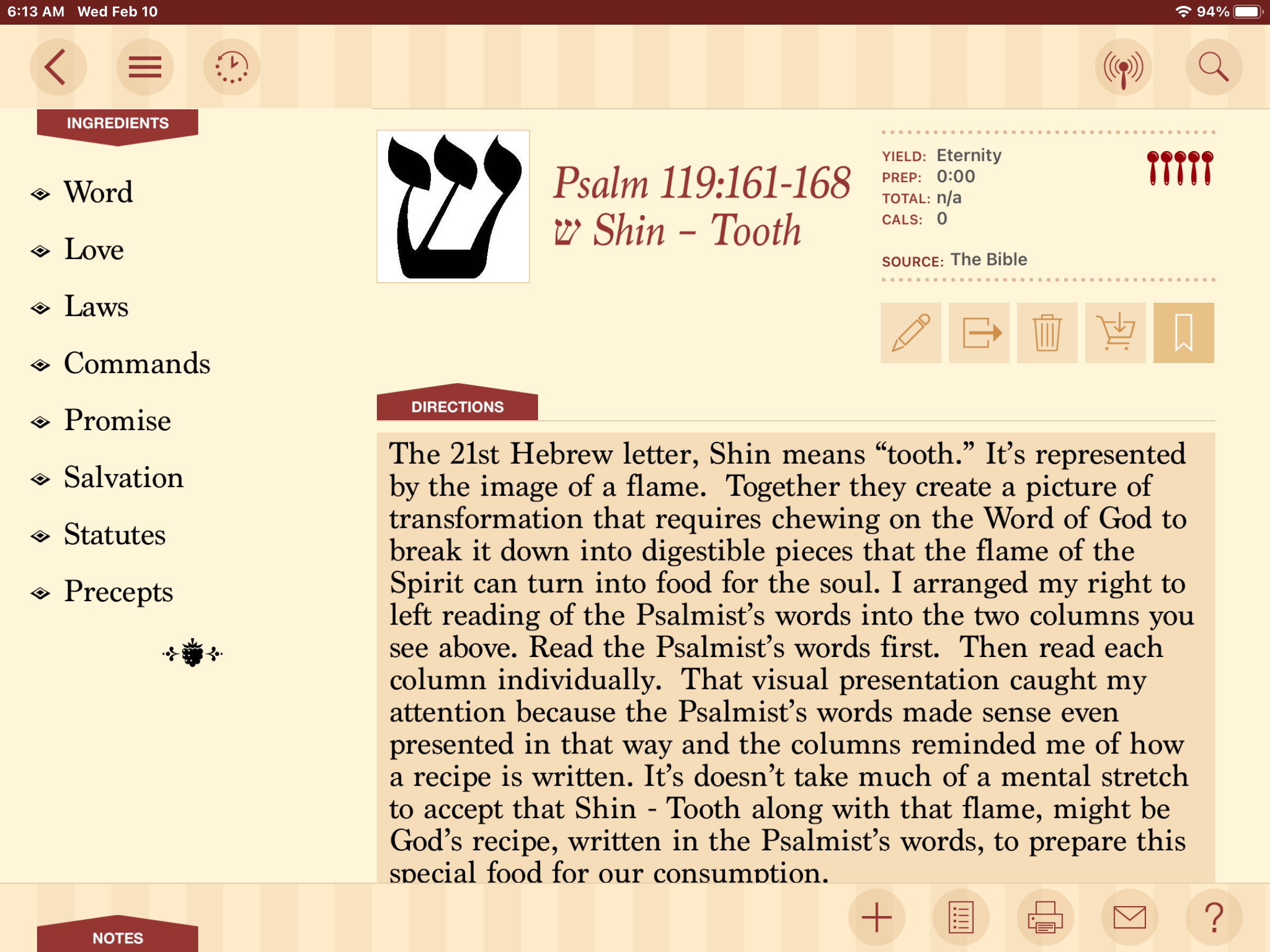
Psalm 119: 161-168 ש Shin – Tooth

Psalm 119
161 Rulers persecute me without cause, but my heart trembles at your word.
162 I rejoice in your promise like one who finds great spoil.
163 I hate and detest falsehood but I love your law.
164 Seven times a day I praise you for your righteous laws.
165 Great peace have those who love your law, and nothing can make them stumble.
166 I wait for your salvation, Lord, and I follow your commands.
167 I obey your statutes, for I love them greatly.
168 I obey your precepts and your statutes, for all my ways are known to you

>§§§> Reading Right to Left but using Columns today

My heart trembles at your word
Like one who finds great spoil
But I love your law
I praise you for your righteous laws
And nothing can make them stumble
I follow your commands
for I love them greatly
for all my ways are known to you

Rulers persecute me without cause but
I rejoice in your promise
I hate and detest falsehood
Seven times a day
Great peace have those who love your law 
And I wait for your salvation, Lord
I obey your statutes
I obey your precepts and your statutes

TAP ON THE IMAGE ABOVE TO EXPAND IT FOR READING

Psalm 119:113-120 Samekh – Prop, Support

Psalm 119
113 I hate double-minded people, but I love your law.
114 You are my refuge and my shield; I have put my hope in your word.
115 Away from me, you evildoers, that I may keep the commands of my God!
116 Sustain me, my God, according to your promise, and I will live; do not let my hopes be dashed.
117 Uphold me, and I will be delivered; I will always have regard for your decrees.
118 You reject all who stray from your decrees, for their delusions come to nothing.
119 All the wicked of the earth you discard like dross; therefore I love your statutes.
120 My flesh trembles in fear of you; I stand in awe of your laws.

Right >§§§> Left

I love your law but I hate double-minded people.  I have put my hope in your word; you are my refuge and my shield.  May the commands of my God keep me away from you evildoers.  According to your promise, I will live; do not let my hopes be dashed.  Sustain me, my God. I will always have regard for your decrees.  Uphold me and I will be delivered.  Their delusions come to nothing.  You reject all who stray from your decrees.  I love your statutes, all the wicked of the earth you discard like dross.  I stand in awe of your laws, my flesh trembles in fear of you.

–––∞∞∞–––

Props and supports are for the crippled.  Sometimes things have been broken so badly only medical traction can help. “Medical traction is the use of a pulling force to treat muscle and skeleton disorders. Traction is usually applied to the arms and legs, the neck, the backbone, or the pelvis. It is used to treat fractures, dislocations, and long-duration muscle spasms, and to prevent or correct deformities.”

This prayer the Psalmist wrote centuries ago sounds way too familiar to the reality of life at this moment doesn’t it?  I’m looking for the “ס Samekh” he’s revealed that can support and prop us up against double-minded people, evildoers, dashed hopes, delusions and the wicked of the earth…today.  Right now our nation is badly crippled by political violence, racial unrest and a pandemic raging around the world.  In one small word, “ס Samekh,” the revelation of God has shown the Psalmist the law is more than a pair of crutches or a wheelchair.  God’s law is spiritual traction for a broken body.  

The Psalmist has told us the love of God’s law is a force that can pull the muscle of the heart back into order.  He’s recorded what God taught him through the law.  God is a refuge and shield that can correct the skeletal disorders of a body fractured, dislocated and having spasms that will surely lead to permanent deformity.  We are a body in need of spiritual traction.

God’s law is the spiritual traction necessary to sustain us and yet we are unable to set it up for ourself.  Jesus is the “promise” of God [v116] and the fulfillment of His law.   He is God’s “ס Samekh” that will provide the spiritual traction God has prescribed for the complete healing of His body in the midst of double-minded people, evildoers, dashed hopes, delusions and the wicked of the earth.  Amen

Psalm 119:81-88 כ Kaph – Bend, Open, Allow, Tame

Psalm 119
81 My soul faints with longing for your salvation, but I have put my hope in your word.
82 My eyes fail, looking for your promise; I say, “When will you comfort me?”
83 Though I am like a wineskin in the smoke, I do not forget your decrees.
84 How long must your servant wait?  When will you punish my persecutors?
85 The arrogant dig pits to trap me, contrary to your law.
86 All your commands are trustworthy; help me, for I am being persecuted without cause.
87 They almost wiped me from the earth, but I have not forsaken your precepts.
88 In your unfailing love preserve my life, that I may obey the statutes of your mouth.  [NIV]

>§§§>

A different plan for reading backwards, writing & praying today:

I have put my hope in your word, my soul faints with longing for your salvation.  When will you comfort me?  My eyes fail looking for your promise.  I do not forget your decrees though I am like a wineskin in the smoke.  When will you punish my persecutors?  How long must your servant wait?  Contrary to your law, the arrogant dig pits to trap me.  I am being persecuted without cause.  Help me.  Your commands are trustworthy.  I have not forsaken your precepts but they almost wiped me from the earth. The statutes of your mouth in your unfailing love, preserve my life that I may obey them. [Amen]

The most intriguing phrase in this part of Psalm 119 was “I am like a wineskin in the smoke.” The wineskin was vital to carrying the wine from place to place in ancient times but eventually it deteriorated as it was exposed to the smoke from fires of life inside a tent. There are many meanings of that phrase, and Kaph, but John Piper gets credit for an idea I thought worth passing on that relates the phrase to Kaph.  Kaph is the open hand of God that can “tame” and “open” the life of one who will “bend” to His will. The wine is the Gospel.  The fragile “wineskin” of life is what God has given us to carry His Gospel from place to place. That opportunity won’t last forever.

Psalm 119:65-72 ט Teth – Serpent, Snake

Psalm 119
65 Do good to your servant according to your word, Lord.
66 Teach me knowledge and good judgment, for I trust your commands.
67 Before I was afflicted I went astray, but now I obey your word.
68 You are good, and what you do is good; teach me your decrees.
69 Though the arrogant have smeared me with lies, I keep your precepts with all my heart.
70 Their hearts are callous and unfeeling, but I delight in your law.
71 It was good for me to be afflicted so that I might learn your decrees
72 The law from your mouth is more precious to me than thousands of pieces of silver and gold.

>§§§>

There is a “before and after” story here in Teth that relates to affliction; where it comes from and how does it relate to a serpent/snake?  Teth is a not-so-subtle reminder of an old “before” story; there really was a serpent hiding in the garden whose purpose was to call into question the absolute truth God had spoken.  Affliction might be the mask of temptation that serpent wears today as he repeats his original question asked long before the Psalmist wrote: “did God really say…?”   

The Psalmist’s words are obviously written to let God know he’s aware there has been a “before and after” in his life.  “Before” I was afflicted I went astray…The “after” is “It was good for me to be afflicted…so that I might learn your decrees…but now I obey your word.”  The Psalmist has shown us the imagery of an “after” we can recognize.  God has built a house [us] and filled it with light [the Word], protected by a strong door [Jesus]and a hedge [the Holy Spirit] around it.  A place where affliction and even the possibility of a serpent hiding in the garden no longer has the power to silence the absolute truth of what God really did say.

Psalm 119:49-56 ז Zayin – Weapon

Today the section title of Psalm 119 is ז Zayin – Weapon.
49 Remember your word to your servant, in which you have made me hope.
50 This is my comfort in my affliction, that your promise gives me life.
51 The insolent utterly deride me, but I do not turn away from your law.
52 When I think of your rules from of old, I take comfort, O Lord.
53 Hot indignation seizes me because of the wicked, who forsake your law
54 Your statutes have been my songs in the house of my sojourning.
55 I remember your name in the night, O Lord, and keep your law.
56 This blessing has fallen to me, that I have kept your precepts. ESV

>§§§>

It’s two days before Christmas and “ז Zayin – Weapon” definitely is NOT where my heart wants to be.  I want Bethlehem, a Holy baby and love, not weapons.  Mankind has provided plenty of weapons for both defense and offense and plenty of desire to use them.  Despite my reaction to it’s title, this section brims with testimony of God actively arming His people with a different kind of “weapons” to protect and defend their minds as well as their eyes and hearts long before the birth of Christ.  My challenge is to a) read and write the verse backwards as I have been doing and b) to look for evidence in them of God’s determined revelation of Himself that we celebrate this Advent, 2020.  

For my own clarification about laws and weapons:
law is the system of rules enforced by the authority with the intention of regulating human behavior for the common good.
statute is a legal document that declares a specific law, expressed in writing.
A precept is a rule dictating a way you should act or behave.

49 You have made me hope as you remind me of your Word.
God has reminded me through the birth of Christ of His own hope for His own creation through His own determination to place Himself in the midst of our world as a way to protect and defend our lives.

50 Your promise comforts my affliction and gives me life. 
Jesus is God’s promise of comfort revealed in human form as a newborn that Luke 2 reminds us “increased in wisdom and in stature and in favor with God and man” to redeem the sins of my afflictions with His love.

52 O Lord, I take comfort when I think of your rules from of old.
I don’t always feel comforted by rules but I do recognize they are a hedge of restraint around me until I come “to my senses.”   Jesus was the “Door” opened to new freedom to “love the Lord your God with all your heart and with all your soul and with all your strength and with all your mind, and your neighbor as yourself.”

53 The wicked who forsake your law cause hot indignation to seize me.
The first Law of God to regulate human behavior is to love Him.  Hot indignation rarely affects the wicked but it’s certainly the fire that can destroy the ability to love. 

54  In this house where I sojourn your statues are my songs.
Our sojourn is the brief span of life we’re given by God for the express purpose learning the words and the music of God’s love song for us, Jesus the Christ.

55 I keep your law O Lord, and remember your name in the night.
I remember that little town of Bethlehem.  I remember the circumstances of life where your answer to regulating human behavior for the common good was revealed in Law of Love, Jesus, born in the likeness of man.

56 I have kept your precepts and this blessing has fallen on me.
I have pledged to let your Law of Love dictate my actions and behavior.  The blessing that has fallen on me this Advent, 2020 is that “God With Us,” is the Law of Love you’ve given to protect and defend my life here and now and forever.