Category Archives: Isaiah

Conditions of the Cure

Acts 2:37 Now when they heard [“this Jesus whom you crucified” 2:36] they were cut to the heart, and said to Peter and the rest of the apostles, “Brothers, what shall we do?” 38 And Peter said to them, “Repent and be baptized every one of you in the name of Jesus Christ for the forgiveness of your sins, and you will receive the gift of the Holy Spirit. 39 For the promise is for you and for your children and for all who are far off, everyone whom the Lord our God calls to himself.” 40 And with many other words he bore witness and continued to exhort them, saying, “Save yourselves from this crooked generation.” ESV

Jesus had said many times that “anyone with ears to hear should listen and understand!”a  And with good reason! God’s truth demands more than a robotic response to powerful words and signs, even His own.  God had spoken that same challenge long before this day through Isaiah 6:10 “Make the heart of this people dull, and their ears heavy, and blind their eyes; lest they see with their eyes, and hear with their ears, and understand with their hearts, and turn and be healed.  God made it clear “this people” was already in His sights.  His challenge was unless “this crooked generation” consciously chose to understand what their ears heard and their eyes saw of His truth it would never lead to their hearts being changed and an unchanged heart would never lead to His promise of healing and “the gift of the Holy Spirit.”  Peter stood before his brothers proclaiming God had satisfied His own challenge.  Now when they heard” him say “this Jesus whom you crucified”…“they heard”…and “they were cut to the heart.”  

This Jesus/God, through His life and resurrection had done everything necessary to cure heavy ears, blind eyes and dull hearts.   Peter’s challenge to them was to “repent and be baptized in the name of Jesus for forgiveness of their sins. God had provided the challenge and the conditions of His promise to remove those barriers and breathe new life into a dull heart with His Holy Spirit so they could “understand with their hearts, and turn and be healed.”  

I have been crucified with Christ. It is no longer I who live, but Christ who lives in me. And the life I now live in the flesh I live by faith in the Son of God, who loved me and gave himself for me.b  And I am sure of this, that he who began a good work in [me] will bring it to completion at the day of Jesus Christ.c

a Matthew 11:15
b Galatians 2:20
c Philippians 1:6 [you]

All the Cost of Discipleship


Luke 14:28-33

28 For which of you, desiring to build a tower, does not first sit down and count the cost, whether he has enough to complete it? 29 Otherwise, when he has laid a foundation and is not able to finish, all who see it begin to mock him, 30 saying, ‘This man began to build and was not able to finish.’ 31 Or what king, going out to encounter another king in war, will not sit down first and deliberate whether he is able with ten thousand to meet him who comes against him with twenty thousand? 32 And if not, while the other is yet a great way off, he sends a delegation and asks for terms of peace. 33 So therefore, any one of you who does not renounce all that he has cannot be my disciple.

The highlighted words of the two small stories inside this parable seemed sensible to me.  The completion of projects, plans, desires, security, prestige and authority often depends on counting the cost and then throwing “all” your resources into making it a success.  What makes the “So therefore” of verse 33  so mysterious is that these Words of Jesus, “renounce all,” don’t seem to fit with the careful planning involved in the two illustrations that precede it.

Jesus did NOT say desiring something or counting the cost of getting it done is unwise or that deliberate and careful planning is a bad way to insure a good outcome that can overcome the odds against you.  In fact He details the negative outcomes of NOT counting the cost; mockery and being captured by an enemy.   “So therefore,” I am compelled to read and ponder what does that “renounce all” mean?  

Turns out I’m not the only one with that question. I read a very good paper by Pastor Tim Kelly[a] and because of his exhaustive referencing I learned Jesus didn’t always require the renouncing of “all” possessions even for His own mother or the disciples.  One helpful thing I learned was the verb that is translated “renounce,” apotassomai, can also mean bid farewell, delegate, appoint for, assign to, set aside or dismiss.  I looked back at that string of associated words I’d picked to consider as part of studying this parable — projects, plans, desires, security, prestige and authority and added [even] faith. It was then  I began to see they did have  connection to the wisdom of what Jesus was teaching His disciples. This parable wasn’t an option — they must “renounce all.”  What He did NOT say turned out to be very important  too.  Jesus was not preaching deprivation but that disciples must acknowledge that “all” things they have are already His to use.  This parable is not about personal deprivation at all but about a different reality for His disciples based on Isaiah 61:1-2.  “The Spirit of the Lord God is upon me, because the Lord has anointed me to bring good news to the poor; he has sent me to bind up the brokenhearted, to proclaim liberty to the captives, and the opening of the prison to those who are bound…”  

The cost that requires disciples to bid farewell, delegate, appoint for, assign to, set aside or dismiss everything as less valuable than Jesus is not deprivation but liberation for His disciples.  That’s “all.”

[a] Read Tim Kelly’s paper

The Sower

Old Testament cross references are added by current evangelical scholars and pastors but they’ve made it possible to see how influential those “old” resources were to the New Testament and to Jesus in particular.  I’m playing the role of “traffic light” today. I’ve copied the NLT cross references to this parable in green and added them in order of their appearance in the text.  You can tap on the link an it will open the reference for you.  Jesus’s familiar words are in red letters.  It’s a fairly new experiment for me to read Old Testament references as the “go-to” truth that backs up the New Testament, then “stop” and ponder how that old evidence is what makes both Testaments of the Bible one “whole.” The whole truth is Jesus spent his life learning the evidence of those old truths and based His simple stories for us on them…wrapped in the mystery of thought.  

The Parable of the Sower:
Luke 8:4 And when a great crowd was gathering and people from town after town came to him, he said in a parable, 5 (Isa 55:10 & Amos 9:13)“A sower went out to sow his seed. And as he sowed, some fell along the path and was trampled underfoot, and the birds of the air devoured it. 6 And some fell on the rock, and as it grew up, it withered away, because it had no moisture. 7 And some fell among (Jer 4:3) thorns, and the thorns grew up with it and choked it. 8 And some fell into good soil and grew and yielded (Gen 26:12)a hundredfold.” As he said these things, he called out, “He who has ears to hear, let him hear.  9 And when his disciples asked him what this parable meant, 10 he said, “To you it has been given to know the secrets of the kingdom of God, but for others they are in parables, so (Isa 6:9 & 10)that ‘seeing they may not see, and hearing they may not understand.’ 11 Now the parable is this: The seed is the word of God. 12 The ones along the path are those who have heard; then the devil comes and takes away the word from their hearts, so that they may not believe and be saved. 13 And the ones on the rock are those who, when they hear the word, receive it (Isa 58:2 & Ezek 33:31)with joy. But these have no root; they (Hos 6:4)believe for a while, and in time of testing fall away. 14 And as for what fell among the thorns, they are those who hear, but as they go on their way they are choked by the cares and riches and pleasures of life, and their fruit does not mature. 15 As for that in the good soil, they are those who, hearing the word, hold it fast in an honest and good heart, and (Hos 14:8)bear fruit with patience.

The Simple Mystery…
The sower has a source that supplies good seeds. Once given those seeds can’t be returned.  They must either produce fruit or they will be wasted.  Ground that may seem useless can be made to produce fruit that fulfills the purpose of those seeds; growth and nourishment.  Sowers can learn to prepare soil for the seeds and when that happens “The time will come,” says the Lord, “when the grain and grapes will grow faster than they can be harvested…” There is one little catch that is the mystery behind the simplicity of this story.  It’s more than the simple repetition of the familiar activity of sowing and reaping that results in the growth that produces blessing. The mystery requires the sower giving conscious and purposeful attention to all the details of the process of preparing the soil to produce an abundant harvest.  The secret of the Kingdom of God is His good seed becomes mature fruit that blesses both the sower and the reaper with more good seed.  “As for that in the good soil, they are those who, hearing the word, hold it fast in an honest and good heart, and bear fruit with patience.

Treasure Hunt

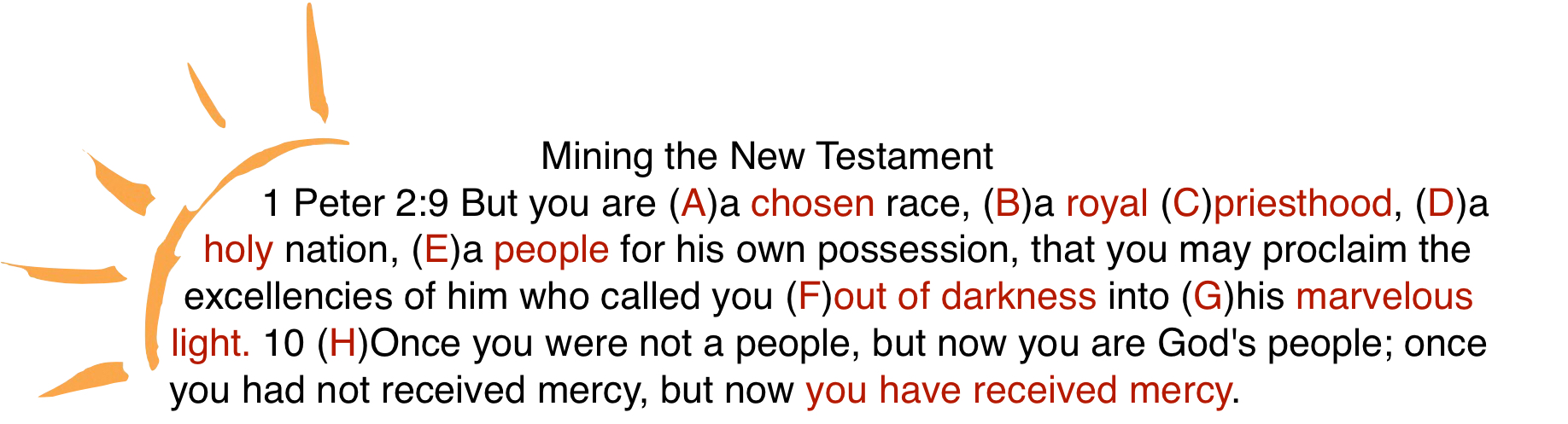
Two little verses in 1 Peter have become the treasure map
to a gold mine. I feel like a prospector from bygone days having
to dig and sift to find treasure. And now I’m asking you to do the same. Here are my special tips for finding gold for yourself today. First read
1 Peter noting the [lettered] WORDS that are about to become your map.  Now comes the mining part: Follow the map, reading just the Scriptures associated with those RED WORDS — in sequence. I promise you there is no “fools” gold here but nuggets you might have missed without following the MAP OF WORDS from the New Testament that turns them into the guide that walks you through the gold mine of the Old Testament.  It will take some time
but they promise to become the gold of your personal treasure.

Discovering Treasure in the Old Testament
CHOSEN [A] Yet the Lord set his heart in love on your fathers and chose their offspring after them, you above all peoples, as you are this day. Deuteronomy 10:15
ROYAL [B]…and you shall be to me a kingdom of priests and a holy nation. These are the words that you shall speak…Exodus 19:6
PRIESTHOOD [C]…you shall be called the priests of the Lord; they shall speak of you as the ministers of our God; Isaiah 61:6
HOLY [D] For you are a people holy to the Lord your God. The Lord your God has chosen you to be a people for his treasured possession, out of all the peoples who are on the face of the earth. Deuteronomy 7:6
PEOPLE [E] Now therefore, if you will indeed obey my voice and keep my covenant, you shall be my treasured possession among all peoples, for all the earth is mine; Exodus 19:5
OUT OF DARKNESS [F] And I will lead the blind in a way that they do not know, in paths that they have not known I will guide them.  I will turn the darkness before them into light, the rough places into level ground. These are the things I do, and I do not forsake them. Isaiah 42:16
INTO MARVELOUS LIGHT [G] For with you is the fountain of life; in your light do we see light. Psalm 36:9
HAVE RECEIVED MERCY [H]…the number of the children of Israel shall be like the sand of the sea, which cannot be measured or numbered. And in the place where it was said to them, “You are not my people,” it shall be said to them, “Children of the living God.” Hosea 1:10

The Integrity of Grace

And Old Testament Verses 
— Isaiah 6:9 And he said, “Go, and say to this people:  “‘Keep on hearing, but do not understand; keep on seeing, but do not perceive.’ 10 Make the heart of this people dull, and their ears heavy, and blind their eyes; lest they see with their eyes, and hear with their ears, and understand with their hearts, and turn and be healed.”
— Isaiah 53:1 Who has believed what he has heard from us? And to whom has the arm of the Lord been revealed?

John repeats some of the most troublesome Words in the Bible.  They are God’s judgement given to Isaiah to let unbelievers know He will use their unbelief for His purpose.  Not all judgment of God is punishment, but it is always reality.  God sets the rules.  He has judged this group of unbelievers will be made deaf, blind and dull of heart.  I see that, but I wish it weren’t so.  

What possible purpose could the Sovereign Lord have in making such a judgment?  Why has He identified these unbelievers in this way?  He’s obviously not punishing them for what He’s done.  I have an idea that this judgment has to do with the reality of grace and glory.

I wonder if what He has seen in this group of people is the nature of man’s heart to listen but not heed His truth and see that truth as a useful tool to manipulate life but not believe it’s His power.  The nature of God’s Sovereignty is driven by grace that must respond to belief.  Could it be that God has judged these unbelievers in order to protect the integrity of His grace for those who DO see with their eyes, and hear with their ears,and understand their transformed heart is for the sake of God’s glory and for His purpose.

“God is sovereign over all belief and unbelief.
He knows exactly how to plan both of them in ways
that exalt his sovereignty and preserve man’s accountability.”
[John Piper]

Remember Now!


Cited from the ESV
— Isaiah 49:8 Thus says the Lord: “In a time of favor I have answered you; in a day of salvation I have helped you; I will keep you and give you as a covenant to the people, to establish the land, to apportion the desolate heritages
— Isaiah 55:6 “Seek the Lord while he may be found; call upon him while he is near;
— Psalm 32:6 Therefore let everyone who is godly offer prayer to you at a time when you may be found; surely in the rush of great waters, they shall not reach him.
— Psalm 69:13 But as for me, my prayer is to you, O Lord.  At an acceptable time, O God, in the abundance of your steadfast love answer me in your saving faithfulness.

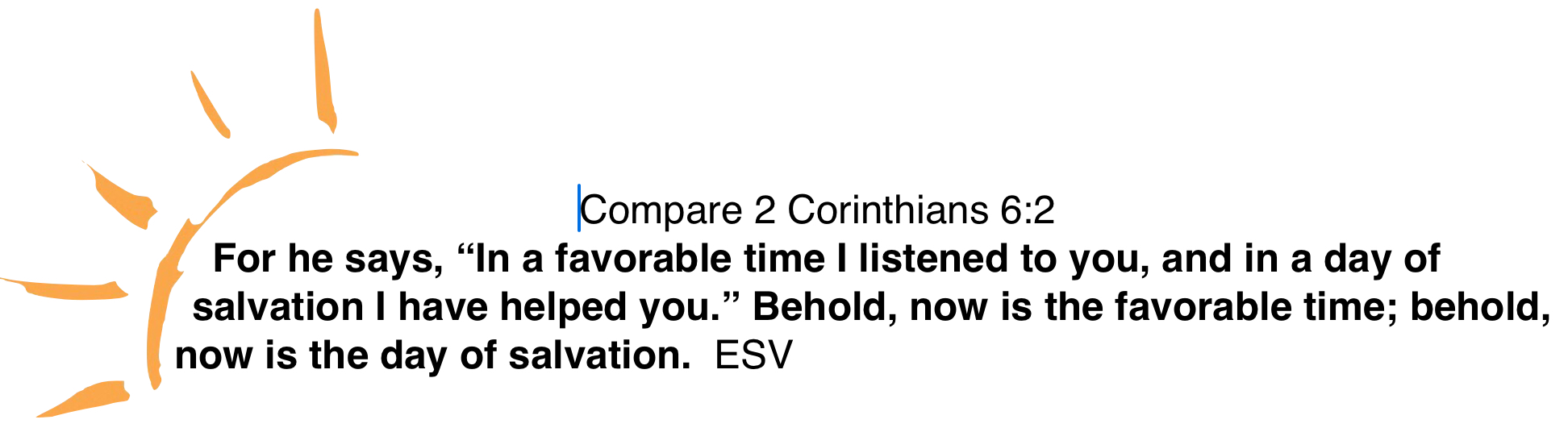
Look at 2 Corinthians 6:2 and ask these valid questions. When is the “favorable time?”  Is it when God listens…or when you speak to Him?  Are you aware that God is saving you right now?  Can we expand the comfortable little box for that word “salvation” from one and done for eternity to a continuous stream of activity for life?  When we became a follower of Jesus Christ there was a spiritual sigh of relief because God saved us to Himself for all eternity. God has affirmed Himself in these scriptures with words like “I have” and “I will.” They have secured the past and the future but that “a” has become the big idea that God is continuously saving in the “present”  There was “a day of salvation” but that was then.  This is now.

Isn’t the reality of “seek the Lord while he may be found” necessary now?  “Now” is the day we need to be saved from drowning in the unexpected flood of circumstances of daily life.  The Lord reminds us of His past faithfulness in our past encounters with Him. I have listened to your prayers, I have answered, I have helped and saved you — remember how you found me then?  It was a favorable and acceptable time between us.  Don’t miss the reality that those memories of “found” time with me are the time you knew I was near.  Those times are past, the present is now.   Now I will keep you just as I did before — I remember, do you?  Now is the time I set for “everyone who is godly [to] offer prayer. “O God, in the abundance of your steadfast love answer me in your saving faithfulness…Behold, now is the favorable time — behold now is the day of salvation.”

In “This” Day

Citing:
— Amos 9:11-12 “In that day I will raise up the booth of David that is fallen and repair its breaches, and raise up its ruins and rebuild it as in the days of old, that they may possess the remnant of Edom (Mount Esau) and all the nations who are called by my name,” declares the Lord who does this.
— Jeremiah 12:15 And after I have plucked them up, I will again have compassion on them, and I will bring them again each to his heritage and each to his land.
— Isaiah 43:7…everyone who is called by my name, whom I created for my glory, whom I formed and made.
— Jeremiah 14:9 Why should you be like a man confused, like a mighty warrior who cannot save? Yet you, O Lord, are in the midst of us, and we are called by your name; do not leave us.”
— Daniel 9:19 O Lord, hear; O Lord, forgive. O Lord, pay attention and act. Delay not, for your own sake, O my God, because your city and your people are called by your name..

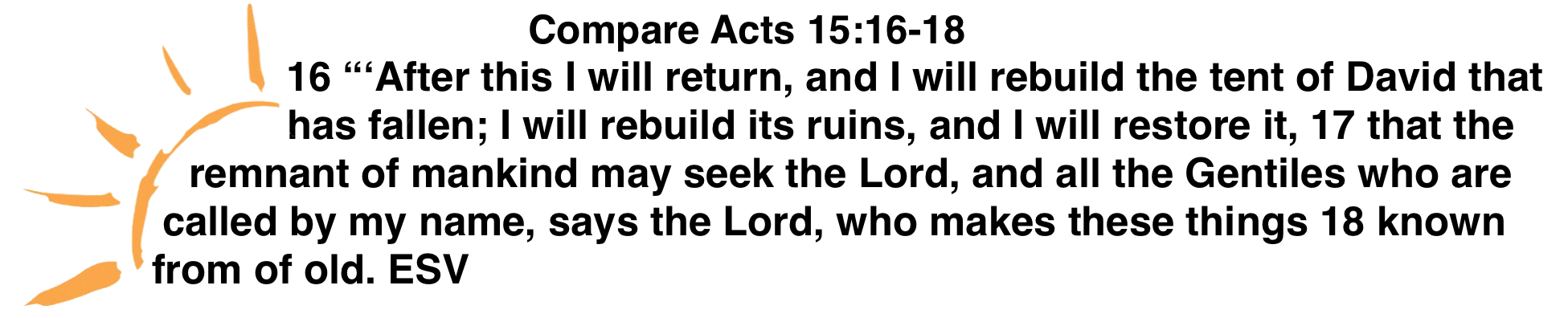
Rebuild and restore are common themes in the New Testament.  Throughout the Bible that is a common theme.  For a couple of days this week I’m at the ocean with my daughter and son-in-law and as God so often does He’s made a connection I can see with my own eyes to these passages.  Two hurricanes battered this area last fall and as a result of that, the work of rebuilding and restoring what was lost is obvious.  The rebuilding is the cosmetic fix but the restoration of what was lost is the ultimate goal.  

Acts quotes Amos saying the Lord has said the “remnant of mankind” will include Gentiles He’s called by His name.  What is “after this”?  Why does Amos refer to “a remnant of Edom?  Why do they want that remnant back?   What does that word “back” really mean? Why is Acts referencing Amos to explain Gentiles who are called by the Lord’s name?  Now Lord read me your truth from the Old Testament written to confirm it’s connection to the New Testament.  

I learned two “new” ancient Greek words studying for today. “Ethne” was a name used to refer to Gentiles or nations and “Laos” referred to the “people of God” the name the Jews called themselves.  Amos has chosen to use Laos to refer to Gentiles including them as “people of God.”  Gentiles who hadn’t become Jews but had remained Gentiles and been called by God’s name way back then in the Old Testament.√  After this?  After the “remnant of mankind,” Jews and Gentiles alike have been shaken and sifted to removed their sin, then “I will rebuild its ruins, and I will restore it.  Then they will seek the Lord.√   Edom [Mount Esau]  a kingdom thought to be founded by the angry, wronged brother of Jacob.  Esau will be restored to complete the restoration of the Kingdon of God.√   And now we come to that word “back.”  The word that says it all. God had never had any other plan but for His Kingdom to a) be rebuilt and b) be restored to the perfection He’d created in those first days of Genesis.   And finally we have our name the Lord Himself has given us, Christians, followers of Jesus Christ and Daniels plea to make our own — “O Lord, hear; O Lord, forgive. O Lord, pay attention and act. Delay not, for your own sake, O my God, because your city and your people are called by your name” — who makes these things known from of old” in “this” day.

Week 2: Acts 15:16-17


Citing:
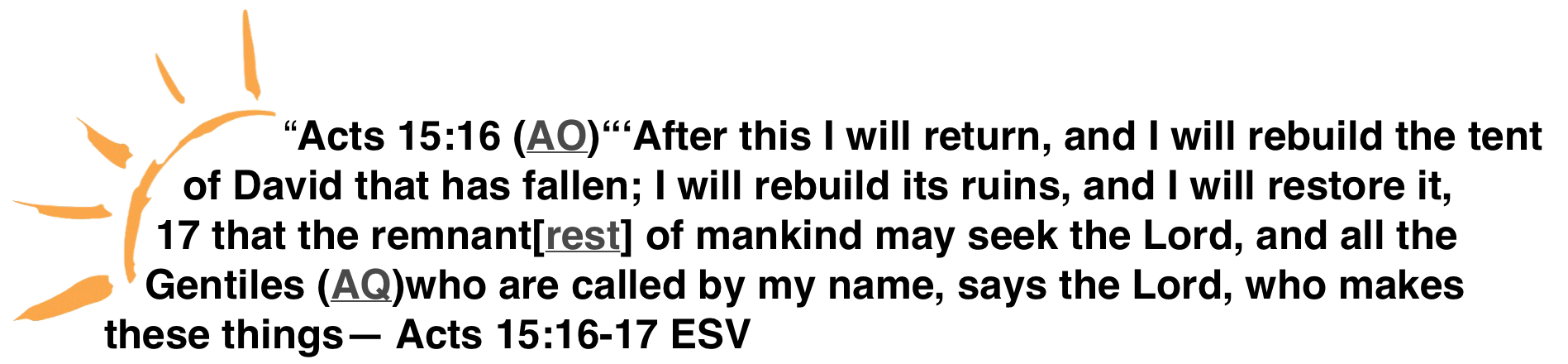
(AO) = Amos 9:11-12 and Jeremiah 12:15
(AQ) = Isaiah 43:7, Jeremiah 14:9, & Daniel 9:19 ESV

Amos 9:11-12 “In that day I will raise up the booth of David that is fallen and repair its breaches, and raise up its ruins and rebuild it as in the days of old, that they may possess the remnant of Edom (Mount Esau) and all the nations who are called by my name,” declares the Lord who does this.
Jeremiah 12:15 And after I have plucked them up, I will again have compassion on them, and I will bring them again each to his heritage and each to his land.
Isaiah 43:7 …everyone who is called by my name, whom I created for my glory, whom I formed and made.
Jeremiah 14:9
Why should you be like a man confused, like a mighty warrior who cannot save? Yet you, O Lord, are in the midst of us, and we are called by your name; do not leave us.”
Daniel 9:19 O Lord, hear; O Lord, forgive. O Lord, pay attention and act. Delay not, for your own sake, O my God, because your city and your people are called by your name.

This kind of study and reading is still unfamiliar, time consuming and more confusing than I imagined it would be. Amos added a surprise detail with a footnote of it’s own for Edom [Mount Esau.]  Esau is thought to have founded the kingdom of Edom.  This is the same Esau who sold his birthright swearing an unbreakable oath to satisfy a temporary need.  Esau will be restored! The Lord’s compassion has reached into a sketchy past and restored a lost heritage. It’s the picture of humanity isn’t it?   Those citations were sidebar details I would have missed without believing they could become contemporary accents that confirm the purpose God has always had in mind; to be in the midst of; to hear, forgive, pay attention and act on behalf of those who are called by His name and created for His glory.

I can’t tell you how many hours I’ve spent these last few days floundering my way through what seems like countless rabbit trails to get to the point where I could write that one paragraph.  I can tell you when I put that period after that phrase “His glory” in that last sentence I felt like I’d just come up for air.  It’s the comfort of a recorded and cited Biblical history that includes people like me in His story today.

Week 1: Choice

citing Isaiah 56:7
…these I will bring to my holy mountain, and make them joyful in my house of prayer; their burnt offerings and their sacrifices will be accepted on my altar; for my house shall be called a house of prayer for all peoples.”
and Jeremiah 7:11
Has this house, which is called by my name, become a den of robbers in your eyes? Behold, I myself have seen it, declares the Lord.

This is my first attempt at using a new study idea based on a book — Old Made New[a].  It’s a how-to book with a different premise;  to let the New Testament read the Old Testament to me thru its citations.  I’m going to use the Scripture references in the book for my post each Wednesday and pay attention to those citations.  What is it about them that mattered to Jesus and may change my mind about what I read?  Here we go…Week 1.

The Book of Jeremiah was written between 630 and 580 B.C. and Isaiah was written sometime during the ministry of Isaiah (approximately 740–701 B.C.).  I can’t be the only one who’s forgotten the antiquity timeline is a countdown.  So…Isaiah wrote first, then Jeremiah.  Their  words show the progression of their choice to neglect those old words.  Luke is reminding his readers that Jesus saw their choice and grieved over the loss of God’s purpose for the purity of His house of prayer.

Jesus had paused to look over the city as he neared Jerusalem and was moved to tears over the “things that make for peace” that are no longer visible there.  They no longer had any claim to innocence.  The passage of time showed the result of neglect to those old Words. Jeremiah had to pass along God’s harsh observation about His house looking like a den of robbers. I  don’t know how to explain why Jesus chose such uncharacteristic behavior in the Temple.  Maybe it was anger, frustration, judgment and grief all combined at their willing acceptance of what had been lost.  Did they even notice the decline?

I’ve noticed something because of following those citations in this passage.  My emphasis changed as I read from wondering about Jesus’s unexplainable behavior to thinking about mine.  It’s a choice to pay attention to old Words like Isaiah’s promise of acceptance and Jeremiah’s warning about neglect.  It’s become a reality check about not neglecting old Words.  Romans 8:12 says we do have an “obligation.” Our obligation to the “house that is called by [God’s] name is not our innocence, Adam took care of that.  It’s our choice!  Jesus is calling us to choose purity and He’s given us a completely different how-to Book filled with everything that can make that a reality in our life.

[a] Old Made New


Risk

Isaiah wrote about restoring the sight of the blind as part of the Messiah’s ability…And the Lord said:
— Isaiah 29:18 In that day the deaf will hear words read from a book,
and the blind will see through the gloom and darkness.
— 35:5 And when he comes, he will open the eyes of the blind and unplug the ears of the deaf.
— 42:7 You will open the eyes of the blind.  You will free the captives from prison, releasing those who sit in dark dungeons.   

 Jesus speaks to his disciples in a third party-like conversation about the cause of blindness and Him being the Light of the world.  That’s a Messianic claim!  Then He physically takes direct action by coating over the man’s eyes with clay he’s just made.  The mixing of the mud is evidence of “violation” of working on the Sabbath!  He never tells the blind man his sight is going to miraculously be restored.  The blind man must choose to risk responding to Jesus and go to the pool to wash.  That’s a step of faith!

The sticking point for the Pharisees was complicated. Twice Jesus had confronted the Pharisees hypocrisy [John 7:23 and Matthew 12:5].  Jewish rules had legitimate provisions for violating the Sabbath in specific cases like circumcision in order to obey Mosaic law, temple service or the birth of a baby.  Isaiah’s words, a broken rule, the eyes of a blind man being opened and an itinerant rabbi who claimed to be the Light of the world became their sticking point. Isaiah’s words were a trusted part of the Pharisees Messianic history and according to their own rules denying a miracle of God was unbelief.  The evidence of acknowledging this miracle might prove Jesus to be the Lord Isaiah wrote about.  That didn’t mesh with what they’d carefully mapped out for the coming Messiah. They couldn’t risk choosing to take that next step of faith.