Category Archives: Jeremiah

Rich is “More” than money

16 And he told them a parable, saying, (AF)“The land of a rich man produced plentifully, 17 and he thought to himself, (AG)‘What shall I do, for I have nowhere to store my crops?’ 18 And he said, ‘I will do this: I will tear down my (AH)barns and build larger ones, and there I will store all my grain and my goods. 19 And I will say to my soul, “Soul, you have ample goods laid up (AI)for many years; relax, (AJ)eat, drink, be merry.”’ 20 But God said to him, (AK)‘Fool! (AL)This night (AM)your soul is required of you, and the things you have prepared, (AN)whose will they be?’  21 So is the one (AO)who lays up treasure for himself and is not rich toward God.

If there’s an opposite to ‘cliff notes’ this post is certainly it!
This parable had so many Old Testament (cross reference) letters I couldn’t ignore them.  They were an insistent interruption to an easy read.  The Old Words are compiled together in order of appearance below. Read in that way they verify there’s continuity of truth in the Bible that matters.
Jesus spoke the truth He knew about what turns a “rich man” into a rich “Fool.”
All the references are footnoted at the bottom.

THE OLD WORDS
1  Be not afraid when a man becomes rich, when the glory of his house increases.  For when he dies he will carry nothing away; his glory will not go down after him.  For though, while he lives, he counts himself blessed—and though you get praise when you do well for yourself—his soul will go to the generation of his fathers, who will never again see light.  Man in his pomp yet without understanding is like the beasts that perish. 2  He who loves money will not be satisfied with money, nor he who loves wealth with his income; this also is vanity. 3  Do not boast about tomorrow, for you do not know what a day may bring. 4  There is nothing better for a person than that he should eat and drink and find enjoyment in his toil. This also, I saw, is from the hand of God,
5  Rejoice, O young man, in your youth, and let your heart cheer you in the days of your youth. Walk in the ways of your heart and the sight of your eyes. But know that for all these things God will bring you into judgment. 6  Like the partridge that gathers a brood that she did not hatch, so is he who gets riches but not by justice; in the midst of his days they will leave him, and at his end he will be a fool. 7  Do not boast about tomorrow, for you do not know what a day may bring. 8  For what is the hope of the godless when God cuts him off, when God takes away his life? 9 Surely a man goes about as a shadow!  Surely for nothing they are in turmoil; man heaps up wealth and does not know who will gather!
10  He may pile it up, but the righteous will wear it, and the innocent will divide the silver. He builds his house like a moth’s, like a booth that a watchman makes. He goes to bed rich, but will do so no more; he opens his eyes, and his wealth is gone. Terrors overtake him like a flood; in the night a whirlwind carries him off. The east wind lifts him up and he is gone; it sweeps him out of his place. It hurls at him without pity; he flees from its power in headlong flight.

1 Psalm 49:16-20, 2 Ecclesiastes 5:10, 3 Proverbs 27:1, 4 Ecclesiastes 2:24,
5 Ecclesiastes 11:9, 6 Jeremiah 17:11,  7  Proverbs 27:1, 8 Job 27:8,”
9 Psalm 39:6, 10 Job 27:17-22

The Sower

Old Testament cross references are added by current evangelical scholars and pastors but they’ve made it possible to see how influential those “old” resources were to the New Testament and to Jesus in particular.  I’m playing the role of “traffic light” today. I’ve copied the NLT cross references to this parable in green and added them in order of their appearance in the text.  You can tap on the link an it will open the reference for you.  Jesus’s familiar words are in red letters.  It’s a fairly new experiment for me to read Old Testament references as the “go-to” truth that backs up the New Testament, then “stop” and ponder how that old evidence is what makes both Testaments of the Bible one “whole.” The whole truth is Jesus spent his life learning the evidence of those old truths and based His simple stories for us on them…wrapped in the mystery of thought.  

The Parable of the Sower:
Luke 8:4 And when a great crowd was gathering and people from town after town came to him, he said in a parable, 5 (Isa 55:10 & Amos 9:13)“A sower went out to sow his seed. And as he sowed, some fell along the path and was trampled underfoot, and the birds of the air devoured it. 6 And some fell on the rock, and as it grew up, it withered away, because it had no moisture. 7 And some fell among (Jer 4:3) thorns, and the thorns grew up with it and choked it. 8 And some fell into good soil and grew and yielded (Gen 26:12)a hundredfold.” As he said these things, he called out, “He who has ears to hear, let him hear.  9 And when his disciples asked him what this parable meant, 10 he said, “To you it has been given to know the secrets of the kingdom of God, but for others they are in parables, so (Isa 6:9 & 10)that ‘seeing they may not see, and hearing they may not understand.’ 11 Now the parable is this: The seed is the word of God. 12 The ones along the path are those who have heard; then the devil comes and takes away the word from their hearts, so that they may not believe and be saved. 13 And the ones on the rock are those who, when they hear the word, receive it (Isa 58:2 & Ezek 33:31)with joy. But these have no root; they (Hos 6:4)believe for a while, and in time of testing fall away. 14 And as for what fell among the thorns, they are those who hear, but as they go on their way they are choked by the cares and riches and pleasures of life, and their fruit does not mature. 15 As for that in the good soil, they are those who, hearing the word, hold it fast in an honest and good heart, and (Hos 14:8)bear fruit with patience.

The Simple Mystery…
The sower has a source that supplies good seeds. Once given those seeds can’t be returned.  They must either produce fruit or they will be wasted.  Ground that may seem useless can be made to produce fruit that fulfills the purpose of those seeds; growth and nourishment.  Sowers can learn to prepare soil for the seeds and when that happens “The time will come,” says the Lord, “when the grain and grapes will grow faster than they can be harvested…” There is one little catch that is the mystery behind the simplicity of this story.  It’s more than the simple repetition of the familiar activity of sowing and reaping that results in the growth that produces blessing. The mystery requires the sower giving conscious and purposeful attention to all the details of the process of preparing the soil to produce an abundant harvest.  The secret of the Kingdom of God is His good seed becomes mature fruit that blesses both the sower and the reaper with more good seed.  “As for that in the good soil, they are those who, hearing the word, hold it fast in an honest and good heart, and bear fruit with patience.

Good News!

1 In the first year of Cyrus king of Persia, that the word of the Lord by the mouth of Jeremiah might be fulfilled, the Lord stirred up the spirit of Cyrus king of Persia, so that he made a proclamation throughout all his kingdom and also put it in writing:  2 “Thus says Cyrus king of Persia: The Lord, the God of heaven, has given me all the kingdoms of the earth, and he has charged me to build him a house at Jerusalem, which is in Judah. 3 Whoever is among you of all his people, may his God be with him, and let him go up to Jerusalem, which is in Judah, and rebuild the house of the Lord, the God of Israel—he is the God who is in Jerusalem. 4 And let each survivor, in whatever place he sojourns, be assisted by the men of his place with silver and gold, with goods and with beasts, besides freewill offerings for the house of God that is in Jerusalem.”  5 Then rose up the heads of the fathers’ houses of Judah and Benjamin, and the priests and the Levites, everyone whose spirit God had stirred to go up to rebuild the house of the Lord that is in Jerusalem. 6 And all who were about them aided them with vessels of silver, with gold, with goods, with beasts, and with costly wares, besides all that was freely offered. 7 Cyrus the king also brought out the vessels of the house of the Lord that Nebuchadnezzar had carried away from Jerusalem and placed in the house of his gods. 

My Cliff Notes:
That the word of the Lord by the mouth of Jeremiah might be fulfilled, the Lord stirred up the spirit of Cyrus king of Persia.  He made a proclamation and also put it in writing:  Whoever is among you of all his people, may his God be with him.  Let him go up to Jerusalem and rebuild the house of the Lord, the God of Israel.  Then rose up everyone whose spirit God had stirred and all who were about them aided them with all that was freely offered.  Cyrus the king also brought out the vessels of the house of the Lord that Nebuchadnezzar had carried away from Jerusalem.

Interesting things I learned:
God used one pagan king, Nebuchadnezzar, to punish the Jews and another, Cyrus, to return the exiled people to Jerusalem to restore their temple. It’s an odd bit of Good News that the success of Godless men does not affect the Sovereignty of God’s complete authority over all men despite their manipulative intent, despite hostile power grabs and despite distance and time. 

God returned His people to the very place His son must be born and to His Temple in the city where Jesus would come in order to accomplish His plans for the salvation of many.   Thanks to a small footnoteª I read these words, also from Jeremiah 29:10, “For thus says the Lord: When seventy years are completed for Babylon, I will visit you, and I will fulfill to you my promise and bring you back to this place.”  It was curiosity that ‘stirred up’ my spirit to see a new connection between Old Testament history and the only verse I could quote from Jeremiah; the very next one after the one Ezra 1 references. It’s just one additional verse but it confirms the centuries old desire from the heart of God to His people that is still true today.  You probably know it too. “For I know the plans I have for you, declares the Lord, plans for welfare and not for evil, to give you a future and a hope.”  That one more verse makes Ezra more than history, it’s Good News for today!

The Mystery In-Between

1 What then shall we say was gained by Abraham, our forefather according to the flesh? 2 For if Abraham was justified by works, he has something to boast about, but not before God. 3 For what does the Scripture say? “Abraham believed God, and it was counted to him as righteousness.” 

Romans 4 contains a timeless truth about righteousness.  I’ve removed Romans 4-12 from this post on purpose to stir up your interest in the mysterious truth that lies in-between those first three verses and verse 24.  I want you to read and ponder those verses for yourself because they are thought-provoking reminders of the visceral [felt in or as if in the internal organs of the body] reality of God’s intent to interact physically with His people not just instruct them.

Romans 4:4-12 is the reality of a physical interaction between God and Abraham that’s now uniquely part of our heritage as his descendants.  True to His word God has given all Abraham’s descendants a new seal  to verify what He has already done; the precise surgical procedurea  that purposely removed the barrier left in-between the heart and the righteousness He counts as His own.

Romans 4:24…It [Righteousness] will be counted to us who believe in him who raised from the dead Jesus our Lord, 25 who was delivered up for our trespasses and raised for our justification.

a Deuteronomy 30:6

In “This” Day

Citing:
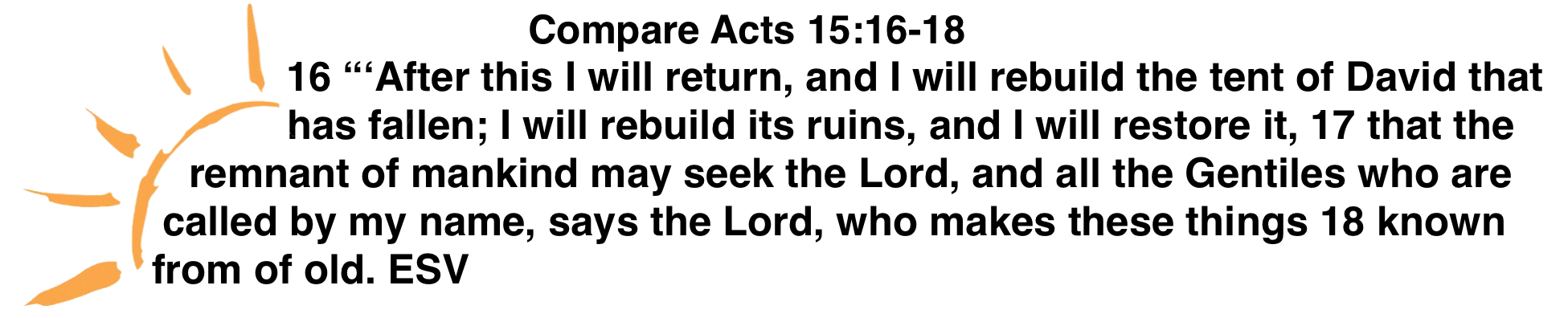
— Amos 9:11-12 “In that day I will raise up the booth of David that is fallen and repair its breaches, and raise up its ruins and rebuild it as in the days of old, that they may possess the remnant of Edom (Mount Esau) and all the nations who are called by my name,” declares the Lord who does this.
— Jeremiah 12:15 And after I have plucked them up, I will again have compassion on them, and I will bring them again each to his heritage and each to his land.
— Isaiah 43:7…everyone who is called by my name, whom I created for my glory, whom I formed and made.
— Jeremiah 14:9 Why should you be like a man confused, like a mighty warrior who cannot save? Yet you, O Lord, are in the midst of us, and we are called by your name; do not leave us.”
— Daniel 9:19 O Lord, hear; O Lord, forgive. O Lord, pay attention and act. Delay not, for your own sake, O my God, because your city and your people are called by your name..

Rebuild and restore are common themes in the New Testament.  Throughout the Bible that is a common theme.  For a couple of days this week I’m at the ocean with my daughter and son-in-law and as God so often does He’s made a connection I can see with my own eyes to these passages.  Two hurricanes battered this area last fall and as a result of that, the work of rebuilding and restoring what was lost is obvious.  The rebuilding is the cosmetic fix but the restoration of what was lost is the ultimate goal.  

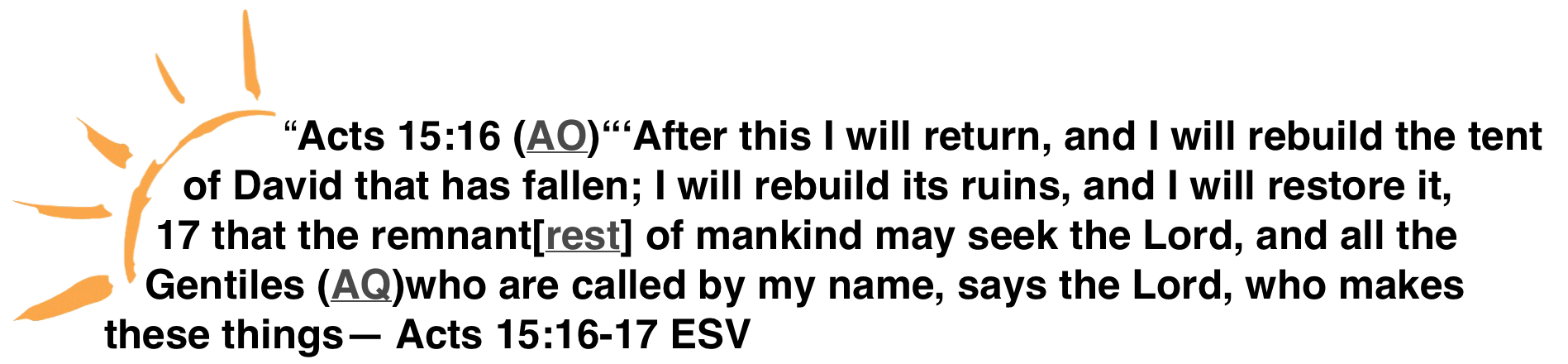
Acts quotes Amos saying the Lord has said the “remnant of mankind” will include Gentiles He’s called by His name.  What is “after this”?  Why does Amos refer to “a remnant of Edom?  Why do they want that remnant back?   What does that word “back” really mean? Why is Acts referencing Amos to explain Gentiles who are called by the Lord’s name?  Now Lord read me your truth from the Old Testament written to confirm it’s connection to the New Testament.  

I learned two “new” ancient Greek words studying for today. “Ethne” was a name used to refer to Gentiles or nations and “Laos” referred to the “people of God” the name the Jews called themselves.  Amos has chosen to use Laos to refer to Gentiles including them as “people of God.”  Gentiles who hadn’t become Jews but had remained Gentiles and been called by God’s name way back then in the Old Testament.√  After this?  After the “remnant of mankind,” Jews and Gentiles alike have been shaken and sifted to removed their sin, then “I will rebuild its ruins, and I will restore it.  Then they will seek the Lord.√   Edom [Mount Esau]  a kingdom thought to be founded by the angry, wronged brother of Jacob.  Esau will be restored to complete the restoration of the Kingdon of God.√   And now we come to that word “back.”  The word that says it all. God had never had any other plan but for His Kingdom to a) be rebuilt and b) be restored to the perfection He’d created in those first days of Genesis.   And finally we have our name the Lord Himself has given us, Christians, followers of Jesus Christ and Daniels plea to make our own — “O Lord, hear; O Lord, forgive. O Lord, pay attention and act. Delay not, for your own sake, O my God, because your city and your people are called by your name” — who makes these things known from of old” in “this” day.

Week 2: Acts 15:16-17


Citing:
(AO) = Amos 9:11-12 and Jeremiah 12:15
(AQ) = Isaiah 43:7, Jeremiah 14:9, & Daniel 9:19 ESV

Amos 9:11-12 “In that day I will raise up the booth of David that is fallen and repair its breaches, and raise up its ruins and rebuild it as in the days of old, that they may possess the remnant of Edom (Mount Esau) and all the nations who are called by my name,” declares the Lord who does this.
Jeremiah 12:15 And after I have plucked them up, I will again have compassion on them, and I will bring them again each to his heritage and each to his land.
Isaiah 43:7 …everyone who is called by my name, whom I created for my glory, whom I formed and made.
Jeremiah 14:9
Why should you be like a man confused, like a mighty warrior who cannot save? Yet you, O Lord, are in the midst of us, and we are called by your name; do not leave us.”
Daniel 9:19 O Lord, hear; O Lord, forgive. O Lord, pay attention and act. Delay not, for your own sake, O my God, because your city and your people are called by your name.

This kind of study and reading is still unfamiliar, time consuming and more confusing than I imagined it would be. Amos added a surprise detail with a footnote of it’s own for Edom [Mount Esau.]  Esau is thought to have founded the kingdom of Edom.  This is the same Esau who sold his birthright swearing an unbreakable oath to satisfy a temporary need.  Esau will be restored! The Lord’s compassion has reached into a sketchy past and restored a lost heritage. It’s the picture of humanity isn’t it?   Those citations were sidebar details I would have missed without believing they could become contemporary accents that confirm the purpose God has always had in mind; to be in the midst of; to hear, forgive, pay attention and act on behalf of those who are called by His name and created for His glory.

I can’t tell you how many hours I’ve spent these last few days floundering my way through what seems like countless rabbit trails to get to the point where I could write that one paragraph.  I can tell you when I put that period after that phrase “His glory” in that last sentence I felt like I’d just come up for air.  It’s the comfort of a recorded and cited Biblical history that includes people like me in His story today.

Week 1: Choice

citing Isaiah 56:7
…these I will bring to my holy mountain, and make them joyful in my house of prayer; their burnt offerings and their sacrifices will be accepted on my altar; for my house shall be called a house of prayer for all peoples.”
and Jeremiah 7:11
Has this house, which is called by my name, become a den of robbers in your eyes? Behold, I myself have seen it, declares the Lord.

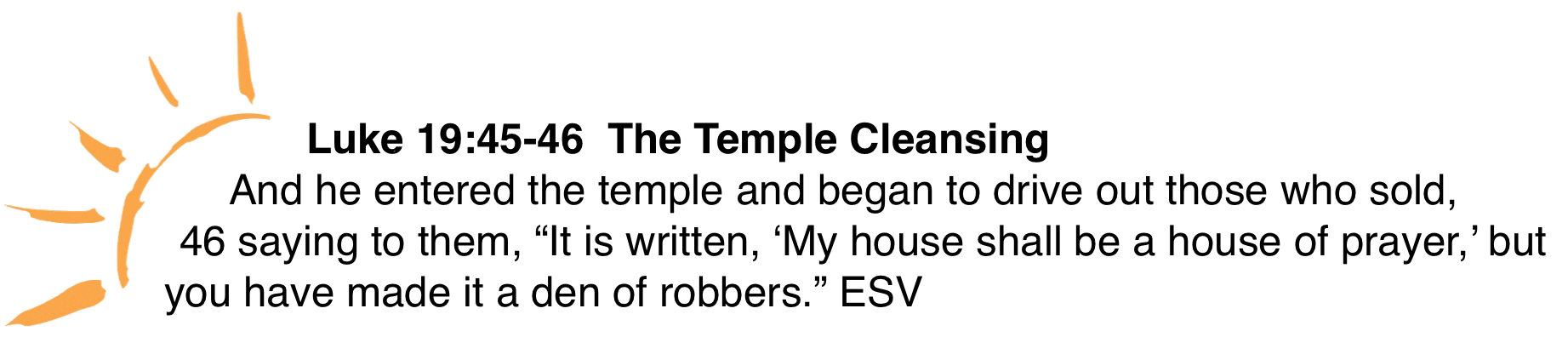
This is my first attempt at using a new study idea based on a book — Old Made New[a].  It’s a how-to book with a different premise;  to let the New Testament read the Old Testament to me thru its citations.  I’m going to use the Scripture references in the book for my post each Wednesday and pay attention to those citations.  What is it about them that mattered to Jesus and may change my mind about what I read?  Here we go…Week 1.

The Book of Jeremiah was written between 630 and 580 B.C. and Isaiah was written sometime during the ministry of Isaiah (approximately 740–701 B.C.).  I can’t be the only one who’s forgotten the antiquity timeline is a countdown.  So…Isaiah wrote first, then Jeremiah.  Their  words show the progression of their choice to neglect those old words.  Luke is reminding his readers that Jesus saw their choice and grieved over the loss of God’s purpose for the purity of His house of prayer.

Jesus had paused to look over the city as he neared Jerusalem and was moved to tears over the “things that make for peace” that are no longer visible there.  They no longer had any claim to innocence.  The passage of time showed the result of neglect to those old Words. Jeremiah had to pass along God’s harsh observation about His house looking like a den of robbers. I  don’t know how to explain why Jesus chose such uncharacteristic behavior in the Temple.  Maybe it was anger, frustration, judgment and grief all combined at their willing acceptance of what had been lost.  Did they even notice the decline?

I’ve noticed something because of following those citations in this passage.  My emphasis changed as I read from wondering about Jesus’s unexplainable behavior to thinking about mine.  It’s a choice to pay attention to old Words like Isaiah’s promise of acceptance and Jeremiah’s warning about neglect.  It’s become a reality check about not neglecting old Words.  Romans 8:12 says we do have an “obligation.” Our obligation to the “house that is called by [God’s] name is not our innocence, Adam took care of that.  It’s our choice!  Jesus is calling us to choose purity and He’s given us a completely different how-to Book filled with everything that can make that a reality in our life.

[a] Old Made New


Think About These Things


What If…
— Before I formed you in the womb I knew you, before you were born I set you apart…” Jeremiah 1:5

— You formed my inward parts; you knitted me together in my mother’s womb. Psalm 139:13

— We are his workmanship, created in Christ Jesus for good works, which God prepared beforehand, that we should walk in them. Ephesians 2:10

— God’s workmanship in me began long before a specific egg and sperm met one another

— God began to justify His choice in my mother’s womb before my first breath

— That first breath began my sanctification even before my first cognitive thought

— God has created me in the likeness of His perfection to insure I could be of value and succeed at what He’s prepared beforehand

— My whole imperfect and incomplete way of life is the inspired field of operation He’s chosen to accomplish His good works

— In him we live and move and have our being…for we are indeed his offspring  Acts 17:28

Whatever is true, whatever is honorable, whatever is just,
whatever is pure, whatever is lovely, whatever is commendable,
if there is any excellence, if there is anything worthy of praise,
think about these things.  Philippians 4:8

God Knows!

Jeremiah 29:10 For thus says the Lord: After seventy years are completed at Babylon, I will visit you and perform My good word toward you, and cause you to return to this place. 11 For I know the thoughts that I think toward you, says the Lord, thoughts of peace and not of evil, to give you a future and a hope. 12 Then you will call upon Me and go and pray to Me, and I will listen to you. [NKJV]

>§§§>

I’m still concentrating on Jeremiah 29: 10-12 and the Spurgeon sermon from 1887.  I found a meaningful difference in the New King James Version’s translation of a phrase from verse 10: “I will perform my good word toward you.”  The Bible is more than history, wisdom and recorded answers to allow us to learn how to live according to the expectations of God.  It’s His good Word written to reveal His intent to intervene and perform it in the life of His leading characters [you and I] as we navigate through the emotional and unexpected circumstances of life.  We are a performance oriented culture, well-trained over most of our years to figure things out but today our unexpected circumstance is a deadly virus.   Coronavirus is now daily confronting our ability to figure out what we do know and what we don’t know. 

God knows!  That is the one thing Spurgeon has reminded me over and over as I’ve read his sermon. “When Moses came out of Egypt, he had no plan as to the march of Israel. He knew that he had to lead the children of Israel to the promised land, but that was all. He probably hoped to take them by the shortest cut to Palestine at once…Brother, you do not know what is to be done, but the Lord knows for you. O, body of Christ, let your head think for you! O, servant of Christ, let your Master think for you. “I know,” says God “the thoughts that I think toward you.” AND “I will visit you and perform My good Word toward you…”

∞ Look back and thank God…Look forward and trust God ∞

Still in Babylon

Jeremiah 29:10 This is what the Lord says: “When seventy years are completed for Babylon, I will come to you and fulfill my good promise to bring you back to this place. 11 For I know the plans I have for you,” declares the Lord, “plans to prosper you and not to harm you, plans to give you hope and a future. 12 Then you will call on me and come and pray to me, and I will listen to you. [NIV]

>§§§>

The exile continues.  The comfort of Jeremiah 29:11 is meant to remind us of the Lords vision for our future.  That’s a treasure but in the re-reading of those familiar words over and over while continuing to ponder the sermon from Spurgeon an eye-opening expansion of my own vision has happened and this is a priceless gift.  There’s more to that beautiful promise of verse 11.  I am so thankful we have the enduring Word, work and wisdom of God given through Jesus, the Holy Spirit AND the writings of His people that can open our eyes in the midst of this contemporary pandemic. There IS a Jeremiah 29:10 and a 29:12 too.  “I will come to you and fulfill my good promise…you will call on me and come and pray to me, and I will listen to you.

In Gods wisdom His vision covers the past, present and the future.  That is the priceless part we need to cling to as God uses Jeremiah to inform our vision to match His own.  “As to our present pain and grief, God saw not these things exclusively, but He saw the future joy and usefulness which will come of them. He regards not only the tearing up of the soil with the plow, but the clothing of that soil with the golden harvest.” [Spurgeon]. 

∞ Look back and thank God…Look forward and trust God ∞