Category Archives: Luke

Rich is “More” than money

16 And he told them a parable, saying, (AF)“The land of a rich man produced plentifully, 17 and he thought to himself, (AG)‘What shall I do, for I have nowhere to store my crops?’ 18 And he said, ‘I will do this: I will tear down my (AH)barns and build larger ones, and there I will store all my grain and my goods. 19 And I will say to my soul, “Soul, you have ample goods laid up (AI)for many years; relax, (AJ)eat, drink, be merry.”’ 20 But God said to him, (AK)‘Fool! (AL)This night (AM)your soul is required of you, and the things you have prepared, (AN)whose will they be?’  21 So is the one (AO)who lays up treasure for himself and is not rich toward God.

If there’s an opposite to ‘cliff notes’ this post is certainly it!
This parable had so many Old Testament (cross reference) letters I couldn’t ignore them.  They were an insistent interruption to an easy read.  The Old Words are compiled together in order of appearance below. Read in that way they verify there’s continuity of truth in the Bible that matters.
Jesus spoke the truth He knew about what turns a “rich man” into a rich “Fool.”
All the references are footnoted at the bottom.

THE OLD WORDS
1  Be not afraid when a man becomes rich, when the glory of his house increases.  For when he dies he will carry nothing away; his glory will not go down after him.  For though, while he lives, he counts himself blessed—and though you get praise when you do well for yourself—his soul will go to the generation of his fathers, who will never again see light.  Man in his pomp yet without understanding is like the beasts that perish. 2  He who loves money will not be satisfied with money, nor he who loves wealth with his income; this also is vanity. 3  Do not boast about tomorrow, for you do not know what a day may bring. 4  There is nothing better for a person than that he should eat and drink and find enjoyment in his toil. This also, I saw, is from the hand of God,
5  Rejoice, O young man, in your youth, and let your heart cheer you in the days of your youth. Walk in the ways of your heart and the sight of your eyes. But know that for all these things God will bring you into judgment. 6  Like the partridge that gathers a brood that she did not hatch, so is he who gets riches but not by justice; in the midst of his days they will leave him, and at his end he will be a fool. 7  Do not boast about tomorrow, for you do not know what a day may bring. 8  For what is the hope of the godless when God cuts him off, when God takes away his life? 9 Surely a man goes about as a shadow!  Surely for nothing they are in turmoil; man heaps up wealth and does not know who will gather!
10  He may pile it up, but the righteous will wear it, and the innocent will divide the silver. He builds his house like a moth’s, like a booth that a watchman makes. He goes to bed rich, but will do so no more; he opens his eyes, and his wealth is gone. Terrors overtake him like a flood; in the night a whirlwind carries him off. The east wind lifts him up and he is gone; it sweeps him out of his place. It hurls at him without pity; he flees from its power in headlong flight.

1 Psalm 49:16-20, 2 Ecclesiastes 5:10, 3 Proverbs 27:1, 4 Ecclesiastes 2:24,
5 Ecclesiastes 11:9, 6 Jeremiah 17:11,  7  Proverbs 27:1, 8 Job 27:8,”
9 Psalm 39:6, 10 Job 27:17-22

The [3] Loaf Prayer

Luke 11:4b-13
He said to them,  4“…And lead us not into temptation.” 5 Then Jesus said to them, “Suppose you have a friend, and you go to him at midnight and say, ‘Friend, lend me three loaves of bread; 6 a friend of mine on a journey has come to me, and I have no food to offer him.’ 7 And suppose the one inside answers, ‘Don’t bother me. The door is already locked, and my children and I are in bed. I can’t get up and give you anything.’ 8 I tell you, even though he will not get up and give you the bread because of friendship, yet because of your shameless audacity [yet to preserve his good name] he will surely get up and give you as much as you need. 9 “So I say to you: Ask and it will be given to you; seek and you will find; knock and the door will be opened to you. 10 For everyone who asks receives; the one who seeks finds; and to the one who knocks, the door will be opened. 11 “Which of you fathers, if your son asks for a fish, will give him a snake instead?12 Or if he asks for an egg, will give him a scorpion? 13 If you then, though you are evil, know how to give good gifts to your children, how much more will your Father in heaven give the Holy Spirit to those who ask him!” NIV

There’s an interesting combination of ideas in this chapter that begins with the disciples request of Jesus in verse 1; “Lord, teach us to pray.” And He does — right through verse 4: “And lead us not into temptation. ” The “threes” caught my attention because of this request being at “midnight” — the scary dark time, the “shameless audacity” of the request in question [that the NIV footnotes is “yet to preserve his good name”] and those “three loaves.”  There was only the one man asking and one guest so why “three loaves?” There’s three other familiar words in this parable that echo Matthew 7: ask, seek and knock! Those three words are the sensible basis of most prayers. They’re the parameters of [1] relationship with God that is based on His Holiness not ours, [2] trusting His desire to meet our needs and [3] His willingness to grant us direct access to Himself. Here’s a BIG idea to ponder about prayer that may explain that request for a third loaf. Jesus wants us to approach Him free from this flawed reasoning. “Perhaps we shouldn’t bother Him with our petty needs. Or perhaps we should come apologetically and timidly, afraid to let Him know what is really on our minds. Maybe once we’ve let our needs be known, we should back off and not bother God again.”[a]

Jesus is teaching us how to pray the [3] Loaf Prayer
[Loaf 1] Ask because of our relationship to the “Friend”
[Loaf 2] Seek the courage to persist in trusting He will respond
[Loaf 3] Knock because “how much more will your Father in heaven give the Holy Spirit to those who ask him…And lead us not into temptation.”

[a] Approaching God

The Good Samaritan

Luke 10:25 And behold, a lawyer stood up to put him to the test, saying, “Teacher, what shall I do to inherit eternal life?” 26 He said to him, “What is written in the Law? How do you read it?” 27 And he answered, “You shall love the Lord your God with all your heart and with all your soul and with all your strength and with all your mind, and your neighbor as yourself.” 28 And he said to him, “You have answered correctly; do this, and you will live.”  29 But he, desiring to justify himself, said to Jesus, “And who is my neighbor?” 30 Jesus replied, “A man was going down from Jerusalem to Jericho, and he fell among robbers, who stripped him and beat him and departed, leaving him half dead. 31 Now by chance a priest was going down that road, and when he saw him he passed by on the other side.  32 So likewise a Levite, when he came to the place and saw him, passed by on the other side. 33 But a Samaritan, as he journeyed, came to where he was, and when he saw him, he had compassion. 34 He went to him and bound up his wounds, pouring on oil and wine. Then he set him on his own animal and brought him to an inn and took care of him. 35 And the next day he took out two denarii and gave them to the innkeeper, saying, ‘Take care of him, and whatever more you spend, I will repay you when I come back.’ 36 Which of these three, do you think, proved to be a neighbor to the man who fell among the robbers? 37 He said, “The one who showed him mercy.” And Jesus said to him, “You go, and do likewise.” ESV

This parable begins with a question, not out of curiosity but to test Jesus.  “Teacher, what shall I do to inherit eternal life?”  Jesus is not troubled by being tested nor does He consider the lawyer’s question a sign of ignorance.  In fact He assures him that the lovely words he’s memorized from the Shema are the truth to live by.  I know all about having faith based on the “right” memorized words and how wide the gap can be between them and the power of faith behind them, until we recognize Jesus came to bridge that chasm with His parables.

Part 1: The Test — The Memorized Answer  — The Assurance
There is a hangover flaw of sin in the heart that makes us content to be confident in the memories of what we already know; to just put our head down and move along to avoid any messy, uncomfortable challenges.   But our challenge as students of the Bible is to dare to test Jesus.  Jesus’s challenge is to dare us to learn beyond our memorized answers.  Jesus knows our reality better than we do. His encouragement is to acknowledge the truth of what is already memorized and to create a new structure of learning that supports the desire to think and remember more.  

Part 2: The Attackers — The Victim
Don’t miss Jesus’s identification that these attackers are “robbers.” They are thieves who will attack an unprepared traveler without mercy to steal everything and leave their victims behind with nothing but their nakedness, and near death.

Part 3: The Priest — The Levite — The Samaritan
The ordained, respected one passes by “on the other side” to insure he will be clean enough to perform the rituals and sacraments required of him somewhere else.  Next, one of God’s own chosen tribe, singled out for special service to assist in worship chooses to pass this unclean man by “on the other side” too.  “But a Samaritan”…the outcast…is the one who remembers compassion and interrupts his own journey to make caring for this defiled, broken man his business. 

Part 4: The Unlikely Neighbor — The Result…Mercy
Martin Luther King noted that the priest and the Levite asked ‘If I stop to help this man, what will happen to me?’ The Good Samaritan reversed the question: ‘If I don’t stop to help him, what will happen to him?’ a  Mercy that prompts action is what turns memorized answers into truth that reveals faith.

a  https://www.jesus-story.net/the-good-samaritan/

The Sower

Old Testament cross references are added by current evangelical scholars and pastors but they’ve made it possible to see how influential those “old” resources were to the New Testament and to Jesus in particular.  I’m playing the role of “traffic light” today. I’ve copied the NLT cross references to this parable in green and added them in order of their appearance in the text.  You can tap on the link an it will open the reference for you.  Jesus’s familiar words are in red letters.  It’s a fairly new experiment for me to read Old Testament references as the “go-to” truth that backs up the New Testament, then “stop” and ponder how that old evidence is what makes both Testaments of the Bible one “whole.” The whole truth is Jesus spent his life learning the evidence of those old truths and based His simple stories for us on them…wrapped in the mystery of thought.  

The Parable of the Sower:
Luke 8:4 And when a great crowd was gathering and people from town after town came to him, he said in a parable, 5 (Isa 55:10 & Amos 9:13)“A sower went out to sow his seed. And as he sowed, some fell along the path and was trampled underfoot, and the birds of the air devoured it. 6 And some fell on the rock, and as it grew up, it withered away, because it had no moisture. 7 And some fell among (Jer 4:3) thorns, and the thorns grew up with it and choked it. 8 And some fell into good soil and grew and yielded (Gen 26:12)a hundredfold.” As he said these things, he called out, “He who has ears to hear, let him hear.  9 And when his disciples asked him what this parable meant, 10 he said, “To you it has been given to know the secrets of the kingdom of God, but for others they are in parables, so (Isa 6:9 & 10)that ‘seeing they may not see, and hearing they may not understand.’ 11 Now the parable is this: The seed is the word of God. 12 The ones along the path are those who have heard; then the devil comes and takes away the word from their hearts, so that they may not believe and be saved. 13 And the ones on the rock are those who, when they hear the word, receive it (Isa 58:2 & Ezek 33:31)with joy. But these have no root; they (Hos 6:4)believe for a while, and in time of testing fall away. 14 And as for what fell among the thorns, they are those who hear, but as they go on their way they are choked by the cares and riches and pleasures of life, and their fruit does not mature. 15 As for that in the good soil, they are those who, hearing the word, hold it fast in an honest and good heart, and (Hos 14:8)bear fruit with patience.

The Simple Mystery…
The sower has a source that supplies good seeds. Once given those seeds can’t be returned.  They must either produce fruit or they will be wasted.  Ground that may seem useless can be made to produce fruit that fulfills the purpose of those seeds; growth and nourishment.  Sowers can learn to prepare soil for the seeds and when that happens “The time will come,” says the Lord, “when the grain and grapes will grow faster than they can be harvested…” There is one little catch that is the mystery behind the simplicity of this story.  It’s more than the simple repetition of the familiar activity of sowing and reaping that results in the growth that produces blessing. The mystery requires the sower giving conscious and purposeful attention to all the details of the process of preparing the soil to produce an abundant harvest.  The secret of the Kingdom of God is His good seed becomes mature fruit that blesses both the sower and the reaper with more good seed.  “As for that in the good soil, they are those who, hearing the word, hold it fast in an honest and good heart, and bear fruit with patience.

Paid Debt

Luke 7:36  One of the Pharisees asked him to eat with him, and he went into the Pharisee’s house and reclined at table. 37 And behold, a woman of the city, who was a sinner, when she learned that he was reclining at table in the Pharisee’s house, brought an alabaster flask of ointment, 38 and standing behind him at his feet, weeping, she began to wet his feet with her tears and wiped them with the hair of her head and kissed his feet and anointed them with the ointment. 39 Now when the Pharisee who had invited him saw this, he said to himself, “If this man were a prophet, he would have known who and what sort of woman this is who is touching him, for she is a sinner.” 40  And Jesus answering said to him, “Simon, I have something to say to you.” And he answered, “Say it, Teacher.” 41 “A certain moneylender had two debtors. One owed five hundred denarii, and the other fifty. 42 When they could not pay, he cancelled the debt of both. Now which of them will love him more?” 43 Simon answered, “The one, I suppose, for whom he cancelled the larger debt.” And he said to him, “You have judged rightly”…49 Then those who were at table with him began to say among themselves, “Who is this, who even forgives sins?”

There is a Pharisee whose life is set apart to reveal himself as a good man — he’s the host.  There is a woman apparently known to nearly everyone as a “sinner.” She’s the mystery guest.  There is an itinerant teacher named Jesus.  There are so many unanswered questions about this scene.  Why did Jesus agree to go?  I wonder if He was the “celebrity” guest the “good” man had invited to his dinner to intrigue the other guests. How did this sinful woman get in there?  Why wasn’t she thrown out immediately?  This event was probably planned by Jesus Himself so everyone in attendance, had a chance to evaluate Him firsthand and He could teach them one of His biggest truths about sin and forgiveness.

“Say it Teacher” was the good man’s odd response response when Jesus asks to speak. He’s just seen this exchange between Jesus and the mystery woman and suspects Jesus is unfit to teach anybody.  The sinful woman’s extreme act of love had become the lesson Jesus needed to illustrate His story and prompt them to question. …“Who is this, who even forgives sins?”  This is Jesus, the one who by the power of God has the authority to forgive sin of any size so the heart can learn to love God freely and without the obligation of debt.

New Wine

Matthew 9:17
17 Neither is new wine put into old wineskins. If it is, the skins burst and the wine is spilled and the skins are destroyed. But new wine is put into fresh wineskins, and so both are preserved.”
Mark 2:22
And no one puts new wine into old wineskins. If he does, the wine will burst the skins—and the wine is destroyed, and so are the skins. But new wine is for fresh wineskins.”
Luke 5:37-38
37 And no one puts new wine into old wineskins. If he does, the new wine will burst the skins and it will be spilled, and the skins will be destroyed. 38 But new wine must be put into fresh wineskins. 

— When I began to study for this parable it seemed like it was only a short add-on to the more important idea from last Wednesday’s parable, the Wedding Guest.  Many were looking for a long expected savior.  Jesus spoke this parable to identify Himself as something new God was doing. There were “old” expectations way back in Genesis 49:11 and Deuteronomy 32:14, describing the coming of one who’s investment would be in “the blood of grapes.” 

Those were old words made new by Jesus identifying Himself as this “new” way God was going redeem and preserve His people…IF they could accept what He was doing and that this “new wine” could not be contained in old expectations and regulations.  There was an odd word in the ESV version of Deuteronomy 32 that described the wine as “foaming.”  The ancient process of wine making seemed like it’s own verification of this parable to me. There was a personal involvement in making new wine.  It took the whole body’s weight for the feet to press the grapes by gently breaking their skins but not destroying the seeds.  Those seeds were a vital part of the flavor of the resulting juice as the process continued foaming and fermenting to finally become the “new wine” that makes those old words from Deuteronomy the reality that today it’s Jesus that “nourishes and sustains its branches while they[we] develop their[our] fruit.”

Wedding Guest

Luke 5:33 And they [the Pharisees and their scribes] said to him, “The disciples of John fast often and offer prayers, and so do the disciples of the Pharisees, but yours eat and drink.” 34 And Jesus said to them, “Can you make wedding guests fast while the bridegroom is with them? 35 The days will come when the bridegroom is taken away from them, and then they will fast in those days.” 36 He also told them a parable: “No one tears a piece from a new garment and puts it on an old garment. If he does, he will tear the new, and the piece from the new will not match the old.  ESV

It seems quite a few cared about why Jesus’s disciples were not fasting.  Let’s assume a good definition of fasting is a discipline to abstain from an ordinary practice [eating in this case] in order to direct the focus away from that practice to something very different; a connection to God in a private and humble way.  If you’re doing it right who will ever even know or notice?  This group of people has noticed and Jesus cares about that.

I’ve never heard anyone call fasting a celebration or a wedding a discipline but it seems clear what Jesus has in mind in this parable is to teach us to consider both focus and timing.  There is a time to abstain from some ordinary things to focus on His presence in us being about more than adding a new patch to what is wearing out so it will last a little longer.  And there is a time to remember we’re in His presence as honored guests at an extraordinary celebration. “Now you’re dressed in a new wardrobe. Every item of your new way of life is custom-made by the Creator, with his label on it.”a

a Colossians 3:10 MSG

Don’t Miss the Details

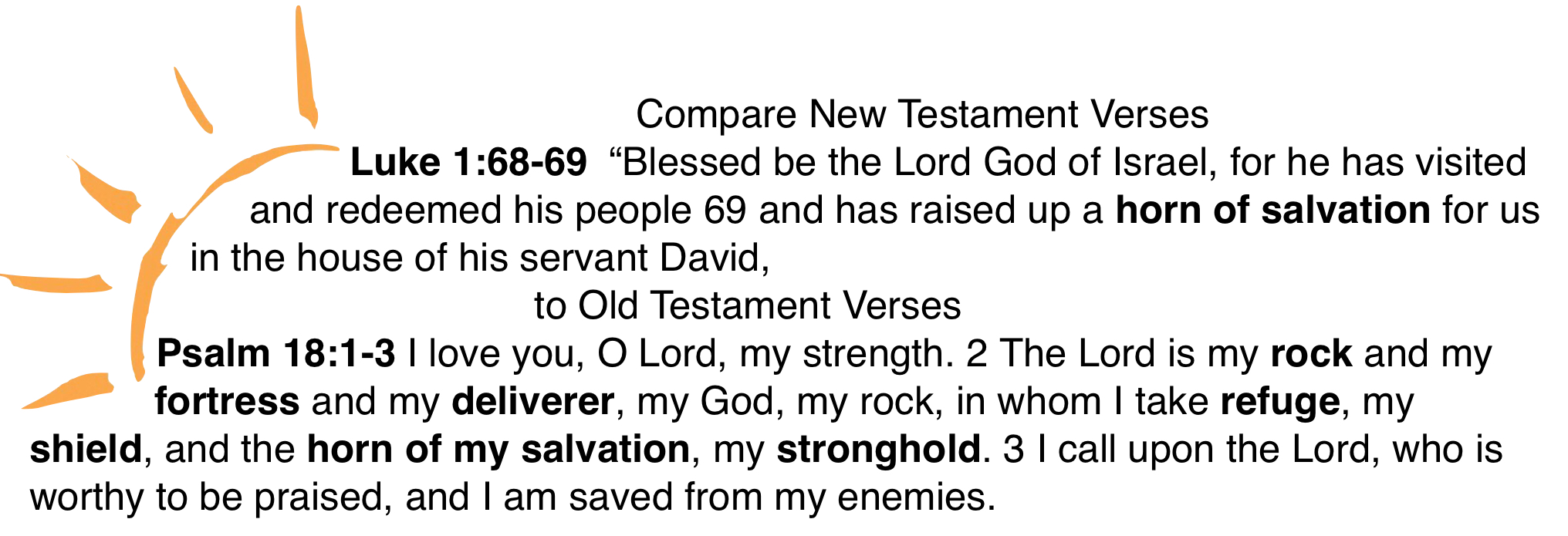
This is a perfect example of the premise of letting one Testament read you the other.  Jesus talks in John 16:25 about using “figures of speech.”  The “horn of salvation” is like that.  I have read it, I know it’s Jesus, I have no reason to disagree. It’s a “figure of speech” I can easily skip over except this exercise has caused me to see a tiny little letter that directs my attention to Psalm 18 and I find details of worship for that moment I would have otherwise missed.

I love you, Jesus, my strength. You are my rock and my fortress and my deliverer the rock, in whom I take refuge, my shield AND “the reality of my salvation,” my stronghold.  Amen.

Week 1: Choice

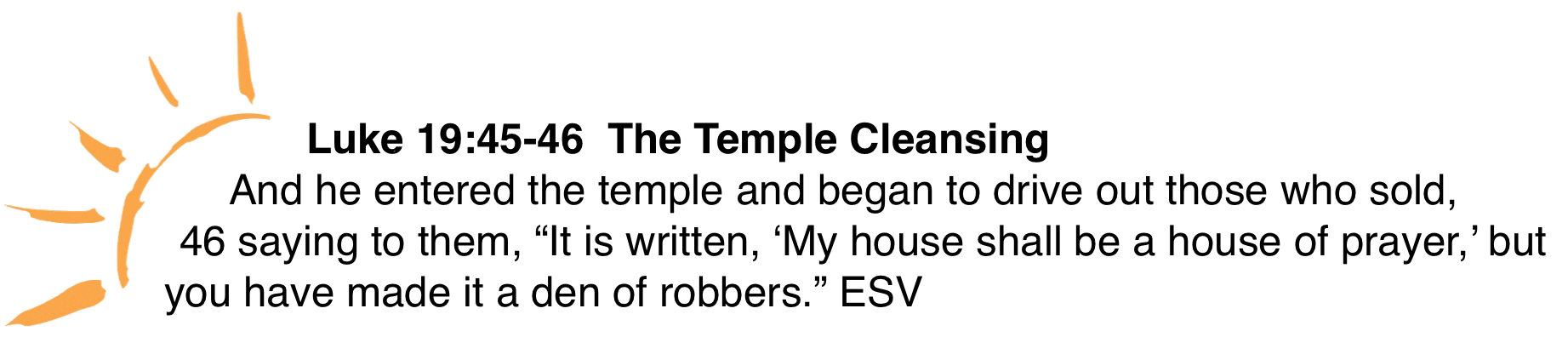
citing Isaiah 56:7
…these I will bring to my holy mountain, and make them joyful in my house of prayer; their burnt offerings and their sacrifices will be accepted on my altar; for my house shall be called a house of prayer for all peoples.”
and Jeremiah 7:11
Has this house, which is called by my name, become a den of robbers in your eyes? Behold, I myself have seen it, declares the Lord.

This is my first attempt at using a new study idea based on a book — Old Made New[a].  It’s a how-to book with a different premise;  to let the New Testament read the Old Testament to me thru its citations.  I’m going to use the Scripture references in the book for my post each Wednesday and pay attention to those citations.  What is it about them that mattered to Jesus and may change my mind about what I read?  Here we go…Week 1.

The Book of Jeremiah was written between 630 and 580 B.C. and Isaiah was written sometime during the ministry of Isaiah (approximately 740–701 B.C.).  I can’t be the only one who’s forgotten the antiquity timeline is a countdown.  So…Isaiah wrote first, then Jeremiah.  Their  words show the progression of their choice to neglect those old words.  Luke is reminding his readers that Jesus saw their choice and grieved over the loss of God’s purpose for the purity of His house of prayer.

Jesus had paused to look over the city as he neared Jerusalem and was moved to tears over the “things that make for peace” that are no longer visible there.  They no longer had any claim to innocence.  The passage of time showed the result of neglect to those old Words. Jeremiah had to pass along God’s harsh observation about His house looking like a den of robbers. I  don’t know how to explain why Jesus chose such uncharacteristic behavior in the Temple.  Maybe it was anger, frustration, judgment and grief all combined at their willing acceptance of what had been lost.  Did they even notice the decline?

I’ve noticed something because of following those citations in this passage.  My emphasis changed as I read from wondering about Jesus’s unexplainable behavior to thinking about mine.  It’s a choice to pay attention to old Words like Isaiah’s promise of acceptance and Jeremiah’s warning about neglect.  It’s become a reality check about not neglecting old Words.  Romans 8:12 says we do have an “obligation.” Our obligation to the “house that is called by [God’s] name is not our innocence, Adam took care of that.  It’s our choice!  Jesus is calling us to choose purity and He’s given us a completely different how-to Book filled with everything that can make that a reality in our life.

[a] Old Made New


Fourth Sunday of Advent — A Shepherd Speaks

And there were in the same country shepherds abiding in the field,
keeping watch over their flock by night. And, lo, the angel of the Lord came upon them, and the glory of the Lord shone round about them: and they were sore afraid. And the angel said unto them, Fear not: for, behold, I bring you good tidings of great joy, which shall be to all people. For unto you is born this day in the city of David a Savior, which is Christ the Lord.  Luke 2:8-11  KJV

ach of us were taking our shifts through the night to keep watch over the sheep and lambs.  It seemed like an ordinary night, but honestly you’ll have to take my word for it, what happened next had all of us up and on our feet in an instant ready to defend our flock and ourselves.  The dangers shepherds face mostly kind of sneak up on them in the darkness so when the night sky was split apart by blinding light we were afraid. It seemed like all our worst fears had became reality. 

It wasn’t until we heard that voice say “Fear not: for behold, I bring you good tidings” that we began to wonder if this might be something special.  Sure, we’d heard there was a coming Savior, but this was a very odd situation.  Angels don’t just appear to bring news every day, especially to shepherds!  We don’t count for much except for those times we’re called upon to choose a perfect lamb for the Temple sacrifice.  We do know a perfect lamb when we see one!  I couldn’t help but wonder if that’s the reason the Lord chose us…of all people…to get first-hand news of the ”great joy, which shall be to all people” — because He trusted we would recognize the Perfect Lamb of His choice.