Category Archives: Matthew

This Then…Lead Us

Matthew 6:9 “This, then, is how you should pray:…13 And lead us not into temptation, but deliver us from the evil one.

Here’s my question for today. Do you believe God uses temptation to see what you’re made of?  My immediate answer was “no.”  I think that’s the right answer but temptation and evil are real and Jesus prayer recognizes that.  I want my answer to be real too, not just a gut reaction.

My observations:
Sometimes our focus is more on praying the devil out of our life than praying the Triune God into it to change us.  That seems like giving that evil one more power than we should.  Sometimes the devil is a convenient excuse for the bad behavior of broken people in a broken world doing awful things. 

The Santa Claus Theology: Job 1:9 “Satan replied, Would Job worship you if he got nothing out of it?”  Temptation is Satan’s power to destroy faith by convincing us God’s blessing is only a bribe for good behavior.

The Need Theology: James 1:13 “When tempted, no one should say, God is tempting me.  For God cannot be tempted by evil, nor does he tempt anyone; 14 but each person is tempted when they are dragged away by their own evil desire and enticed.”  God doesn’t waste his power tempting us.  He’s focused on building faith first, then behavior. That faith has the power over temptation to reveal our broken desires to US so when we pray “lead us not into temptation, but deliver us from the evil one” we’ll finally understand  “desire” for the Triune God IS the blessing and gift.
This Then…Forgive Us

4. Matthew 6:9 “This, then, is how you should pray:…12 And forgive us our debts, as we also have forgiven our debtors.

• debt: something that is owed or due, a feeling of gratitude for a service or favor, obligation
• obligation: an act or course of action to which a person is morally or legally bound;

A dictionary definition can bring up a less commonly used word like “obligation” as part of “debt.”  It’s a tool that helps me think about what I’m reading in a broader way.  That one word “obligation” reminded me of Romans 8:12: “Therefore, brothers and sisters, we have an obligation—but it is not to the flesh, to live according to it.” That’s truth, right?

The terms of a debt are usually not ours to set but once agreed upon they are a contract.  We owe…we pay…”we have an obligation.”  What I’m pondering is why that truth is obviously grace when we pray Jesus’s words “forgive US our debts” but becomes an obligation to repay it when we add “as we also have forgiven our debtors.”  

We recognize our indebtedness. We want his forgiveness.  Our debt is too big to pay without it, but it’s easy to forget we’ve agreed to all the clauses of that contact.  That obligation is where Jesus’s prayer model meshes together with Romans to become the confession he meant it to be for us.  Lord help us to recognize your forgiveness of our debt has such an important relationship to our struggle to recognize our obligation to forgive.

This Then…Give Us This Day – That Mental Leap

3. Matthew 6:9 “This, then, is how you should pray:…
11 Give us today our daily bread

• Numbers 11: 5 We [the Israelites] remember the fish we ate in Egypt at no cost—also the cucumbers, melons, leeks, onions and garlic. 6 But now we have lost our appetite; we never see anything but this manna!”
• Exodus 16:4 Then the Lord said to Moses, “I will rain down bread from heaven for you. The people are to go out each day and gather enough for that day. In this way I will test them and see whether they will follow my instructions. 5 On the sixth day they are to prepare what they bring in, and that is to be twice as much as they gather on the other days.” … 19 Then Moses said to them, “No one is to keep any of it until morning.”…21 Each morning everyone gathered as much [manna] as they needed, and when the sun grew hot, it melted away.

It’s not much of a leap from this line of the Lord’s Prayer to the “manna” bread God provided daily for the Israelites. They ate it but they grumbled about it even though it was what sustained them during their wandering years until they reached the promised land.  Their grumbling was focused on the familiarity of what they had to eat but in reality their problem was what they “wanted” to eat. 

I’m not that different from the Israelites after all.  I’m not immune from grumbling about the “daily” aspect of the spiritual nourishment God has provided for me.  It’s hard to get up every day and want to look for fresh food in the familiar Book and the familiar Word when I could just flip on the TV.  I remember fondly the tasty spiritual meals I’ve already had and can easily forget they were just “enough for that day.” I confess I need to hear Jesus remind me “this then is how you should pray…give us today our daily bread” and then tell me “I am the bread of life. Whoever comes to me will never go hungry, and whoever believes in me will never be thirsty.” John 6:35 

I read and ponder daily because because Jesus is that mental leap for me that turns familiar bread into the bread of “wanting” what will sustain me until the banquet at end of my wanderings.  

This Then…123 Thy Kingdom Come

2. Matthew 6:9 “This, then, is how you should pray:…
10 your kingdom come, your will be done, on earth as it is in heaven.

1. Kingdom: the spiritual reign or authority of God
2. Will: expressing God’s desire, consent, or willingnes
3. Heaven and Earth: used to indicate the whole universe. Genesis 1:1

It’s tempting to ask “what went wrong” instead of praying “thy kingdom come.”  It’s easy to forget two kingdoms were created by your will Father, heaven AND earth.  Earth is not an act of creation that went awry.  The reality is you are still in charge!  We are your act of creation that went awry. That’s an uncomfortable reality.

We pray your words not because we’re perfect but because as imperfect as we are, we’re expressions of your will right here on earth.  Romans 8:12 reminds us we have an obligation to be evidence of your desire to reunite those two kingdoms.  Many of us now find ourselves with one foot in your heavenly kingdom and the other planted firmly here on earth. Who else would know what it means to live with the separation of those kingdoms?  We persist.  We pray for your reality…“thy kingdom come, thy will be done on earth as it is in heaven.”  

This Then…123

Matthew 6:5 “And when you pray, do not be like the hypocrites, for they love to pray standing in the synagogues and on the street corners to be seen by others. Truly I tell you, they have received their reward in full. 6 But when you pray, go into your room, close the door and pray to your Father, who is unseen. Then your Father, who sees what is done in secret, will reward you. 7 And when you pray, do not keep on babbling like pagans, for they think they will be heard because of their many words. 8 Do not be like them, for your Father knows what you need before you ask him.  9 “This, then, is how you should pray:
“‘Our Father in heaven,
hallowed be your name,

Hallowed: regarded as holy; venerated; sacred

This, then…
1. Abba, your name itself is holy.
2. Your name is the prayer.
3. Your name is sacred in the life of your creation…my life.
I’m grateful you have chosen to be an eternal presence in the world you made.  I’m thankful for your willingness to teach me my life is your blessing.  Teach me to see holiness through your eyes not through rules of my own making. 

Maundy Thursday Bread

Bread for Breakfast: the first meal of the day.
• Matthew 6:9
“This, then, is how you should pray:
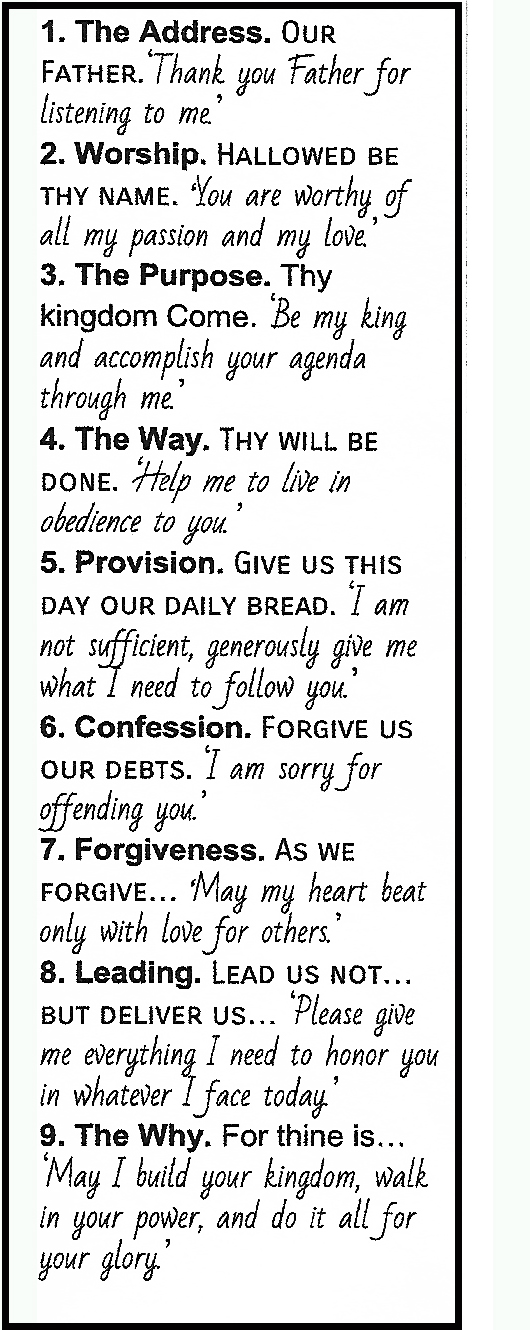
“‘Our Father in heaven, hallowed be your name, 10 your kingdom come, your will be done, on earth as it is in heaven. 11 Give us today our daily bread. 12 And forgive us our debts, as we also have forgiven our debtors. 13 And lead us not into temptation, but deliver us from the evil one.’”

I’ll bet you’ve never thought of your hours of sleep as fasting but that’s what they are. This “break-fast” meal is nourishment that only comes from heavenly food.  The downloadable graphic image at the left is created by Pastor Greg Long and used with his permission.  Click on the image to enlarge it and print.   Jesus’s familiar prayer can become bread for your daily nourishment.

Bread for Lunch: A meal eaten in the middle of the day.
John 6:32 Jesus said to them, “Very truly I tell you, it is not Moses who has given you the bread from heaven, but it is my Father who gives you the true bread from heaven…35 Then Jesus declared, “I am the bread of life.

Lunch is often a meal eaten on the run, “sandwiched” in between that first awakening and the end of the day. Doesn’t that sound like a metaphor for the span of our life on earth? Jesus declares “it is my Father who gives you the true bread from heaven…I am the bread of life.”  He is our spiritual nourishment for this “middle of the day meal” we call life.

Bread for Supper: the final meal of the day.
Matthew 26:26 While they were eating, Jesus took bread, and when he had given thanks, he broke it and gave it to his disciples, saying, “Take and eat; this is my body.” 27 Then he took a cup, and when he had given thanks, he gave it to them, saying, “Drink from it, all of you. 28 This is my blood of the covenant, which is poured out for many for the forgiveness of sins.“

Jesus had probably eaten many evening suppers with his closet friends. Unlike  other meals they’d shared, this “last” supper was to become one they’d never forget.  A simple piece of bread and an ordinary cup would become enduring reminders for his followers of a life link between them.  Jesus still honors his covenant to nourish “his” life within us through that bread and cup.  He doesn’t need to be reminded about that, but today we do.  

Focus of Preparation

•Luke 9:1 When Jesus had called the Twelve together, he gave them power and authority to drive out all demons and to cure diseases, 2 and he sent them out to proclaim the kingdom of God and to heal the sick. 3 He told them: “Take nothing for the journey—no staff, no bag, no bread, no money, no extra shirt.
•Matthew 4:3 The tempter came to him and said, “If you are the Son of God, tell these stones to become bread.” 4 Jesus answered, “It is written: ‘Man shall not live on bread alone, but on every word that comes from the mouth of God. [Deut. 8:3]’”

Jesus was sending his disciples out for a very special purpose.  That didn’t just happen, it took time to prepare. That’s what makes his instructions to the disciples so interesting. “He sent them out to proclaim the kingdom of God and to heal the sick.” He told them: “Take nothing for the journey—no staff, no bag, no bread, no money, no extra shirt.” It seems like comfort and convenience weren’t to be a part of their preparation. I wondered about the “no” parts.

The disciples were prepared to go out to “proclaim the kingdom of God and to heal the sick”  but why not send them out with those small things that could give them comfort and convenience?  Did Jesus have in mind his own experience of being tempted in the wilderness as he gave them those instructions?  His own temptation had not been about hunger at all. The tempter had used comfort and convenience in his failed attempt to entice Jesus to settle for any means to an end and become a “convenient” Messiah.

Jesus still wants his disciple’s focus of preparation to be on proclaiming the truth that protected him from the temptation to settle for any means to an end – the word of God.  “Man shall not live on bread alone, but on every word that comes from the mouth of God.”  There’s bread enough to last until tomorrow morning.  I invite you to check back then for fresh Maundy Thursday Bread.

Jesus Chose

Matthew 26: 53 Do you think that I cannot appeal to my Father, and he will at once send me more than twelve legions of angels? 54 But how then should the Scriptures be fulfilled, that it must be so?”

“There always remains a choice to be made between the creative power of love and life and the destructive power of hatred and death. I, too, must make that choice myself, again and again. Nobody else, not even God, will make that choice for me…
Reading the Signs by Henri Nouwen

Jesus chose to reveal himself rather than hide in that garden. Jesus was not the hunted victim of Judas’ betrayal. He chose Judas. He chose the time. He chose the spot. He chose God’s will when he could have chosen rescue for himself. This is an heart-inspiring truth to think about this Palm Sunday because of what we know is coming.

Not even God, His Father, made that choice for Jesus.  Jesus chose…to rescue us instead! Hosanna!

Commentary

-Mark 12:30 Love the Lord your God with all your heart and with all your soul and with all your mind and with all your strength.

-Matthew 22:37 Love the Lord your God with all your heart and with all your soul and with all your mind.

-Luke 10:27…Love the Lord your God with all your heart and with all your soul and with all your strength and with all your mind; and, Love your neighbor as yourself.

These three New Testament Scripture passages all quote Jesus speaking words that would have been familiar to his Jewish hearers, the Shema. They’re words still used repeatedly in Jewish prayers. They all include loving God with your heart and soul which seems obvious. The inclusion of mind and/or strength is the variant that got my attention.  I understand the access to mind and strength more than I do heart and soul.

This is the age-old debate: Is it strength of commitment or the exercise of the mind that fills the heart and soul? How do we figure out what’s required of us to prove our sincerity?  It would seem even these Bible authors had their own opinion on that.  Mind and strength? Mind? Strength? Do I have to choose one or the other?

Hillel was a famous religious leader in Jewish history. He was asked to recite the whole law for a dedicated student who would prove his sincerity and his physical strength by listening to it all while standing on one leg. That’s a funny mind picture isn’t it?  Hillel’s short answer was probably pretty welcome to him; “What thou hatest for thyself, do not to thy neighbour. This is the whole law, the rest is commentary. Go and learn.”

This is the whole law…“Love the Lord your God with all your heart and with all your soul…”   Now go find a comfortable spot, read, study and think.  God will begin to write his whole commentary in your mind and on your heart to strengthen your soul

Seed of Innocence

Matthew 13:3 Then he [Jesus] told them many things in parables, saying: “A farmer went out to sow his seed. 4 As he was scattering the seed, some fell along the path, and the birds came and ate it up. 5 Some fell on rocky places, where it did not have much soil. It sprang up quickly, because the soil was shallow. 6 But when the sun came up, the plants were scorched, and they withered because they had no root. 7 Other seed fell among thorns, which grew up and choked the plants. 8 Still other seed fell on good soil, where it produced a crop—a hundred, sixty or thirty times what was sown. 9 Whoever has ears, let them hear.” NIV

I am a confirmed believer the Spirit of God uses repetition to direct my mind. Repetition of a recent word or thought gets my attention and that’s exactly what God desires. Remember my reference to the “mustard seed” in the last post? This truth about seeds just “happened” to pop up in this blog by raincitypastor, Richard Dahlstrom, Step by Step Journey.
“One of the most famous parables in the Bible is the story about the seed and the sower. “A farmer went out to sow his seed” is how it begins, and by the end of the tale we discover that not all the seeds reached their full potential. The seed, though, was never the problem; it was the soil. Too many rocks. Too many thorns. Not enough depth. It’s a powerful tale, because later in the Bible we’re told that “His seed abides in us.”

That thoughtful commentary recalled yet another recent repetition of thought for me – the book of Genesis and our future.  We all know the long-ago story of Adam and Eve and their “original sin” that became our heritage.  Thankfully that is not the end of the story at all.  1 John 3: 9 says “No one who is born of God will continue to sin, because God’s seed remains in them; they cannot go on sinning, because they have been born of God.”

I think God’s  provision for Adam and Eve was more than clothing as they left that perfect Garden to begin a life of “painful toil.” He chose to leave a little seed of his “original innocence” within them insuring there would be a new heritage for all their descendants – the possibility of overcoming their own sin.  Innocence was no longer a given but there would be “good soil” that could produce a crop of purity — “a hundred, sixty or thirty times what was sown. Whoever has ears, let them hear.”