A Gift Hidden in Brokeness

This idea came up Sunday morning in our adult class: the challenge for Christians is to find the perfect balance between grace and judgment in our lives and in our behavior toward others.

When it comes to the choice between grace and judgment, we’re broken.   We swing to the grace side grateful for the recognition of God at work in ourselves and others and then the next moment we’re slammed into that “other” less desirable side – judging ourselves sometimes, but mostly others, harshly.  We long to find that balance.  We long to be like Jesus, triumphant in both his grace and his judgment but instead we get caught in that pendulum of frustration at our own brokenness.    That led me to ponder what it takes to be like Jesus and what “triumphant” really looks like.  I don’t have a Scripture text today but…

This is what triumphant looks like
Grace…†…Judgment

Jesus was triumphant over death on a cross!  He is the only way we’ll ever begin to understand the perfect balance between grace and judgement.  Our responses will look different seeing them through THAT triumphant Jesus; the one who became a gift hidden in brokenness for us.

Our God is an awesome God
He reigns from heaven above
With wisdom, power, and love
Our God is an awesome God

Because I Was There

John 16:12 “I have much more to say to you, more than you can now bear. 13 But when he, the Spirit of truth, comes, he will guide you into all the truth. He will not speak on his own; he will speak only what he hears, and he will tell you what is yet to come. 14 He will glorify me because it is from me that he will receive what he will make known to you. 

Quote from Jean-Pierre de Caussade: “The duties of each moment are the shadows beneath which hides the divine operation.”

Could I look back and see the reality of the truth Jesus promised in John 16 and the ‘divine operation’ hidden under the shadow of my own duties?  The earliest shadow I remember goes way back to 1963 before I even recognized there was a journey of faith and I wasn’t on it. I was married.  I was a young mother.  I was in church.  I was in a Bible study.  I was ignorant…BUT I was there.  I’d married a preacher’s kid and you were “supposed” to go to church.  It was only a duty but they had free babysitting.  Isn’t that an interesting list of contradictions? 

I wanted to know how you could be an open person when life was teaching you to build a protective shell of “image” around yourself.  I knew about that!  I asked my question in that Bible study not realizing just how much it revealed what I didn’t know.  I didn’t know God would continue to work his divine operation hidden under the shadow of that one duty…because I was there.

I’m grateful for the discovery of that quote from Jean-Pierre de Caussade this week.  It’s true “the duties of each moment are the shadows beneath which hides the divine operation” and more importantly it confirms the truth of Jesus’s words, and the reality of his commitment: “I have much more to say to you, more than you can now bear.  But when he, the Spirit of truth, comes, he will guide you into all the truth.” 

The Total Package

Dis·cern·ment – the ability to judge well.

Hebrews 4:12 For the word of God is living and active, sharper than any two-edged sword, piercing to the division of soul and of spirit, of joints and of marrow, and discerning the thoughts and intentions of the heart.

Reality and healthy survival demands our being able to judge well to live well. That ability to judge well is what our Sovereign Judge, Resurrected Perfecter an Evidence of Truth have united to provide us. Defining the “division of soul and of spirit” requires more imagination than the grisly image Hebrews paints of a sword whacking through bone to reveal the living inner part, the marrow, that actually provides it needed nourishment.

Hebrews is saying the soul is like a boney structure we might identify as the biblical hard heart.  The penetration of that boney structure has to happen to reveal the marrow, the Spirit, inside that hard heart.  That allows the Spirit and the Word of God to become the needed nourishment of our growth, impact the intentions of our heart and teach us to judge well. It’s the total package.

The Best Day of Your Life!

Hebrews 12:1 Therefore, since we are surrounded by such a great cloud of witnesses, let us throw off everything that hinders and the sin that so easily entangles. And let us run with perseverance the race marked out for us, 2 fixing our eyes on Jesus, the pioneer and perfecter of faith. For the joy set before him he endured the cross, scorning its shame, and sat down at the right hand of the throne of God. 3 Consider him who endured such opposition from sinners, so that you will not grow weary and lose heart.

Wit·ness:
1. one that gives evidence, specifically: one who testifies in a cause or before a judicial tribunal.
2. one asked to be present at a transaction so as to be able to testify to its having taken place.

What a day! I’m thankful I have a “great cloud of witnesses;” the heroes of the Bible and real-life saints whose evidence has become part of my life of faith. I’m thankful this morning for the realization that in addition to those heroes and saints that great cloud also includes what the dictionary defines as the judicial tribunal; God, Jesus and the Holy Spirit. I’m celebrating a new awareness on this day of the Resurrected Perfecter.

“For the joy set before him he [Jesus] endured the cross, scorning its shame, and sat down at the right hand of the throne of God.”  We’re quite familiar with the middle part of that sentence; “[Jesus] endured the cross, scorning its shame” and we know the end of the story – He’s risen, Hallelujah!  But pay special attention to the first and last last phrases of that sentence. “For the joy set before him” followed by “and [Jesus] sat down at the right hand of the throne of God.”

This Easter morning I have a new awareness there was a celebration of joy at the “throne of God” when the Father, Son and Holy Spirit were physically reunited. Their reunion completed our list of witnesses in that great cloud and put the final plan in place. The Sovereign Judge, the Resurrected Perfecter and the Evidence of Truth were to be witnesses AND evidence forever on our behalf.

That’s what makes this Easter celebration the best day of your life! Hallelujah!

Maundy Thursday Bread

Bread for Breakfast: the first meal of the day.
• Matthew 6:9
“This, then, is how you should pray:
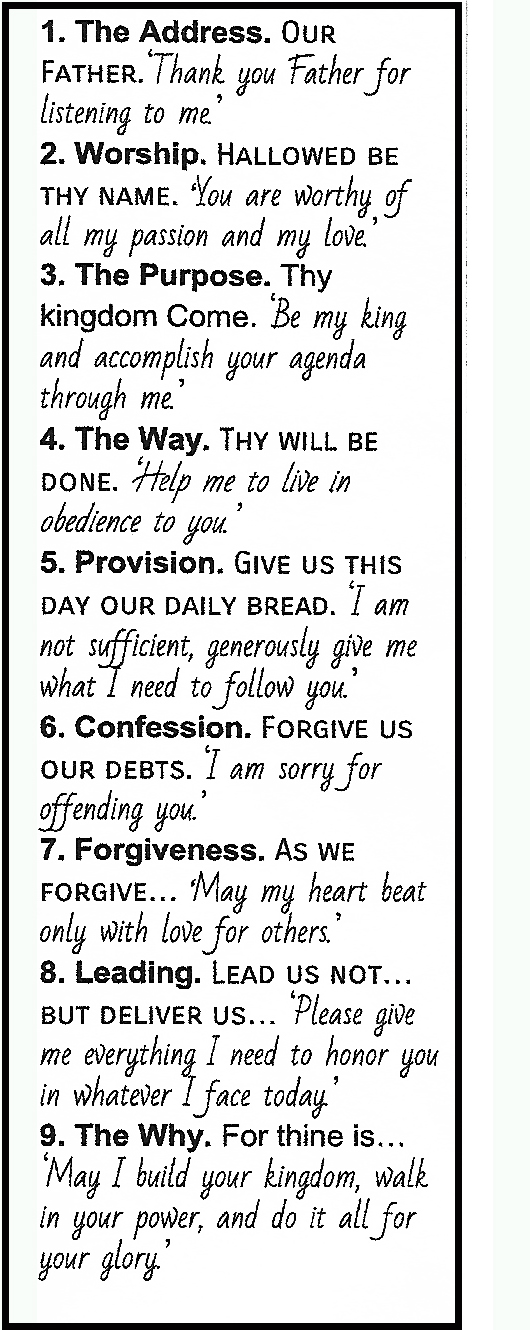
“‘Our Father in heaven, hallowed be your name, 10 your kingdom come, your will be done, on earth as it is in heaven. 11 Give us today our daily bread. 12 And forgive us our debts, as we also have forgiven our debtors. 13 And lead us not into temptation, but deliver us from the evil one.’”

I’ll bet you’ve never thought of your hours of sleep as fasting but that’s what they are. This “break-fast” meal is nourishment that only comes from heavenly food.  The downloadable graphic image at the left is created by Pastor Greg Long and used with his permission.  Click on the image to enlarge it and print.   Jesus’s familiar prayer can become bread for your daily nourishment.

Bread for Lunch: A meal eaten in the middle of the day.
John 6:32 Jesus said to them, “Very truly I tell you, it is not Moses who has given you the bread from heaven, but it is my Father who gives you the true bread from heaven…35 Then Jesus declared, “I am the bread of life.

Lunch is often a meal eaten on the run, “sandwiched” in between that first awakening and the end of the day. Doesn’t that sound like a metaphor for the span of our life on earth? Jesus declares “it is my Father who gives you the true bread from heaven…I am the bread of life.”  He is our spiritual nourishment for this “middle of the day meal” we call life.

Bread for Supper: the final meal of the day.
Matthew 26:26 While they were eating, Jesus took bread, and when he had given thanks, he broke it and gave it to his disciples, saying, “Take and eat; this is my body.” 27 Then he took a cup, and when he had given thanks, he gave it to them, saying, “Drink from it, all of you. 28 This is my blood of the covenant, which is poured out for many for the forgiveness of sins.“

Jesus had probably eaten many evening suppers with his closet friends. Unlike  other meals they’d shared, this “last” supper was to become one they’d never forget.  A simple piece of bread and an ordinary cup would become enduring reminders for his followers of a life link between them.  Jesus still honors his covenant to nourish “his” life within us through that bread and cup.  He doesn’t need to be reminded about that, but today we do.  

Focus of Preparation

•Luke 9:1 When Jesus had called the Twelve together, he gave them power and authority to drive out all demons and to cure diseases, 2 and he sent them out to proclaim the kingdom of God and to heal the sick. 3 He told them: “Take nothing for the journey—no staff, no bag, no bread, no money, no extra shirt.
•Matthew 4:3 The tempter came to him and said, “If you are the Son of God, tell these stones to become bread.” 4 Jesus answered, “It is written: ‘Man shall not live on bread alone, but on every word that comes from the mouth of God. [Deut. 8:3]’”

Jesus was sending his disciples out for a very special purpose.  That didn’t just happen, it took time to prepare. That’s what makes his instructions to the disciples so interesting. “He sent them out to proclaim the kingdom of God and to heal the sick.” He told them: “Take nothing for the journey—no staff, no bag, no bread, no money, no extra shirt.” It seems like comfort and convenience weren’t to be a part of their preparation. I wondered about the “no” parts.

The disciples were prepared to go out to “proclaim the kingdom of God and to heal the sick”  but why not send them out with those small things that could give them comfort and convenience?  Did Jesus have in mind his own experience of being tempted in the wilderness as he gave them those instructions?  His own temptation had not been about hunger at all. The tempter had used comfort and convenience in his failed attempt to entice Jesus to settle for any means to an end and become a “convenient” Messiah.

Jesus still wants his disciple’s focus of preparation to be on proclaiming the truth that protected him from the temptation to settle for any means to an end – the word of God.  “Man shall not live on bread alone, but on every word that comes from the mouth of God.”  There’s bread enough to last until tomorrow morning.  I invite you to check back then for fresh Maundy Thursday Bread.

Jesus Chose

Matthew 26: 53 Do you think that I cannot appeal to my Father, and he will at once send me more than twelve legions of angels? 54 But how then should the Scriptures be fulfilled, that it must be so?”

“There always remains a choice to be made between the creative power of love and life and the destructive power of hatred and death. I, too, must make that choice myself, again and again. Nobody else, not even God, will make that choice for me…
Reading the Signs by Henri Nouwen

Jesus chose to reveal himself rather than hide in that garden. Jesus was not the hunted victim of Judas’ betrayal. He chose Judas. He chose the time. He chose the spot. He chose God’s will when he could have chosen rescue for himself. This is an heart-inspiring truth to think about this Palm Sunday because of what we know is coming.

Not even God, His Father, made that choice for Jesus.  Jesus chose…to rescue us instead! Hosanna!

It’s a Daily Thing

Galatians 5:1 It is for freedom that Christ has set us free. Stand firm, then, and do not let yourselves be burdened again by a yoke of slavery…16 So I say, walk by the Spirit, and you will not gratify the desires of the flesh…22 But the fruit of the Spirit is love, joy, peace, forbearance, kindness, goodness, faithfulness, gentleness and self-control.  Against such things there is no law. [NIV]‬‬

I try to find ways to read Scripture to experience it’s meaning for my life. That one word “freedom” and the association Paul made to the fruit reminded me of a study method I’d learned from William Barclay’s commentary. Jewish Rabbis would study Scripture based on these four words that formed the consonants of PaRaDiSe:
1. Peshat – literal
2. Remaz – suggested
3. Derush – investigative
4. Sod – allegorical

That idea of reading Scripture as a connection to paradise seems helpful and right. Here are my cliff notes if you want to try this method of studying the Bible for yourself.
1. What is the simplest possible meaning?
2. Is there a sub-text meaning?
3. What can I learn from references, footnotes & commentaries
And finally the bottom line…
4. Can I see how to make these truths a part of my daily life?

1. Paul tells us our freedom was the whole point of what Christ did to free us from the “law.” We have within us a willful desire to identify freedom with being satisfied that what we are doing is right if we meet certain requirements. √
2. Relying on what we think God requires of us instead of Christ changing us is an invisible barrier that distracts us from the real freedom God means us to experience. √
3. New thoughts from Rev. Bruce Puckett at Duke University. “We are a society and a culture that loves (and I mean loves) to talk about freedom… we’ve looked for the wrong fruit within a community and called it freedom. We see…desire for more and more and more — and call it ambition and success. We see strife, dissensions, and factions…and call it our right to individual opinion, and options from which to choose.” √
And finally the bottom line…
4. Pay attention to the distractions of daily life. Don’t let them become an invisible barrier that settles for “fake” fruit. “Walk by the Spirit…” and choose a serving from the fruit of freedom: love, joy, peace, patience, kindness, goodness, faithfulness, gentleness and self control.  It’s a daily thing.

PTL for Seeing Reality

We ask that you may be filled with the knowledge of God’s will in all spiritual wisdom and understanding so that you may lead lives worthy of the Lord. —Colossians 1: 9–10 NRSV

Today has become one of many meaningful lessons for me since I created this site. I decided I should tackle The Revelation. I’d spent 4 or more hours to come up with what I thought would be my first post until I read the last few sentences of what I’d written:
…from my point of view the end times began the day Adam and Eve ate that fruit. End times are all I’ve ever known. I’ve spent more than half my life learning to live with, and from, Jesus. Personally it matters more to me that I know the end of the story than the details. Jesus wins…and I’ll be there with him.’

Then I had my own revelation and had to confess and pray ‘I can’t do this.’  It was humbling to admit that A. I didn’t have the theological expertise to understand all that symbolism and B. I didn’t really care about the details. I feel twinges of guilt about both “A” and “B” but truth is a reality of God’s will and that reality is a process not a program you can decide on.   And…I do know the end of the story!

In the meantime I rediscovered the reality of this prayer from Colossians and by changing the pronouns to personal ones it could become my prayer.  I also found  this quote in Reading the Signs of Daily Life by Henry Nouwen; “theology is all about—looking at reality with the eyes of God.”  I really did need a spiritual eye check-up to see God’s reality.  I’m am not a theological scholar but I am learning to see the reality of God’s will at least some of the time.  PTL for seeing reality.

Cause and Effect

John 3:16 For God so loved the world that he gave his one and only Son, that whoever believes in him shall not perish but have eternal life.

I’ll bet most of us have thought about our own salvation in terms of surrendering our circumstances and behavior to God. There may be as many stories of personal conversion as there are saved people. That testimony almost always states the effects, the blessings, of “our” surrender to him.

This quote from My Utmost for His Highest reminded me of the “cause” of my surrender: “The fact that He [Jesus] saves from sin and makes us holy is actually part of the effect of His wonderful and total surrender to us.”

It’s a blessing to live with the effects of our surrender but there would be no blessing without the reality of John 3:16. It was God’s “total surrender” of his own son Jesus on our behalf that caused our surrender to effect his blessings in our life. We surrender to God because he first surrendered to us!